Cabinet to consider Outline Business Case on 16 July
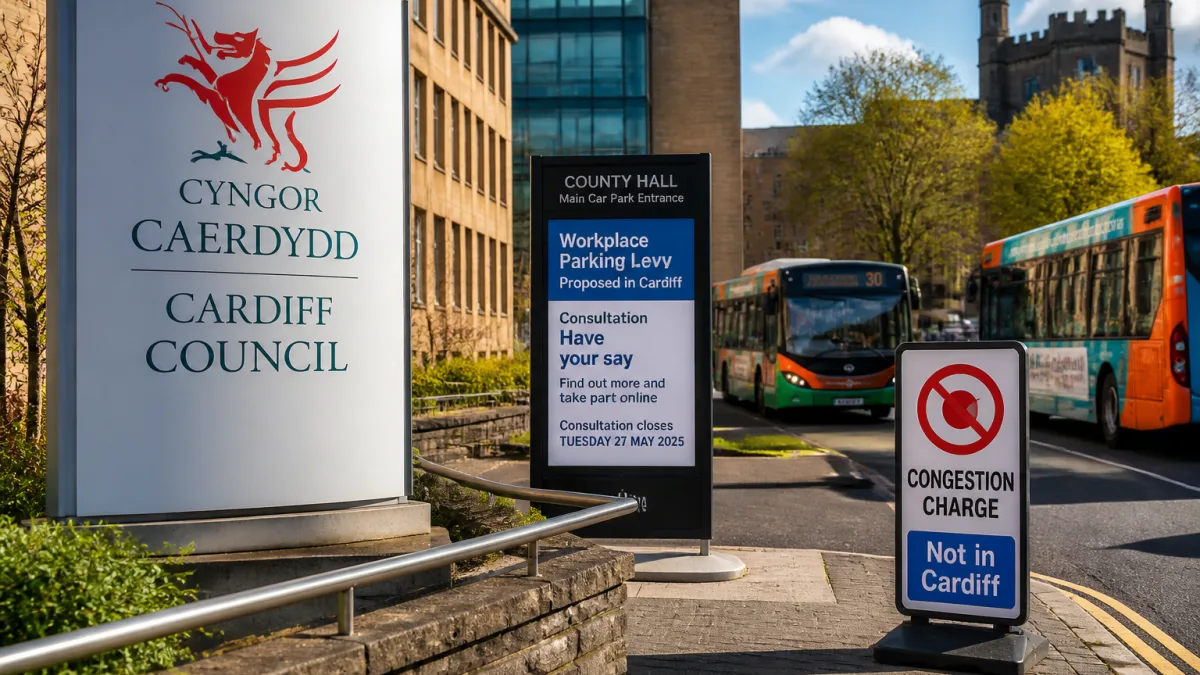
Cardiff Council’s Cabinet has confirmed it does not support a city centre congestion charge as its preferred road-user approach, and will instead take forward a Workplace Parking Levy (WPL) as the leading option for consultation. The position follows an appraisal of an initial business case and recent public engagement, and coincides with the publication of a Road User Payment Scheme Outline Business Case due before Cabinet on Thursday, 16 July.
A WPL is a charge levied on certain employers for parking spaces provided on their premises. According to the Council, revenue raised would be ringfenced to improve local public transport—particularly the quality, frequency and affordability of bus services—thereby offering a more reliable alternative to commuting by car.
Learning from Nottingham; other cities exploring similar moves
Officials say they have studied the experience of Nottingham, where a WPL has operated for years, applying mainly to larger businesses and organisations within the local authority area. Nottingham’s model exempts many smaller firms and certain sites such as hospitals. The authority notes that other cities, including Bristol, are actively examining comparable schemes. Cardiff’s analysis indicates there is flexibility in design and scope, with details to be shaped through a formal consultation.
“Creating a high-quality public transport system to support economic growth in Cardiff is important to the city’s future and this has been set out in our 10-year Transport Strategy. Cardiff already has the highest level of car ownership of any UK Core City, and that is putting increasing pressure on our road network.”
The Council intends to open a citywide consultation over the summer—subject to Cabinet’s approval of the Outline Business Case—inviting views from residents and employers on design choices, exemptions and phasing.
What will be consulted on
While the WPL is recommended as the preferred option to explore in detail, Cardiff will also include a congestion charge and a ‘do nothing’ alternative in the consultation to test public and stakeholder preferences.
| Option | How it works (as outlined) | Intended use of revenue |
|---|---|---|
| Workplace Parking Levy | Charge on eligible workplace parking spaces provided by employers | Enhance bus services (quality, frequency, affordability) |
| Congestion charge | Considered as an option for consultation; not the preferred approach | Not specified in the Council’s summary |
| Do nothing | No new road-user charging intervention | None |
Implications for commuters and employers
The Council links the policy direction to Cardiff’s transport and climate ambitions, citing high car ownership and pressure on the road network. A WPL would target parking supply at the point of provision rather than charging individual drivers at the kerbside. Under the model studied in Nottingham, the levy is focused on larger organisations and includes exemptions for some sectors; Cardiff emphasises that the precise design here would be subject to local consultation.
For employers, the consultation will be crucial in determining which premises and spaces could fall within scope, what exemptions might apply, and how any scheme would be phased. For commuters, the Council argues that reinvestment into buses aims to provide a credible and affordable alternative to driving, aligning with its longer-term 10-year Transport Strategy.
How to take part and next steps
- The Cabinet will consider the Outline Business Case on 16 July.
- If approved, a summer consultation will invite views from residents, businesses and organisations on a WPL, a congestion charge, and a do-nothing option.
- Feedback would inform the preferred scheme design, including potential exemptions and implementation choices.
Officials stress that consultation feedback will shape any eventual proposal for Cardiff, including decisions on who would pay, how revenue would be allocated to services, and how the scheme would interact with smaller firms and essential services. No final decision has been made on the introduction of any charging regime at this stage.
The Council positions the WPL as the most suitable route to fund better public transport without adopting a congestion charging zone. The inclusion of alternatives in the consultation—along with a ‘no intervention’ option—sets up a clear public debate on how Cardiff should manage growth, climate targets and transport capacity in the years ahead.