Capital-wide framework urged to unlock growing on unused public land
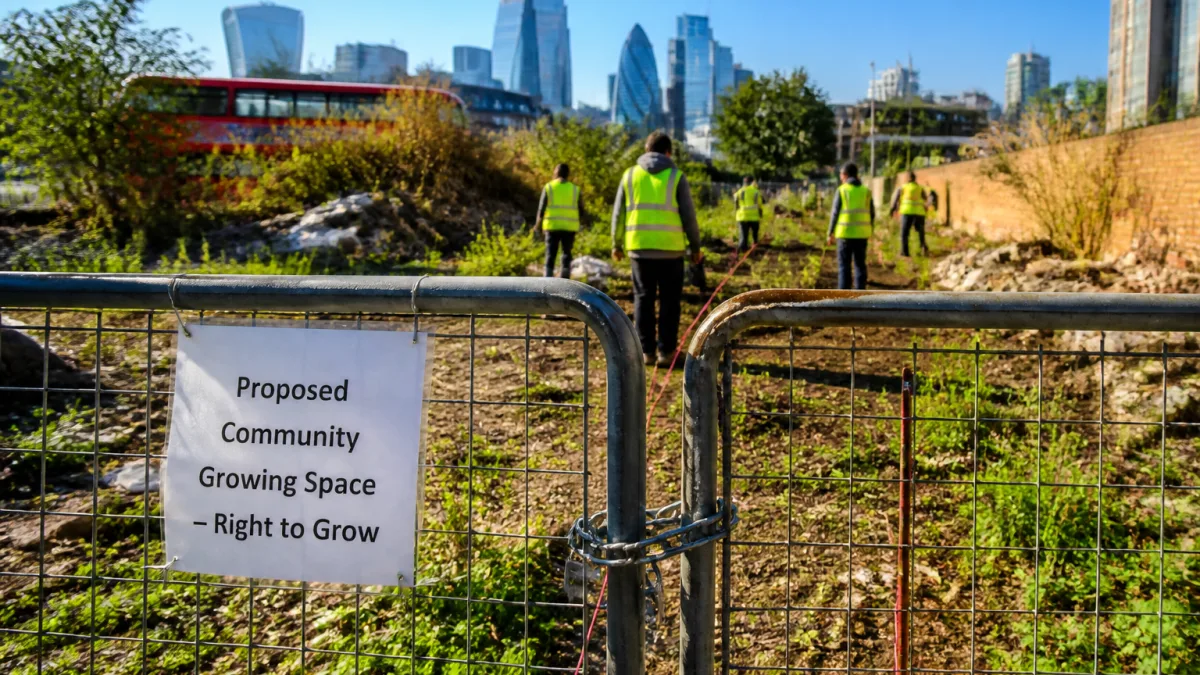
Campaigners are urging City Hall to introduce a London-wide ‘right to grow’ framework, allowing communities to repurpose underused public land for allotments, community gardens and orchards. Proponents say a standard policy would make it easier for residents and local groups to cultivate food and nature projects on neglected spaces across all 32 boroughs and the City of London.
Several boroughs — including Southwark, Hackney and Hounslow — have already adopted their own versions, streamlining how derelict or idle plots can be brought into use for food growing. Campaigners now want the Greater London Authority (GLA) to set out a model approach others can follow, arguing this would bring consistency, cut bureaucracy and support boroughs that lack the capacity to design schemes from scratch.
New report sets out demands to make London “greener and more edible”
The call comes in a report from the London People’s Assembly on Food, Nature and the Right to Grow, which outlines a dozen London-wide actions to be delivered by 2035. The measures include a City Hall-backed framework for accessing public land, the appointment of community growing officers in every borough, and the embedding of food growing within future health and planning strategies. Supporters say clearer routes to land would help residents respond to rising food insecurity while improving biodiversity and community wellbeing.
Demand for plots continues to outstrip supply across the capital. A recent Greenpeace Freedom of Information exercise found at least 30,500 Londoners on allotment waiting lists, with 16 boroughs closed to new applicants. Waiting times can be extreme in some areas, underlining the scale of unmet demand.
| Area | Indicator |
|---|---|
| London-wide | At least 30,500 on allotment waiting lists |
| Multiple boroughs | 16 closed to new applicants |
| Camden | Waiting times reportedly up to 12 years |
| Islington | 106 allotment plots for c. 17,000 households without gardens |
Campaigners say a City Hall model would accelerate take-up
Organisers argue that a single, adaptable framework from the GLA would lower barriers and ensure boroughs implement comparable, transparent processes for mapping land and handling requests from community groups. They also want growing projects to be better integrated with public health objectives and spatial planning, so that food cultivation is treated as essential infrastructure rather than a marginal add-on.
“We want the GLA to implement the right to grow within its food and housing policies so it’s easier for boroughs to sign onto the framework,” she said. “We have a lot of ambition
The push follows an event attended by the Deputy Mayor for Environment, Mete Coban, reflecting growing interest in how public land can support food resilience, reduce costs for households and enhance urban nature. The report’s authors emphasise that bringing smaller pockets of land into use — from verges and corners of parks to disused plots — could cumulatively make a significant difference.
What this could mean for Waltham Forest
Although the initiative targets London as a whole, any City Hall policy would be relevant to Waltham Forest, where residents face the same pressures seen across the capital: high demand for growing space, limited availability and long waits. A standardised GLA framework could:
- Provide a clear route for local groups to identify and apply to use unused public land.
- Encourage the integration of food growing into planning and health strategies at borough level.
- Support capacity by highlighting the role of community growing officers and consistent procedures.
Local campaigners and residents often cite the multiple benefits of small-scale cultivation projects: community cohesion, access to fresh produce, learning opportunities for schools and young people, and improved biodiversity through pollinator-friendly planting. The report’s backers argue that these gains justify systematic support and clearer governance from the GLA.
Next steps and how residents can engage
With several boroughs already operating their own ‘right to grow’ arrangements, attention now turns to whether City Hall will develop a pan-London model. If progressed, the framework could set expectations for how public land is identified, consulted upon and allocated for community growing. Residents in Waltham Forest who are interested in food cultivation may wish to monitor City Hall announcements, engage with local councillors, and follow updates from community groups advocating for the policy.
While the specifics of any new framework would be subject to consultation and legal checks, the direction of travel is clear: faced with prolonged waiting lists and finite allotment stock, campaigners believe a more structured approach to bringing idle land into productive use is overdue. As London navigates food cost pressures and the health impacts of limited access to green space, the case for a capital-wide ‘right to grow’ is likely to feature prominently in the coming policy debate.