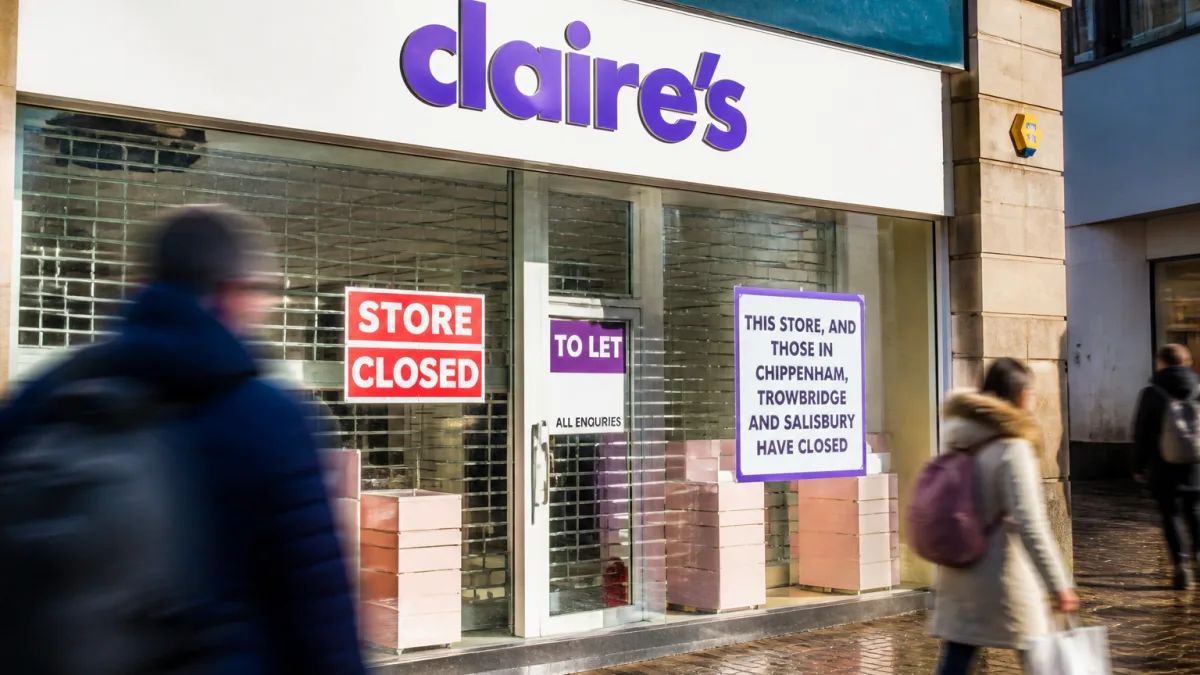
Administrators have set out the behind-the-scenes struggle to salvage Claire’s Accessories before the high street chain collapsed, confirming the scale of redundancies and the closure of branches across Wiltshire, including both Swindon sites, Chippenham, Trowbridge and Salisbury.
Report reveals failed rescue efforts and creditor shortfall
The latest administrators’ report details how the once “historic” accessories brand, which originated in the United States in 1961, ultimately fell into financial distress in the UK despite a series of turnaround attempts. The April closure of the last 154 UK and Ireland stores resulted in around 1,300 redundancies. Administrators say creditors now face losing approximately £3 million, and the business carried debts of almost £20 million.
Appointed in January, Philip Dakin, Benjamin Wiles and Janet Burt of Kroll oversaw the company in administration. Their appointment did not affect the firm’s 356 concessions or its head office at that time. The brand’s difficulties followed a turbulent period: in 2025, the US-based parent, Claire’s Holdings LLC, sought court protection in the US Bankruptcy Court, District of Delaware. Later that August, Claire’s Accessories UK entered administration with Christopher Pole and William Wright of Interpath, after which most of the business and assets were acquired by Modella Capital for £3.6 million.
“The directors implemented a number of revenue generation and cost reduction measures including attempts to negotiate rent reductions with landlords, exiting where possible and seeking new concession partners.”
Wiltshire high streets lose all standalone stores
By last August, administrators confirmed all standalone outlets had closed, including those in Wiltshire. The Designer Outlet Swindon branch had already shut in April, and further closures affected the Brunel Shopping Centre (Swindon), Borough Parade (Chippenham), The Shires (Trowbridge) and Old George Mall (Salisbury). The loss of these units leaves prominent gaps on shopping parades and in malls frequented by families and younger shoppers, for whom the brand had been a familiar presence since its UK expansion in 1995 with the acquisition of Bow Bangles.
| Town/City | Location | Status |
|---|---|---|
| Swindon | Designer Outlet | Closed (April) |
| Swindon | The Brunel Shopping Centre | Closed |
| Chippenham | Borough Parade | Closed |
| Trowbridge | The Shires | Closed |
| Salisbury | Old George Mall | Closed |
What the administrators say was tried
The report outlines a series of late-stage actions designed to stabilise trading and protect jobs. These included negotiating with landlords to reduce rental costs, exiting certain locations, and seeking additional concession partnerships to maintain a presence without the full overheads of standalone stores.
- Rent renegotiations were attempted to lower fixed costs.
- Site exits took place where deals could not be reached.
- Concession expansion was explored to retain customer reach.
Despite these measures, administrators concluded the business could not be returned to a sustainable footing. The report indicates that, even with operational savings, cash flow and profitability deteriorated without sufficient new agreements in place.
Impact for Wiltshire’s retail centres
For Wiltshire, the closures remove a recognisable mid-market accessories retailer from several central locations. In Swindon, the shuttering at both the Designer Outlet and The Brunel Shopping Centre compounds a period of flux for the town’s retail mix. Chippenham’s Borough Parade, Trowbridge’s Shires centre and Salisbury’s Old George Mall similarly lose a brand that drove regular footfall from younger shoppers and gift buyers. Local managers and staff, many with years of service, were among those affected by the nationwide redundancies.
Shopping centre operators typically seek replacement tenants quickly to limit the effect on neighbouring traders. However, filling multiple units simultaneously can be challenging, and the process of refitting for new occupiers takes time. In the interim, surrounding independents and chains may notice changes in weekday traffic and weekend peaks as families re-route to alternative retailers.
How the collapse unfolded
Claire’s built its UK presence over nearly three decades following its 1995 acquisition of Bow Bangles and subsequent expansion. The recent sequence of events began with the US-based entity’s court proceedings in 2025, followed by the UK administration later that year and the sale of most UK business and assets to Modella Capital for £3.6 million. The attempt to restructure trading continued into 2026, with Kroll’s appointment in January and the closure of the remaining UK and Ireland stores in April.
While the administrators’ report underscores the breadth of attempted remedies, including cost cuts and lease talks, the estate of standalone shops ultimately closed, leaving only concessions unaffected at the time of appointment. Creditors, according to the report, face a shortfall of around £3 million, underlining the scale of the financial hole.
What it means for shoppers and staff locally
With all standalone stores in Wiltshire now closed, customers who previously relied on those branches will need to look to alternative retailers on the high street or online. The administrators note that concessions were not affected at the time they were appointed; however, no further detail is provided in the report excerpt regarding their long-term status. Former staff affected by the April redundancies are among the 1,300 people whose roles were lost across the UK and Ireland estate.
The closures draw a line under Claire’s long-standing footprint in the county’s shopping centres. For local authorities and centre managers, attention now turns to backfilling the units to sustain footfall and provide continuity of offer for families and younger shoppers who previously visited for fashion jewellery and gifting.