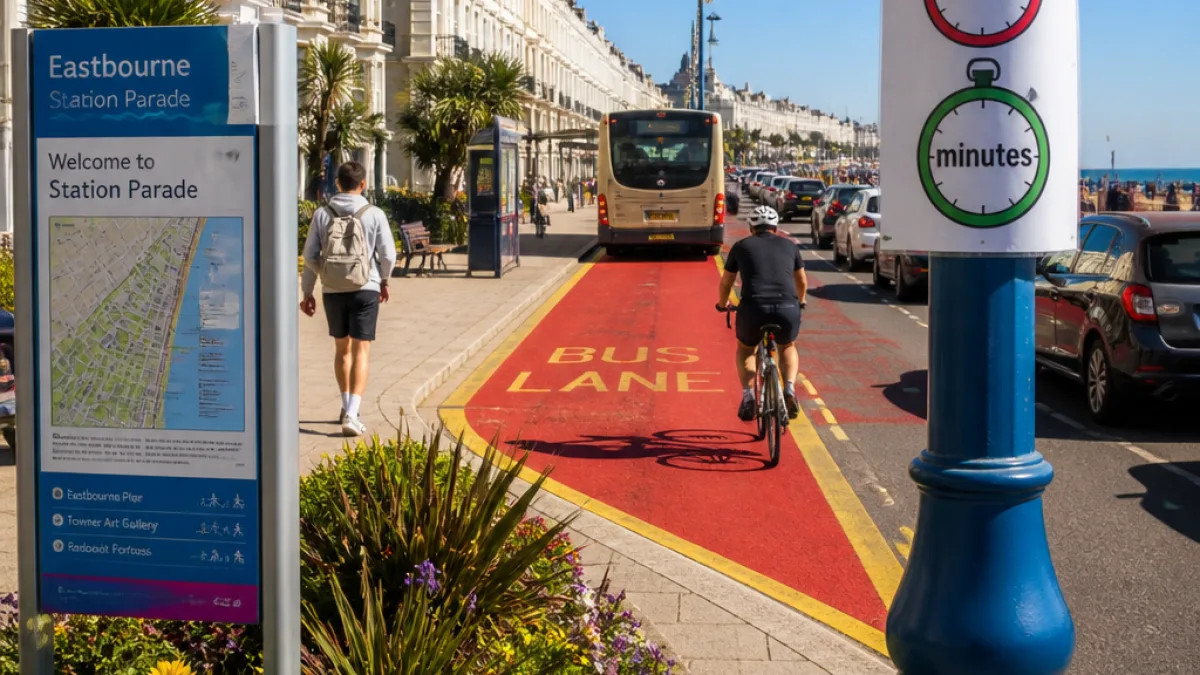
East Sussex County Council (ESCC) has confirmed that new bus lanes will be introduced on Seaside and Station Parade in Eastbourne. The announcement has reignited discussion about the routes’ projected time savings for buses and passengers, and how those figures should be interpreted.
Conflicting numbers: seconds, minutes or more?
Opponents of the Seaside scheme point to traffic modelling that suggests only around 25 seconds of average time saved per trip, a figure widely cited in local consultations. Supporters and some council materials have used larger figures: a published consultation document referenced a seven-minute saving often quoted in the local media, which ESCC later clarified applies to a return trip — effectively around 3.5 minutes each way.
The council’s Bus Service Improvement Plan uses a different approach. It summed weekly time savings for all buses at 76 hours and divided that by the reported weekly passenger total of 14,000, producing an average saving of about 20 seconds per passenger, per trip. That calculation has been criticised for mixing system-wide cumulative savings with per-passenger averages.
| Measure | Figure | Notes |
|---|---|---|
| Local modelling (Seaside) | 25 seconds | Average saving cited by campaign groups |
| Consultation document (return trip) | 7 minutes | Equivalent to ~3.5 minutes each way |
| Bus Service Improvement Plan | 20 seconds | Average per passenger derived from cumulative weekly savings |
Why the disagreement matters
Residents have raised concerns that the schemes will remove parking, push traffic onto neighbouring streets and offer too little benefit to justify the expense. Campaigners argue that if per-trip savings are measured in only a few dozen seconds, the local impact may not be worth the trade-offs.
- Time savings vary by time of day — off-peak services may gain less benefit than busy periods.
- Per-passenger averages can understate per-bus improvements; conversely, aggregated figures may overstate benefit for individual journeys.
- Post-construction monitoring is needed to check whether predicted savings are realised in practice.
ESCC has been asked to restate and clarify the expected time savings for the Seaside and Station Parade schemes, and to make clear whether quoted figures refer to single trips, return journeys, per-bus performance or per-passenger averages. Local campaigners and councillors have called for a firm plan to evaluate outcomes once the works are completed.
For residents and commuters, the practical questions remain straightforward: how long will individual bus journeys be reduced by, and whether any time saved offsets the loss of local parking or changes to traffic flow. The council’s forthcoming communications and the promised post-implementation assessment will be key to resolving those points.
Where this stands: bus lanes are confirmed; debate continues over the precise scale of journey-time benefits; the council is being pressed to clarify its figures and to assess effectiveness after implementation.