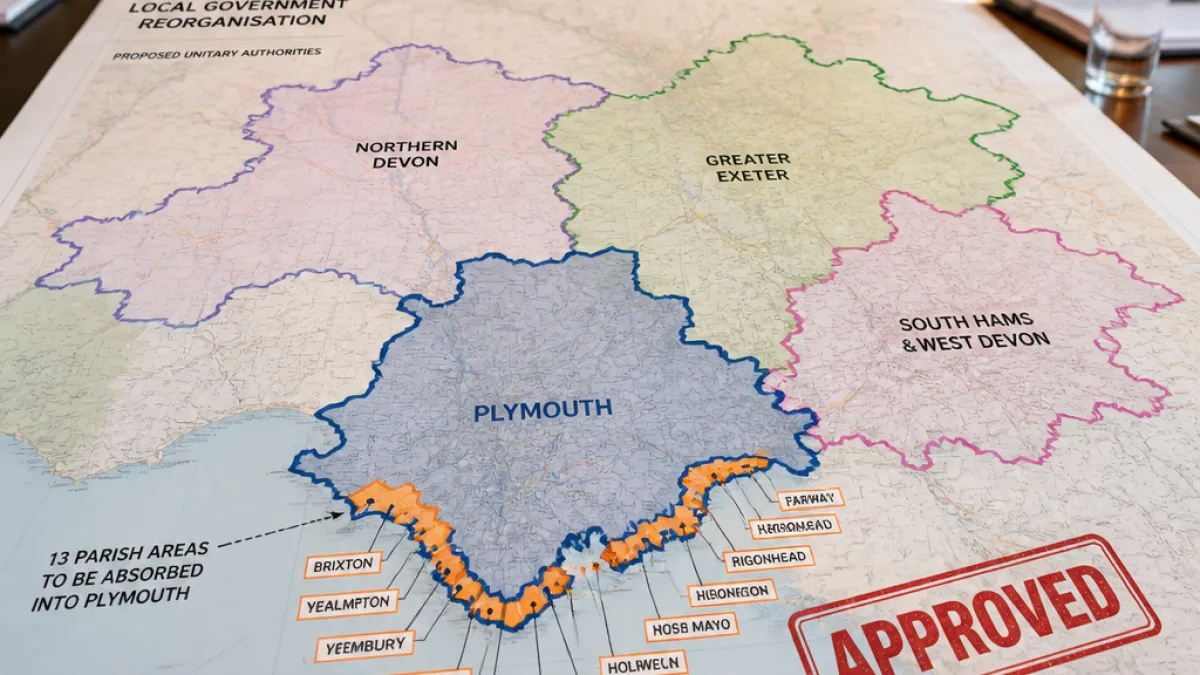
The government has approved a scheme that will extend Plymouth City Council to incorporate 13 parishes of the South Hams, dramatically redrawing local government in Devon and creating what the city proposes to call "Greater Plymouth".
What has been decided
Under the reorganisation, the city council’s area will expand so that its population rises to roughly 300,000. The move is part of a wider shake-up that will replace Devon’s existing two-tier structure with four unitary councils. All current district councils in Devon, along with Devon County Council, will be abolished. The new arrangements are due to come into force in April 2028.
Which communities are affected
The 13 parishes currently within South Hams that will transfer into Plymouth’s council area are listed below.
| Parish |
|---|
| Bickleigh |
| Shaugh Prior |
| Cornwood |
| Sparkwell |
| Harford |
| Ugborough |
| Ivybridge |
| Ermington |
| Brixton |
| Yealmpton |
| Wembury |
| Newton and Noss |
| Holberton |
What the councils and MPs have said
Plymouth’s council leader welcomed the decision, saying the proposal was the product of work with Exeter and local MPs. The decision was announced in the House of Commons by Steve Reed, the secretary of state for housing, communities and local government, who described the choices as reflecting "local identities." Conservative MP for South West Devon, Rebecca Smith, described the outcome differently, calling it "an urban stitch up."
"We are pleased the government has recognised the strength of our proposal developed with Exeter City Council and supported by two of our local MPs."
Practical implications for residents
The enlarged Plymouth authority will assume responsibility for services currently split between district councils and Devon County Council in the affected parishes — including waste collection, highways, social care and other local services. Officials say the four-unitary model will provide clearer lines of accountability for council tax payers across Devon.
- Service provision: responsibilities such as bin collections, roads and adult social care will transfer to the new unitary councils.
- Local democracy: district and county councillors will be replaced by councillors on the new unitary authorities.
- Timescale: the new structure is scheduled to take effect in April 2028.
What happens next
The government’s announcement sets out the preferred structure for Devon: an expanded Plymouth, an expanded Exeter, an expanded Torbay and a coast-and-countryside authority covering remaining towns and parishes. Detailed implementation—such as the precise arrangements for service transition, staffing, budgets and local representation—will follow through statutory processes and preparations between now and 2028. Residents and community groups in the affected parishes can expect further information from both Plymouth City Council and transitional bodies as plans are developed.
This decision marks the most significant reorganisation of local politics in the county for five decades and will reshape how local services are managed and democratically overseen across much of Devon.