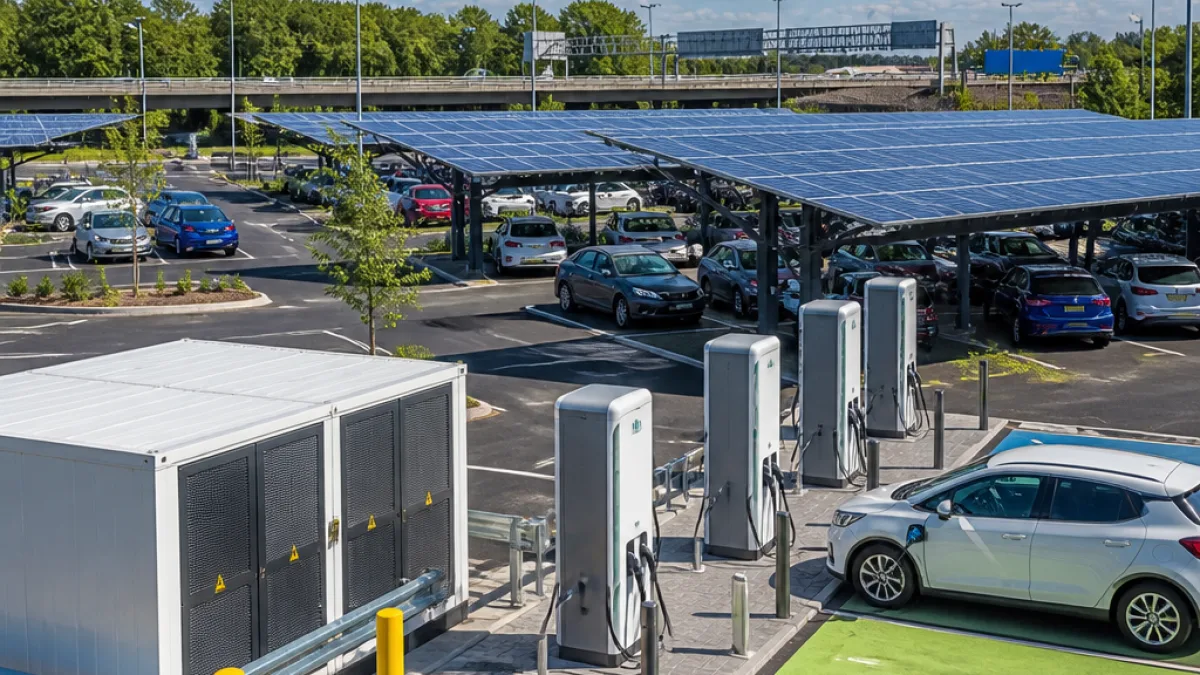
Wokingham Borough Council has given approval for a solar-powered electric vehicle charging project at Mereoak Park and Ride, the transport hub off the A33 near junction 11 of the M4. The scheme, which now includes a battery energy storage system and an expanded mix of charging units, is set to move into procurement stage as councillors cleared the updated plans.
What the project will deliver
Council documents and an artist’s impression show solar canopies fitted above the parking area, feeding electricity into on-site batteries and a new array of chargers. The council says the canopy array will produce sufficient energy annually to power more than 440 homes or to supply roughly 150,000 EV charges.
| Item | Figure |
|---|---|
| Estimated homes powered per year | 440+ |
| Estimated EV charges per year | 150,000 |
| Parking spaces at Mereoak | around 600 |
| Forecast net income (annual, 25 years) | at least £400,000 |
Timeline, procurement and operation
A contractor is to be appointed through an ongoing procurement process, with construction anticipated to begin towards the end of this year. The council said work will be phased so Mereoak Park and Ride — which has about 600 parking spaces and is operated day-to-day by Reading Borough Council — can continue to operate throughout the build.
- Solar canopies with battery storage will be installed.
- A mixture of rapid and standard EV chargers will be provided.
- A tariff for charging has not yet been set and will be announced nearer opening.
Financial and policy context
The scheme is projected to produce at least £400,000 of net income each year over a 25-year period; the council says that revenue will be reinvested into frontline services. Officers also indicated they will continue to explore external funding and grant opportunities as the project progresses.
“This scheme represents a win-win for the borough and its residents, whether they use the proposed chargers or experience the broader benefits,”
Cllr Imogen Shepherd-DuBey, the council’s executive member for finance and governance, said the development will meet growing demand for electric vehicle infrastructure while providing a “reliable, environmentally sustainable source of revenue” for council services.
Practical details remain to be confirmed. In particular, the charging tariff structure and the exact number and specification of rapid versus standard chargers will be finalised as the project progresses through procurement and construction phases.
For residents and commuters, the development promises more local charging options close to the M4 and the A33, potentially supporting longer journeys and encouraging EV uptake. For the council, the scheme offers a way to generate steady income from an existing asset and align local infrastructure with net-zero ambitions.
Further announcements from Wokingham Borough Council are expected once the contractor procurement concludes and a construction timetable is finalised.