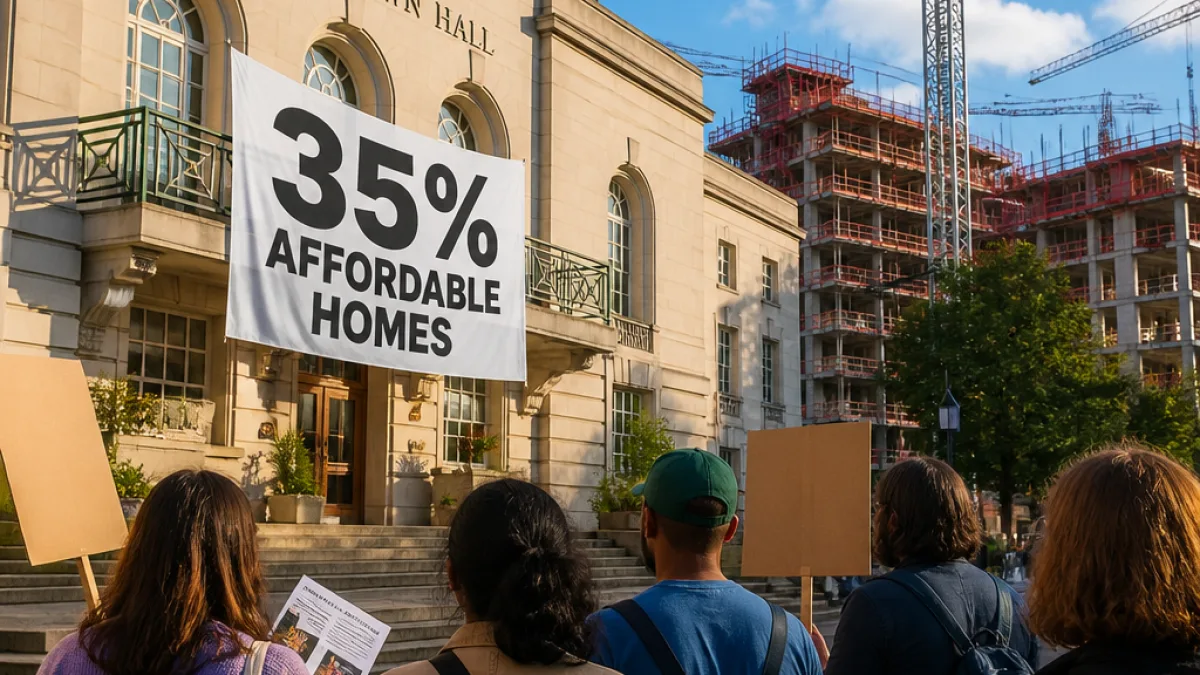
Hackney has won a partial victory in a high‑profile fight over how many affordable homes are built in the capital after the Mayor of London announced a U‑turn on a controversial target that would have allowed developers to cut the affordable element of new schemes.
What was changed
Last month Hackney joined Tower Hamlets and Lewisham in launching a Judicial Review against the Mayor of London’s plan that would have reduced the proportion of affordable housing in new developments across London from 35% to as little as 20%. In a partial reversal announced on 16–17 July 2026, the Mayor has confirmed the 20% rate will be removed from 2028 and that each borough will be given its own affordable housing quota.
For Hackney this means the borough will have its target restored to 35% — a change the council says will matter to households waiting for secure, genuinely affordable homes.
Immediate effects and the two‑year gap
The reversal does not come into force immediately. There will be a transitional two‑year period during which boroughs — including Hackney — could still see developers apply the lower percentages to schemes approved under the interim arrangements.
- Pre‑change target: 35% affordable housing in new developments (Hackney)
- Mayor's proposal: Allow reductions to as low as 20% across London
- New position: 20% rate scrapped in 2028; boroughs set individual targets (Hackney to return to 35%)
“In Hackney, this announcement is good news for every family trapped in unsuitable temporary housing, every household waiting years for a genuinely affordable home, and every private renter living in insecure accommodation. But it still leaves a two year period where the Mayor of London will give the green light for developers in Hackney to cut back on affordable homes – while in other boroughs they are let off the hook indefinitely. We’re pleased the Mayor has listened, but will keep the pressure on and continue the fight for affordable housing in London.”
— Zoë Garbett, Mayor of Hackney
Local context and consequences
Hackney is among the boroughs most acutely affected by the city's housing pressures. While the restoration of a 35% target is welcomed by the council, the two‑year window before the 2028 change means some new developments consented in the interim could deliver fewer affordable units than residents and campaigners had hoped.
For families in temporary accommodation, long‑waiting social housing applicants and private renters facing insecurity, the decision is therefore a mixed outcome: a longer‑term safeguard on paper, but a short‑term period when fewer genuinely affordable homes may be built.
Who took legal action
The Judicial Review was brought jointly by Hackney, Tower Hamlets and Lewisham councils. The challenge prompted the Mayor’s partial u‑turn, restoring borough discretion on quotas and signalling that London boroughs will no longer be bound by a blanket minimum of 20% from 2028.
| Item | Detail |
|---|---|
| Original Hackney target | 35% |
| Mayor's initial proposal | Allow reductions to 20% |
| New arrangement | 20% scrapped from 2028; boroughs assigned individual quotas |
Hackney Council has framed the announcement as a victory for local campaigning and legal action, while noting the remaining two‑year period remains a cause for concern. The council has said it will continue to press for stronger protections and faster delivery of affordable homes for local people.
Developers, housing campaigners and residents now face a period of close scrutiny as planning permissions granted before the 2028 change may reflect lower affordable housing shares. The longer‑term impact will depend on how borough quotas are translated into planning decisions and on the pace of new development in Hackney.