Historic baths could become food hall as restoration application lands
The long-dormant Collier Street Baths in Greengate — one of Salford’s most significant surviving Victorian buildings — may finally see meaningful restoration work, after a fresh planning application was submitted to the city council to bring the 1855 landmark back into public use as a food and drink destination.
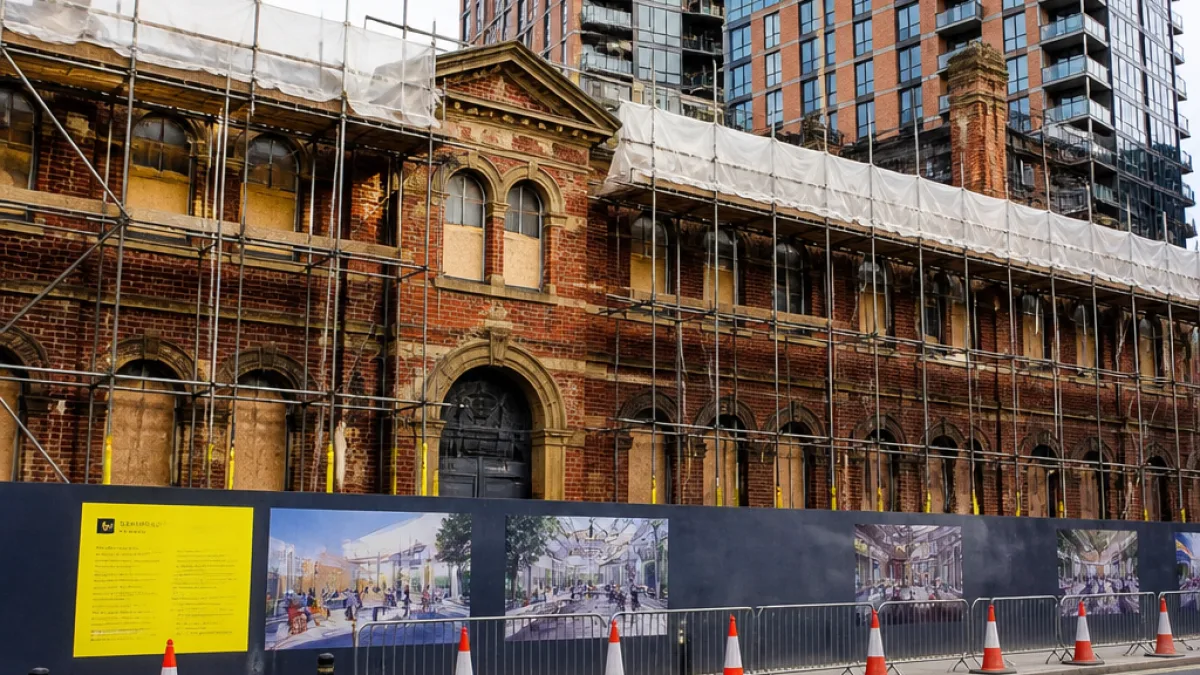
The Grade II*-listed former baths sit at the centre of Colliers Yard, a major redevelopment of Salford’s historic core led by Renaker. Planning approval for three residential towers was granted in 2020 on the understanding that the baths would be repaired and reactivated. While the developer’s visuals have long shown the building restored, on the ground progress has until now been limited to scaffolding and protective coverings.
What the new plans propose
According to the submission, the scheme focuses on stabilising and sensitively adapting the deteriorating structure. Proposed works include:
- Masonry repairs and repointing across external elevations
- Roof works to make the building watertight
- Replacement of damaged windows and doors
- Insertion of a new mezzanine level
- Installation of stairs and a lift to improve access
- A fire escape for safety compliance
- A new metal and concrete floor to support future use
The intent is to convert the baths into a food and drink venue — drawing comparisons to the Mackie Mayor hall in Manchester’s former Smithfield Market — while preserving the character of the historic shell.
Central promise in a reshaped skyline
Renaker’s wider Colliers Yard development has already delivered two major towers and a third is in the pipeline. The residential elements are as follows:
| Tower | Height | Apartments | Status |
|---|---|---|---|
| Cortland | 50 storeys | 559 | Completed Oct 2023 |
| Bankside | 43 storeys | 444 | Completed Mar 2025 |
| Parkside | 40–42 storeys | 420–444 (expected) | Planned |
Bringing the baths back to life was a condition tied to these permissions. The structure, long recognised as among the nation’s buildings most at risk, has stood empty for decades despite its deep ties to Salford’s social history. One of the city’s best-known figures learned to swim there, underscoring its place in local memory.
Developer’s vision for a civic focal point
Renaker’s own material presents the baths as the centrepiece of a new public square in Greengate. In promotional text for the scheme, the developer states:
“Forming the core of Colliers Yard, the new tree-lined public square will reframe the iconic Collier Street Baths, celebrating its historic significance whilst creating a vibrant space for both residents and the wider community to enjoy. Lined with independent retail and leisure operators, Collier Square will be a standout destination – a place to meet, relax, and savour life outdoors.”
Submitting the restoration plans marks the first substantial step towards matching those visuals on the ground and meeting the commitment made to Salford City Council when the towers were approved.
Why this matters for Salford
The baths are a rare survivor from the mid-19th century drive to improve public health through bathing and swimming facilities. Their rescue would preserve a significant piece of Salford’s civic fabric while adding a publicly accessible venue in an area where thousands of new residents now live. For long-standing communities adjoining Greengate, reusing a landmark in this way could help knit older and newer parts of the city centre together.
There are also practical considerations. A food hall format has potential to support independent operators and provide local employment, while activating an edge of the River Irwell that has seen rapid residential growth but fewer everyday amenities. However, heritage-led works are complex and depend on specialist conservation, sequencing approvals and managing cost pressures in the construction market. The priority will be stabilisation of the fabric before new uses are fitted out.
Next steps and how to follow progress
The application will now be assessed by council planners against local and national heritage policy. If listed building consent and planning permission are granted, technical conditions are likely to shape how materials are specified and how original features are retained. Residents and interested groups can track the file and comment via the Salford City Council planning portal by searching for the address or development name. Timetables for works would be set out after a decision, subject to any conditions and contractor availability.
For now, the filing signals momentum on a pledge made more than four years ago. Bringing the baths back into daily use would be a visible sign that Greengate’s rapid growth can support not only new homes but the careful rescue of a landmark that tells Salford’s story.