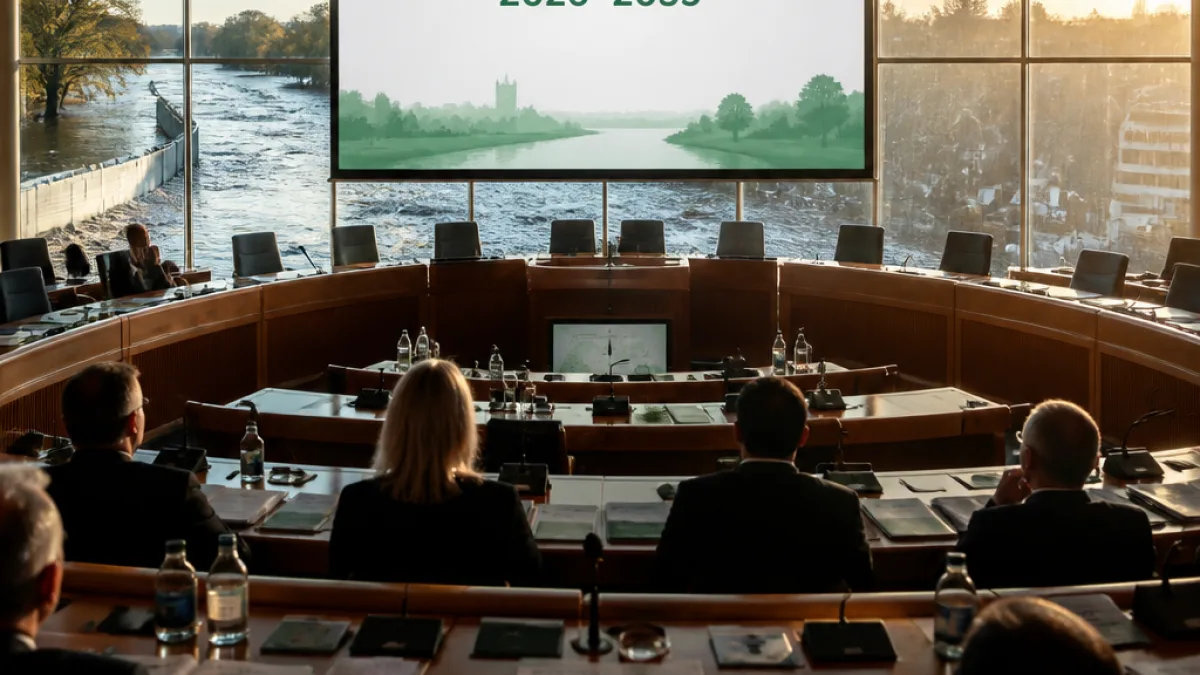
The Royal Borough of Windsor and Maidenhead has this week formally adopted a new environment and climate strategy for 2026–2035, a move council leaders say is essential to tackle the increasing local impacts of climate change such as extreme heat, flooding and pollution.
Urgency stressed at Town Hall
At the Town Hall meeting on Monday (July 13), councillors across the chamber gave unanimous backing to the document, which replaces the borough’s previous plan. The council originally declared a climate emergency in 2019 and adopted its first environment and climate strategy in 2020; the new strategy is billed as a refreshed, longer-term approach intended to embed climate considerations across council decisions.
“We are not debating a distant problem or a hypothetical future. Human made climate change is no longer an abstract concept. It is a lived reality and its footprint is visible right here in our borough.”
The remark came from the council leader, who warned councillors that postponing implementation would amount to “failing our obligations”.
Priorities and practical focus
The strategy sets out five priorities intended to guide borough action and resource allocation over the next decade. Councillors said the document must act as the “gold thread” running through council business and be a living plan that adapts as conditions change.
- Energy – reducing emissions and improving efficiency
- Sustainable transport – cutting transport emissions and promoting alternatives
- Natural environment – protecting and enhancing green spaces and biodiversity
- Reducing waste – lowering landfill and bolstering recycling
- Governance and finance – embedding climate action across budgets and decision-making
Councillors from different parties welcomed the strategy but cautioned on the practical challenges of delivery. Cllr Julian Sharpe (Con, Ascot and Sunninghill) said he supported the thrust of the plan while warning that development pressures and major infrastructure projects, such as potential expansion at Heathrow, present obstacles the borough cannot control alone.
Cllr Jodie Grove (Ind, Datchet, Horton and Wraysbury) described the situation as alarming and said the risk of public overwhelm was real, urging that the plan be translated into tangible, local actions to avoid apathy.
What this means for residents
With unanimous political backing, the strategy provides a framework for the council’s decisions on planning, transport, parks and waste services. For residents, the practical effects will depend on how quickly the council moves from strategy to implementation and how it allocates funding and staff to the priorities laid out.
| Item | Implication |
|---|---|
| Energy programmes | Potential retrofit grants, efficiency measures in council buildings |
| Transport | Support for active travel and low-emission options |
| Natural environment | Plans to protect green spaces and urban tree cover |
Council documents state that the strategy aims to be mainstreamed across services. How quickly that happens and what funding is made available will determine whether the strategy remains an aspirational document or leads to measurable reductions in local emissions and improved resilience to heat and flooding.
As the borough faces more frequent extreme weather, the council’s next steps will be closely watched by residents and campaigners seeking evidence that commitments on paper become action on the ground.