Salford City Council is recommending the addition of 140 buildings and sites to its local list of heritage assets, a move intended to ensure the city’s historic places are given greater weight when planning applications are considered.
What the local list does — and doesn’t — mean
The local list is a register of places judged to be of particular local importance because of their architecture, history or cultural associations. It is separate from national statutory listing and does not place the same legal controls on owners. However, it does require that the history and character of a site be taken into account when development proposals are assessed.
Council officers compiled the proposed additions following a public call for nominations in the summer of 2025. The list includes well-known landmarks alongside more unexpected entries that reflect the everyday and commercial past of the city.
Unexpected entries and familiar landmarks
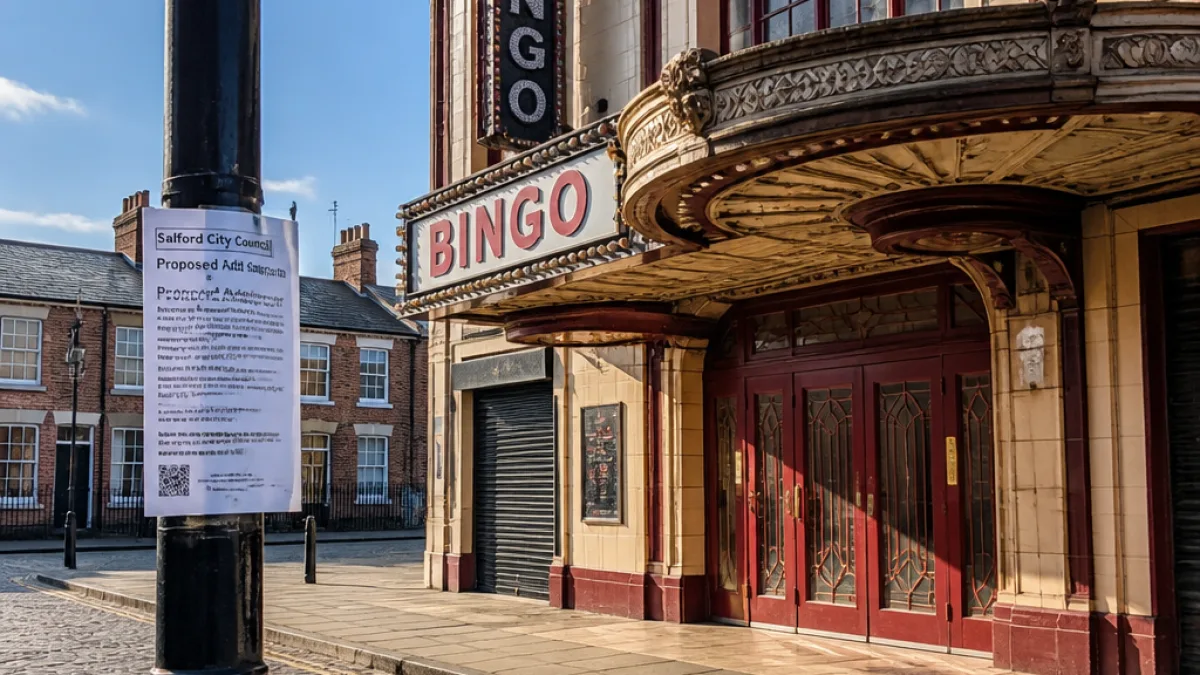
Among the more unusual suggestions is Cosmo Bingo on Liverpool Road in Eccles. The building originally opened as a cinema and is noted as an example of Edwardian Baroque architecture, later converted into a bingo hall in the 1980s. Also proposed is Booth Villa in Worsley, now occupied by a pet grooming business, and a former potato warehouse in Boothstown.
Several churches, pubs, bridges, war memorials and public conveniences feature among the nominations, together with ordinary street furniture such as post boxes. Notable civic and cultural sites are included too: RHS Garden Bridgewater, Ingleside Mansion (now a birthing centre) and Height Library are among the recommended entries.
"The history and character of a site must be taken into account before development is approved."
Bexley Square: architecture and protest
One of the list’s most historically significant inclusions is Bexley Square, situated opposite the University of Salford. While its Georgian townscape is rare and architecturally notable, the square is also marked by its role in social and political history. The 1931 gathering at Bexley Square, when around 10,000 workers protested new means testing for unemployment benefits, is cited as an important moment in the city’s working-class and political past.
Practical effects on planning and owners
Being added to the local list will not prevent owners from altering their properties, nor will it equate to national listing. What it will do is mean planning officers and developers must consider a site’s local significance in decisions. That extra consideration can affect the design and acceptability of proposed changes, extensions or redevelopment.
- Scale: 140 places proposed for local-listing across Salford.
- Range: civic buildings, pubs, churches, commercial premises, gardens, and street furniture.
- Process: nominations from the public in 2025 reviewed by council officers.
Selected sites proposed for the Salford local list
| Site | Location | Notes |
|---|---|---|
| Cosmo Bingo | Liverpool Road, Eccles | Former cinema; Edwardian Baroque, converted to bingo in the 1980s |
| Booth Villa | Worsley | Now a pet grooming business |
| Former potato warehouse | Boothstown | Industrial-commercial heritage |
| Bexley Square | Opposite University of Salford | Complete Georgian townscape; 1931 protest site |
Residents who suggested sites during the council’s consultation will see their nominations reviewed alongside professional assessments. The council’s approach reflects a wider trend among local authorities to recognise the value of places that may not meet national criteria but are nonetheless important to community identity.
Next steps will be the formal adoption process by the council, during which there may be further public consultation and opportunities for owners or other stakeholders to comment. The final composition of the local list will determine how these places are treated in future planning decisions across the city.
The proposed local list is intended to provide a clearer framework for balancing development pressures with the retention of local character, helping to guide planners, developers and communities when change is proposed.