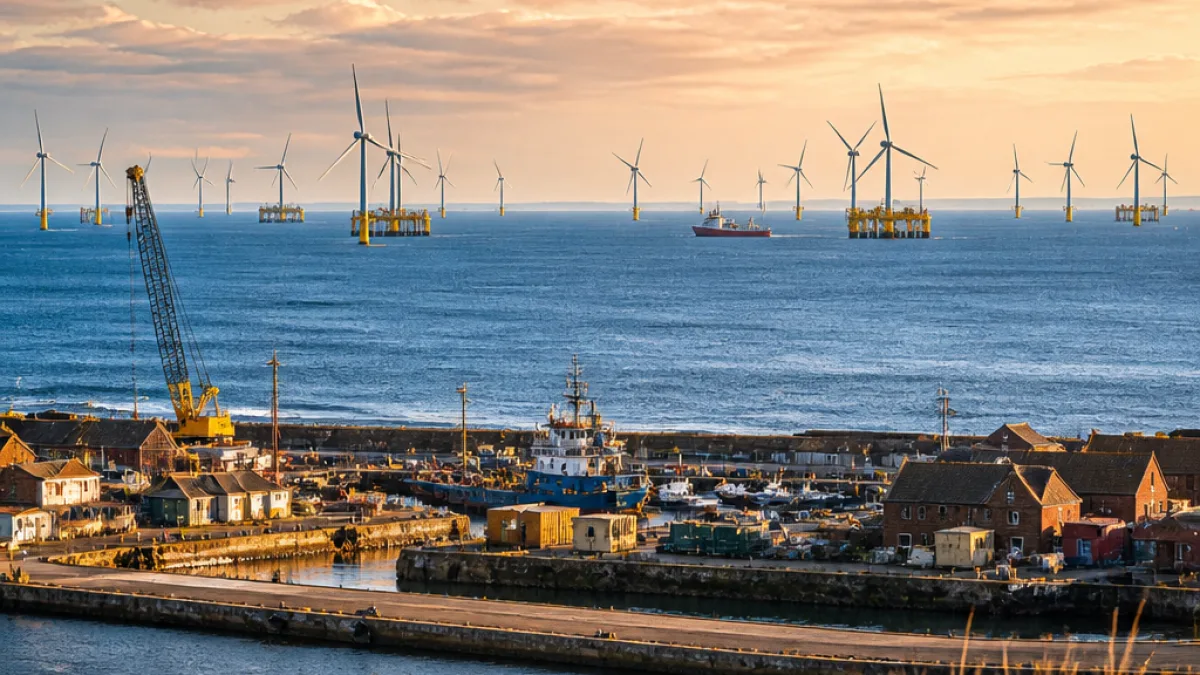
The Scottish Government has granted marine licences for two large offshore wind developments in the Moray Firth, authorising the Caledonia North and Caledonia South projects to progress towards construction. Together the schemes are designed to produce about 2 gigawatts of capacity, enough to power the equivalent of two million homes annually, and will occupy a combined area of 429 square kilometres off the coasts of Wick and Banff.
Project details and technology
Caledonia North is planned as a fixed‑bottom windfarm, while Caledonia South will use a combination of fixed and floating foundation technologies. The developments could include up to 140 turbines across the two sites. The projects form the second set of ScotWind licences to receive consent from Scottish ministers.
- Capacity: Around 2GW (combined)
- Area: 429 sq km (combined)
- Number of turbines: Up to 140 (combined)
- Technology: Fixed‑bottom (North); mixed fixed and floating (South)
- Developer commitment: £1.7bn to the Scottish supply chain
Economic and environmental conditions
Developer Ocean Winds has pledged a £1.7 billion commitment to the Scottish supply chain, which ministers say is expected to support long‑term roles in engineering, manufacturing, ports and operations. The consent includes a requirement for the developer to supply detailed seabird compensation plans before construction can begin, reflecting concerns about potential impacts on marine wildlife.
“This consent decision is a step in Scotland’s progress towards tackling climate change and reaching net zero,”
First Minister John Swinney said ministers had given the applications "very careful consideration" and that the Scottish Government would work closely with the developer and stakeholders including the fishing and conservation sectors to minimise marine impacts.
| Item | Detail |
|---|---|
| Sites | Off Wick and Banff |
| Combined area | 429 sq km |
| Capacity | 2 GW (equivalent to ~2 million homes) |
| Investment commitment | £1.7bn to Scottish supply chain |
Local impact and next steps
For communities across Moray and neighbouring Aberdeenshire, the projects bring potential economic opportunities in port services, fabrication and ongoing operations and maintenance work. Ministers have set conditions intended to address environmental concerns, notably avian impacts, and have signalled further engagement with fisheries and conservation interests.
The developer must submit the seabird compensation measures before construction commences. Beyond that submission, any detailed construction and consenting process will determine timelines for procurement, onshore works and offshore installation. The licences represent a significant milestone for the ScotWind programme in the north-east marine area and for efforts to expand renewable energy generation in Scottish waters.
Local authorities, fishing organisations and conservation bodies will now be watching the detailed plans to understand how impacts will be mitigated and what benefits might flow to the local economy.