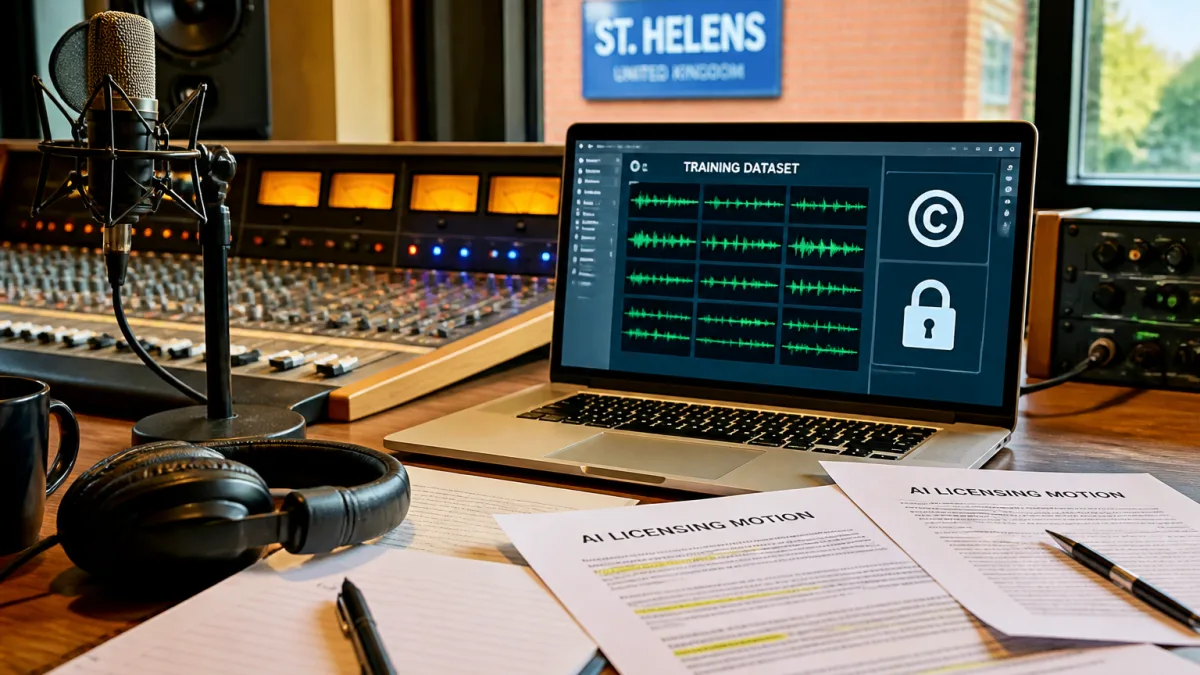
Why musicians say AI training is crossing the line
Danny O’Donoghue, lead singer of The Script, has thrown his weight behind a Sinn Féin motion calling for stronger protections for artists in the face of rapid advances in artificial intelligence. Speaking on RTÉ’s Morning Ireland ahead of a parliamentary debate on Tuesday, he alleged that 125 songs from his own catalogue and The Script’s backlist had been swept up by five major AI companies to train their models without permission — a practice he condemned as large-scale infringement.
“Intellectual property theft on an industrial scale.”
O’Donoghue argued the economic harm reaches well beyond headline acts, pointing to the network of session players, engineers and small businesses tied to each recording. He warned that a surge in AI-generated music is flooding release platforms — with an estimated 80,000 tracks a day now appearing — leaving emerging artists struggling to be heard.
What the motion is asking for
The Sinn Féin proposal, titled Protecting the Copyright of Irish Artists in the era of Artificial Intelligence, sets out a framework to rein in unlicensed data mining and ensure creators are paid when their work underpins new AI tools and outputs. In interviews, O’Donoghue endorsed measures that would put consent and compensation at the centre of the rules.
- Clear consent (“opt-out”) rights for artists to decide if their material can be used to train AI models — and on what terms.
- Fair pay and proper licensing when recordings or compositions inform AI products.
- No public funding for AI-generated content, according to his suggested guardrail.
He urged Ireland to use its influence, noting the country’s role on the European stage, to signal firm support for creators as technology evolves. The motion, he said, draws a “line in the sand” for those seeking to protect musicians’ livelihoods.
Why this matters for local artists and small studios
Although the debate is taking place in Dublin, the questions raised are familiar to many musicians, producers and independent labels across the North West. If artists’ catalogues are scraped without consent, it can undercut the licensing income that sustains local studios, engineers and publishers. O’Donoghue’s emphasis on the broader ecosystem will resonate with gigging musicians and micro-businesses that rely on royalties and sync fees to make projects viable.
He drew a blunt comparison to trade secrets in other industries, arguing that creative IP deserves equivalent respect and enforcement. Copyright law, he noted, already exists — but musicians, who spend their time making music rather than “lobbying for power or money”, face a resource imbalance when challenging powerful tech firms.
Calls for accountability and a clearer rulebook
O’Donoghue contends that a transparent licensing regime is overdue, particularly as AI music tools become more capable and accessible. He described AI songs as “diluting the market”, not only by increasing the volume of releases but by masking human-made work in crowded distribution channels. For rising acts trying to build a following, discoverability can be the difference between a tour and a cancelled project.
In Dublin, Minister for Research, Innovation and Science James Lawless TD was photographed speaking to reporters as the policy discussion gathered momentum. While ministers will weigh the parliamentary motion, O’Donoghue pressed for policy that both recognises innovation and secures a sustainable deal for creators whose work trains the systems behind the scenes.
At a glance: what’s on the table
| Issue | Proposal/Concern |
|---|---|
| Use of artists’ catalogues to train AI | Introduce consent-based access and licensing |
| Payment for training data | Ensure fair remuneration to rights holders |
| Public funding | Bar funding for AI-generated content |
| Market saturation | Address impact of 80,000 daily releases on discoverability |
What changes next
The parliamentary motion sets a political marker rather than rewriting law on its own. However, its timing underscores growing pressure for governments to clarify how copyright applies to AI training, where consent sits, and who gets paid. For artists and managers in our area, the direction of travel in Ireland — and across Europe — will be closely watched as the UK conducts its own policy reviews around data mining, copyright exceptions and creator protections.
As O’Donoghue put it, songs are more than a single author’s expression; they are the product of a community of craftspeople. How policymakers balance innovation with that reality will shape the business model on which many local creatives depend.