West Northamptonshire Council has agreed a major contract with charging company Char.gy to install more than 3,000 on‑street electric vehicle sockets across the district, a programme supported by £2.85 million from the UK government’s Local Electric Vehicle Infrastructure (LEVI) Fund and additional private investment from Char.gy.
What is being installed and how it works
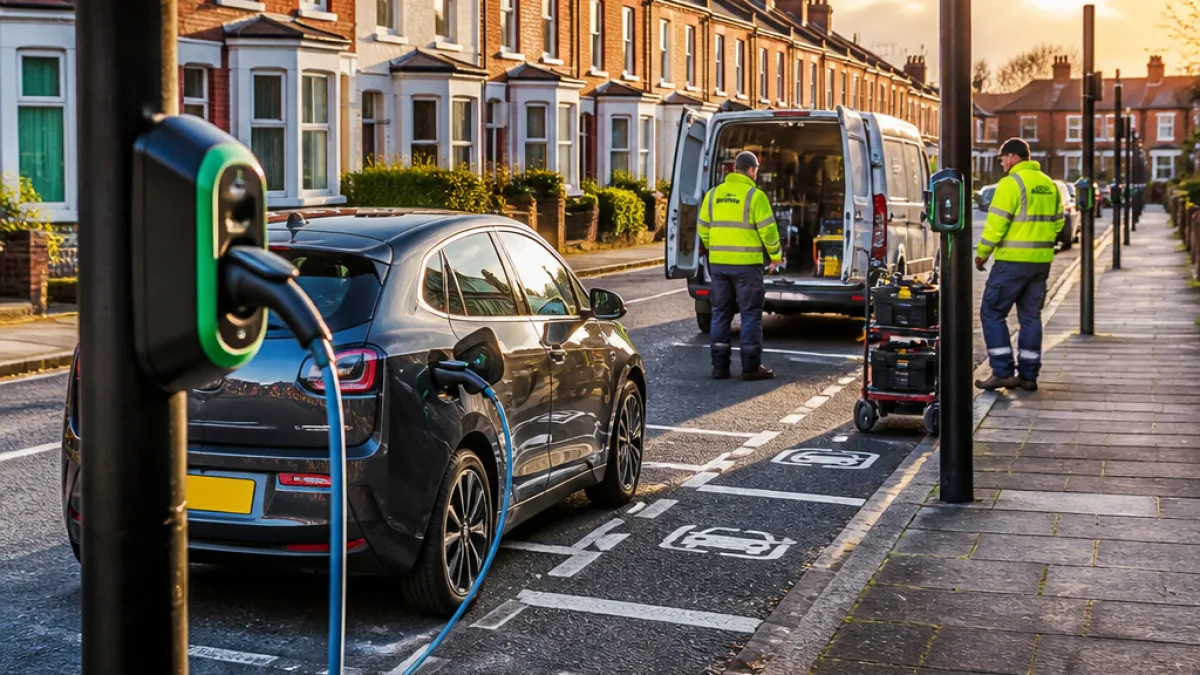
The majority of the new sockets will be retrofitted onto existing street lighting columns. Because standard lamp columns are already wired into the local distribution network, Char.gy’s approach does not require new grid connections, excavation or lengthy planning procedures. The council says the method will allow rapid deployment in residential streets where residents park on the kerb.
This model addresses a key local barrier to electric vehicle (EV) adoption: for many households without private driveways, overnight home charging is not an option. National surveys indicate that access to convenient charging is a decisive factor for drivers considering a switch away from petrol and diesel.
Why this matters locally
Around 40% of households nationally lack off‑street parking; for those residents, relying on town‑centre or motorway chargers is often impractical when a full charge is needed by morning. The planned on‑street sockets are designed to give those motorists the realistic prospect of nightly charging near their homes.
- Number of sockets: more than 3,000
- Public funding: £2.85m from the LEVI Fund
- Delivery model: lamp‑post retrofits with no new grid connection or excavation
National context and targets
The programme in West Northamptonshire forms part of a growing number of local authorities adopting public‑private concession models supported by the LEVI fund. Other councils that have pursued similar approaches include Brighton, Reading and the Isle of Wight, and central government has set a target of 300,000 public chargers by 2030.
Industry data from Zapmap recorded 121,171 active public charging connectors in the UK as of June 2026, an increase of 10% year on year in the first half of 2026. That rate of growth has slowed from the rapid expansion seen in 2024, highlighting the need for targeted deployments that serve those without access to off‑street charging.
| Measure | Figure |
|---|---|
| Planned on‑street sockets in West Northamptonshire | More than 3,000 |
| LEVI funding awarded | £2.85 million |
| UK public chargers (June 2026, Zapmap) | 121,171 active connectors |
| UK target by 2030 | 300,000 public chargers |
Local impact and next steps
The council’s decision to appoint Char.gy follows the LEVI framework that uses public funds to unlock private investment and rapid deployment. For residents, the rollout should mean more on‑street charging options in coming months and years, though precise timings, locations and rollout phases have not been published in the council’s announcement.
For drivers who rely on kerbside parking, the programme could reduce one of the main practical obstacles to purchasing an electric vehicle: the inability to charge at home. For the council, the model offers a way to meet climate and transport objectives without the large‑scale civil works that traditionally slow infrastructure projects.
Further details on installation schedules, street‑by‑street plans and any associated parking controls will be important for residents and neighbourhood groups as the scheme progresses. The council and Char.gy will need to set out how sockets will be allocated, any usage charges, and how access will be managed in areas with competing parking demand.
The appointment marks a significant step for West Northamptonshire in expanding public charging infrastructure and demonstrates how the LEVI public‑private concession model is being applied at scale beyond isolated pilots.