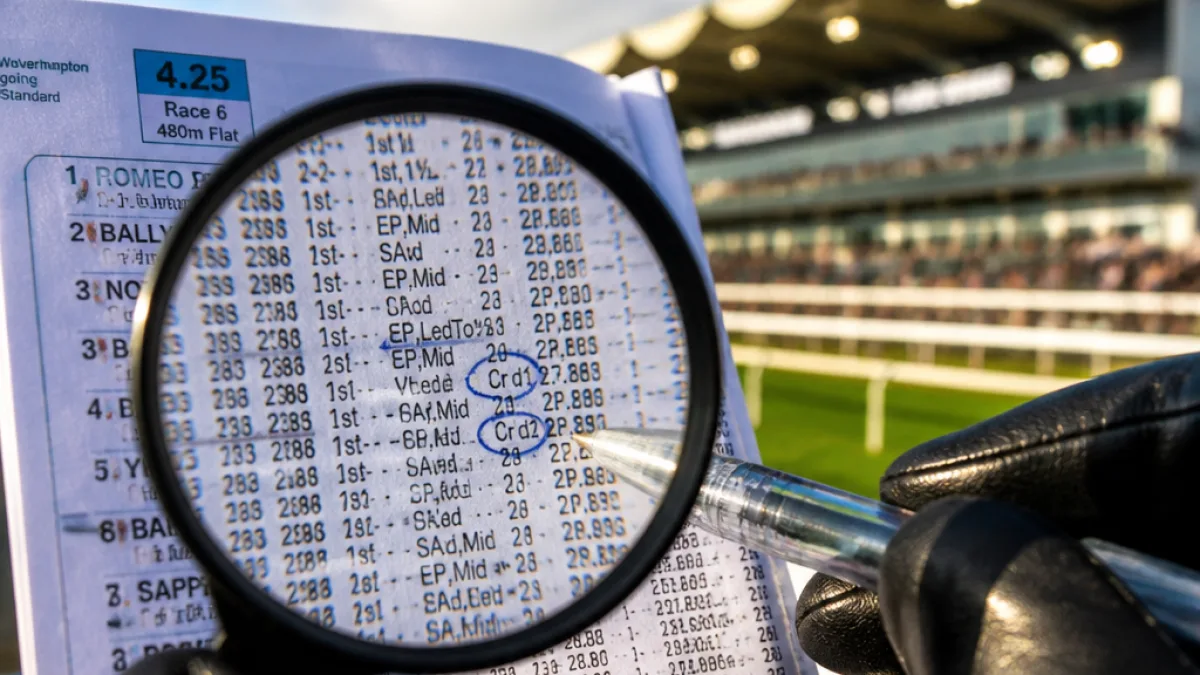
Racecards are dense with shorthand. For anyone attending or following meetings — including those with an interest in Wolverhampton racing — the small letters and short codes beside a runner's name carry practical information about form, equipment and result history. Knowing how to read them helps with assessing runners quickly and understanding the brief notes handed out at tracks or printed on betting slips.
What the abbreviations show
Racecard abbreviations fall into a few clear groups: form and finishing positions, reasons a horse didn't finish, equipment or headgear, and shorthand for past achievements or status. Below is a concise explanation of the common codes used across racecards.
- Form and finishing positions — numbers such as 1–9 denote the horse's finishing position in a race; 0 indicates the horse finished outside the top nine.
- Non-finishes — single letters record incidents: F for fell, P for pulled up, U for unseated rider, D for disqualified and so on.
- Headgear — items fitted to a horse are shortened: for example, h is hood, b for blinkers, v for visor and t for tongue‑tie.
- Status and track history — codes such as BF (beaten favourite), CD (previous course and distance winner) and N/R (non‑runner) summarise recent context.
Quick reference table
| Code | Meaning |
|---|---|
| 1–9 | Finishing position |
| 0 | Finished outside the top nine |
| F | Fell |
| P | Pulled up |
| b | Blinkers |
| h | Hood |
Other shorthand to watch
Some codes compress more specific race information. For example, BF flags a horse that was the beaten favourite in its last race; WT denotes weight carried and OR stands for official rating. Trainers, jockeys and form lines often appear with their own initials or short codes too.
"Abbreviations are present on all racecards, appearing alongside horses, jockeys, trainers, and in the form lines of runners."
For Wolverhampton followers this shorthand matters when scanning a racecard quickly before a race, checking the form in the paddock or when filling a betting slip. It condenses several facts into a few characters, enabling faster comparisons between runners. Racegoers unfamiliar with the codes can keep a printed list or use a racecard key — most printed and online racecards include such a legend.
Understanding the shorthand does not replace judgment based on watching a horse at the track, but it does make the paper evidence of a horse's recent history easier to interpret. That is particularly useful on busy race days when multiple meetings and many runners are on a card.