Major boost for rural infrastructure across the Borders
Scottish Borders Council has confirmed a significant funding injection from Scottish Forestry’s Strategic Timber Transport Fund (STTF) to upgrade several heavily used rural routes. The programme will focus on roads that shoulder the weight of timber haulage, improving surfaces and safety while protecting vulnerable carriageways that link dispersed communities to services and employment.
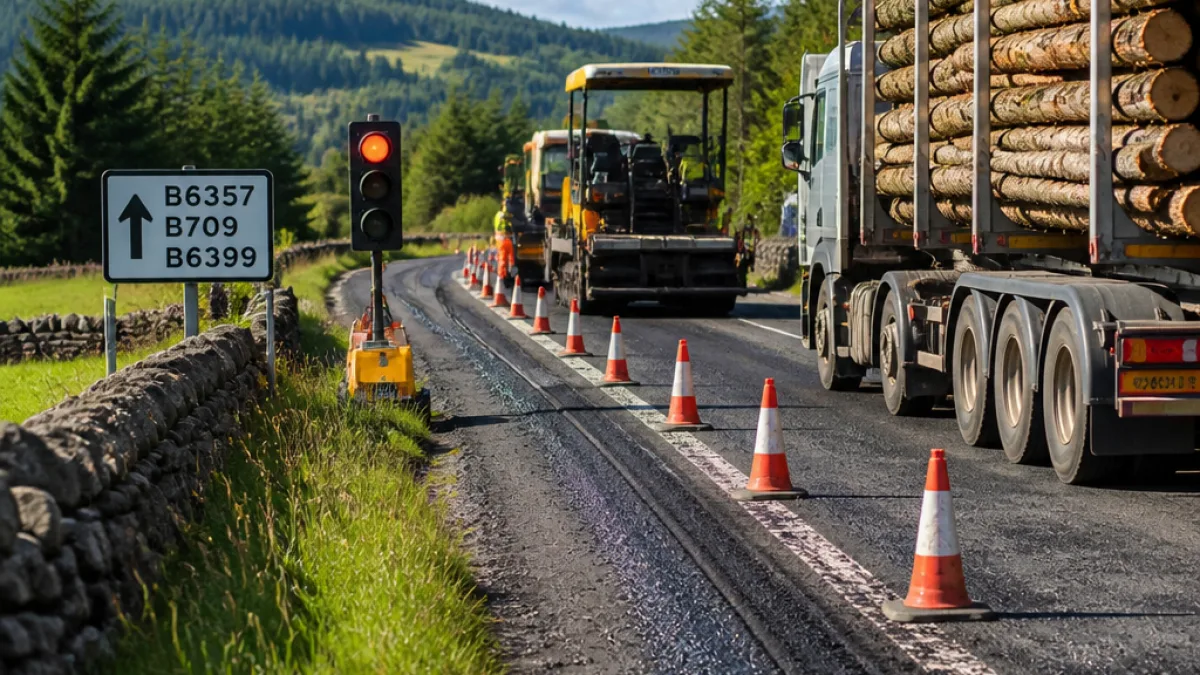
The works will target sections of three corridors crucial to forestry and local travel: the B6357 between Dinalbyre and Kirndean, the B709 from north of Blackhopebyres to Garvald Lodge, and the B6399 south of Shankend. These are lifeline routes for residents as well as for commercial operators transporting timber to processing and distribution sites.
“Our rural road network is the lifeblood of our communities and our local economy, but it faces unique pressures from heavy industries like forestry.”
“By upgrading these specific routes, we are protecting our infrastructure, ensuring our roads remain safe and resilient for everyday commuters, and easing the impact of heavy timber transport on our local towns and villages.”
“It’s a fantastic example of partnership working between local government, Scottish Forestry and industry partners.”
With forestry forming a major plank of the rural economy, the Council’s focus is on resilience as well as day‑to‑day usability. Scotland’s forestry sector underpins more than 34,000 jobs and contributes around £1.1 billion to the economy annually, much of it in places like the Borders where plantation, harvesting and haulage create steady traffic on B‑class roads never designed for sustained heavy loads.
Where the improvements will happen
| Route | Section earmarked |
|---|---|
| B6357 | Dinalbyre to Kirndean |
| B709 | North of Blackhopebyres to Garvald Lodge |
| B6399 | South of Shankend |
While technical designs and delivery programmes have not been detailed publicly, the Council has indicated that work is expected to commence in the coming months. Motorists can expect temporary traffic management during construction, with advance notice promised to keep disruption to a minimum. For residents along these stretches, the upgrades should reduce surface wear, noise from heavy vehicles on degraded tarmac, and the risk of damage to verges and drainage.
Why this matters for communities and industry
The STTF exists to balance the needs of timber transport with the capacity of rural road networks. In the Borders, that balance is especially delicate: forestry lorries must move product efficiently to sustain jobs, yet narrow, undulating B‑roads thread through villages, farm access points and tourist routes. Targeted strengthening and surface renewal can materially improve safety for all users, from school traffic and local buses to cyclists and agricultural vehicles.
- Safety and reliability: Smoother, stronger surfaces cut braking distances and reduce pothole risks for everyday commuters.
- Economic resilience: Better‑conditioned roads support haulage schedules, protecting rural supply chains and employment.
- Community wellbeing: Managing timber traffic on upgraded corridors helps limit vibration, edge erosion and noise close to homes.
The Council’s emphasis on partnership working mirrors the approach across Scotland, where local authorities, Scottish Forestry and operators co‑fund projects that deliver mutual benefit. By concentrating on corridors that carry the greatest volume of timber traffic, interventions can extend road life, reduce maintenance backlogs and minimise unplanned closures following surface failures.
What residents and drivers should know
Construction timetables and traffic management details will be communicated ahead of works beginning. Drivers who regularly rely on the B6357, B709 and B6399 should allow extra time once the programme gets underway and heed all site signage. Local access will be maintained wherever possible, with the Council signalling a commitment to phasing works to keep communities connected.
In a region where distances to services are substantial and alternative routes limited, upgrading these specific stretches offers practical gains that will be felt beyond the forestry sector. The planned works are intended to safeguard the long‑term condition of key roads, easing pressure on maintenance budgets and supporting safer journeys throughout the Scottish Borders.