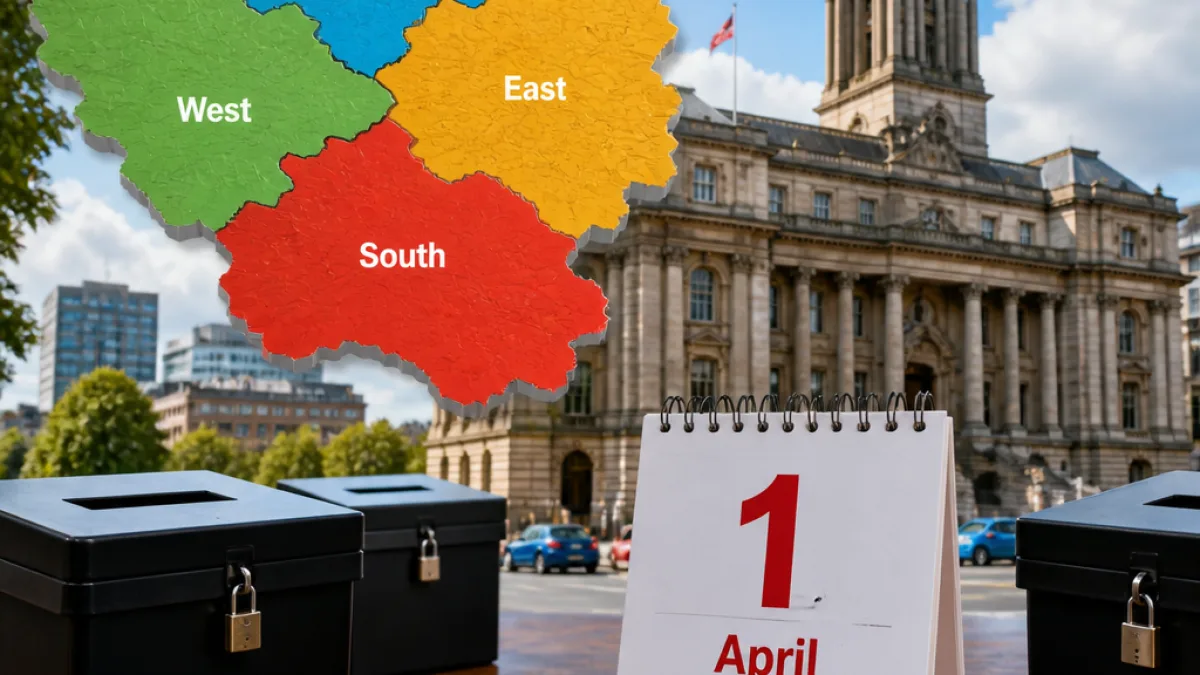
The Government has set out plans to replace Lancashire’s existing multilevel council system with four unitary authorities, a structural change organisers describe as the county’s most significant reorganisation for more than half a century. The decision is subject to Parliamentary approval.
What has been proposed
If approved, the county’s current 15-council arrangement will be dissolved and responsibilities for all local services within each area will transfer to the new single-tier councils. The proposals allocate districts and boroughs into four new authorities as follows:
- North Lancashire: Lancaster, Preston and Ribble Valley
- West Lancashire: Fylde, Wyre and Blackpool
- South Lancashire: Chorley and South Ribble
- East Lancashire: Pendle, Blackburn with Darwen, Hyndburn, Rossendale and Burnley
The reorganisation forms part of a broader national programme intended to simplify local government structures and, the Government says, to improve service delivery and accountability.
Timetable and transitional arrangements
Under the current timetable government ministers intend that elections for the new shadow authorities should take place in May 2027, with the new councils formally assuming their duties on 1 April 2028. In the meantime, existing councils will continue to deliver services without interruption while planning for the transition continues.
| New unitary authority | Constituent councils |
|---|---|
| North Lancashire | Lancaster, Preston, Ribble Valley |
| West Lancashire | Fylde, Wyre, Blackpool |
| South Lancashire | Chorley, South Ribble |
| East Lancashire | Pendle, Blackburn with Darwen, Hyndburn, Rossendale, Burnley |
Council response and next steps
The county’s Local Government Reorganisation (LGR) Board of Chief Executives welcomed the announcement as an important milestone while emphasising continuity of services during the transition. A board spokesperson said the focus remains on maintaining standards for residents and staff as planning proceeds.
"Today’s announcement marks an important milestone for Lancashire… No matter how we are reshaped, our priority remains unchanged – to continue delivering high-quality services while we work together across Lancashire to plan the next steps."
The board also acknowledged that such a wide-ranging change will create uncertainty and pledged to keep residents, employees and partners informed as further details emerge. Officials say there is existing collaboration across councils which they aim to build on to ensure a managed handover.
Local impact and practical implications
For residents, the immediate practical message is continuity: day-to-day council services are expected to continue under the current authorities until the handover. However, the shift to unitary government may have longer-term effects on service organisation, local representation, council tax arrangements and procurement. Workstreams now required will include human resources for council staff, harmonisation of policies and IT systems, and electoral arrangements for the shadow authorities.
Local businesses and community groups will want clarity on how contracts, grants and partnerships will be handled during and after the transition. The reorganisation timetable gives councils and stakeholders time to plan, but it also places a premium on transparency and rigorous project management to avoid disruption.
The next key milestones to watch are Parliamentary approval of the proposal, publication of detailed transition plans by the LGR board, the shadow authority elections in May 2027 and preparatory consultations on service design and governance ahead of the April 2028 handover.
Further updates and formal documentation are expected to be published in the coming weeks as councils and central government set out the next stages of implementation.