County Durham landmark in renewed focus
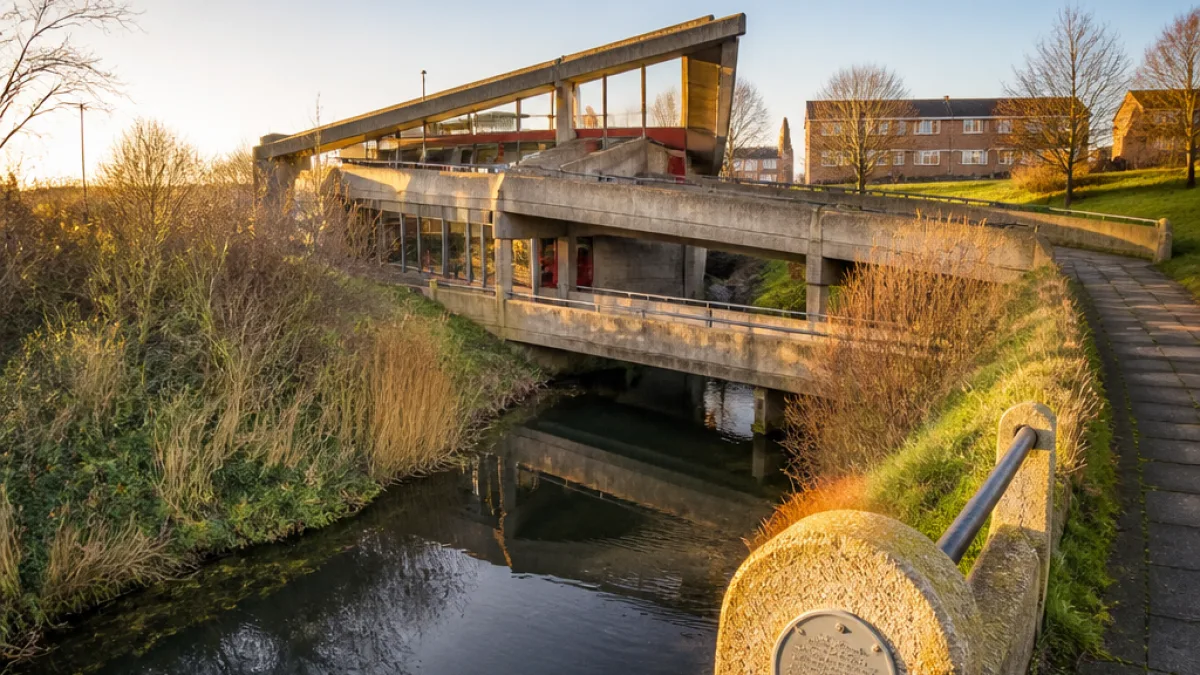
A distinctive piece of public art in Peterlee is once again drawing attention to County Durham’s modernist heritage. The Apollo Pavilion — also known as the Pasmore Pavilion — has stood on the Sunny Blunts estate since 1969, its angular concrete forms a lasting reminder of the town’s post-war ambitions and its commitment to integrating art into everyday urban life.
Designed by British artist and architect Victor Pasmore, the structure was conceived as part of the wider vision for Peterlee new town. While it faced early scepticism and complaints from some residents, it is now Grade II*-listed and widely recognised as one of the North East’s most striking examples of public art and architecture.
From controversy to recognition
Public reaction to the pavilion was mixed from the start. Its abstract geometry and elevated walkways divided opinion, and it became a focal point for debate about the purpose of public art in residential settings. Over time, however, the pavilion’s architectural importance has been formally acknowledged through listing, reflecting its national significance and its unique role in Peterlee’s planned landscape.
Pasmore’s original intent was unapologetically avant‑garde. He envisaged an artwork that residents would inhabit as part of daily life, not simply observe at a distance. As he put it:
“an architecture and sculpture of purely abstract form through which to walk, in which to linger and on which to play.”
He also described it as “a free and anonymous monument” intended to elevate the activity of an urban housing community “on to a universal plane.”
Rooted in the new town experiment
The pavilion emerged from Peterlee’s post-war development programme. In 1955, Pasmore was appointed consulting director of architectural design for the Peterlee Development Corporation, where he pursued a plan to knit art into the fabric of the growing town. The name references the optimism surrounding the Apollo Space Program, and the structure was completed in the same year as the Moon landing.
That heritage continues to resonate locally. While the pavilion’s stark silhouette once made it a lightning rod for criticism, it now stands as a marker of the era’s aspirations — a built reminder of the desire to combine function, community and culture in the new towns of County Durham.
On-screen profile via ITV drama
Beyond architecture circles, the Apollo Pavilion reached a wider audience through a prominent appearance in ITV’s Vera. The structure featured in the Season 12 episode Against the Tide, broadcast in January 2023, where it served as the backdrop to a family home. The episode sparked amused reactions among some local viewers, who noticed the familiar television quirk of elastic geography: characters shown living beside the pavilion in Peterlee yet heading to Morpeth for shopping.
Television exposure has invariably prompted renewed interest in the pavilion’s story and its place in the townscape, reinforcing its status as one of Peterlee’s best-known landmarks and contributing to ongoing discussions about the value of public art in residential areas.
Key facts at a glance
| Detail | Information |
|---|---|
| Location | Sunny Blunts estate, Peterlee |
| Designer | Victor Pasmore |
| Completed | 1969 |
| Listing status | Grade II* |
| TV appearance | Vera, Season 12, Against the Tide (Jan 2023) |
Why it matters for County Durham
The pavilion encapsulates a chapter of County Durham’s civic and architectural history: the ambition of a new town, the challenge of embedding avant‑garde art in community spaces, and the long arc from controversy to conservation. As a Grade II*-listed site, it is part of the county’s nationally recognised heritage, and its continuing visibility — on screen and on the ground — helps sustain public interest in the story of Peterlee’s design and identity.
- Cultural significance: A rare example of large-scale abstract public art integrated into a residential setting.
- Local identity: A landmark that continues to spark discussion about place-making in Peterlee.
- National profile: Listing and TV exposure reinforce its status in the UK’s modernist landscape.