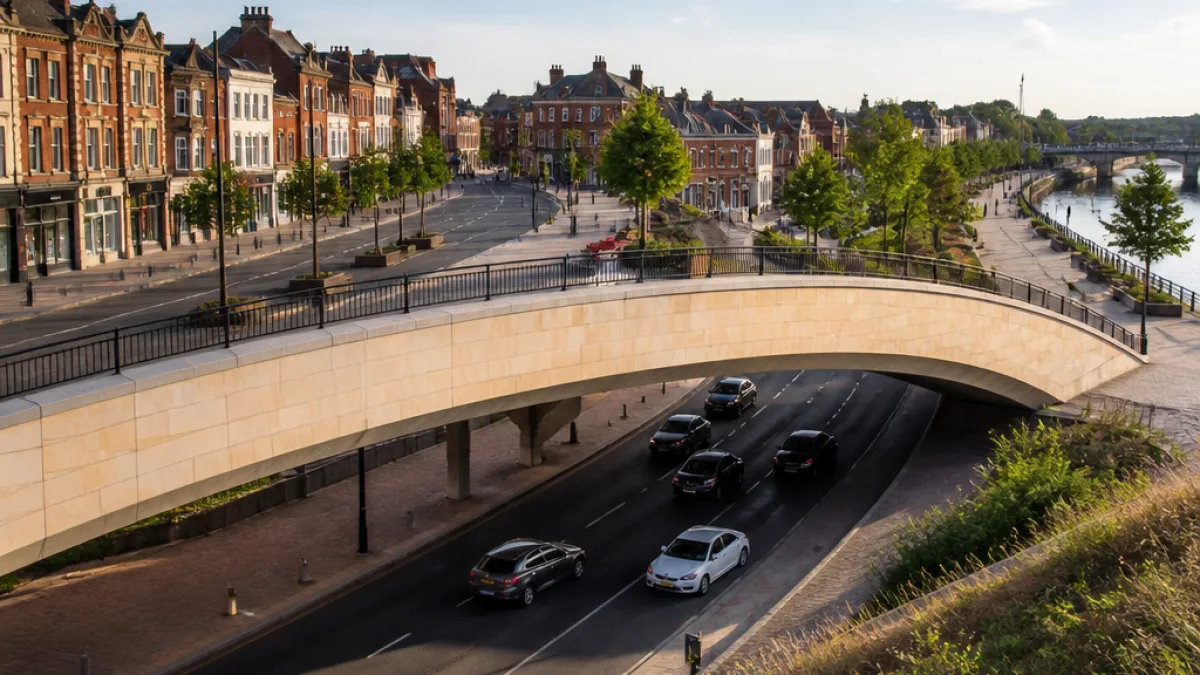
Stockton and Darlington — two market towns with industrial roots — have taken different but complementary approaches to reversing long-term decline in their centres. What links them is a willingness to make bold, physical changes that aim to reconnect people with civic spaces and local history rather than rely on piecemeal measures.
Visible changes that make movement easier
In Stockton, one of the most striking physical interventions is a new 55-metre land bridge across a major road that directly links the high street to the riverside. The structure includes granite-lined ramps and steps and creates a continuous route from town centre to river, avoiding the awkward access that once forced pedestrians to negotiate an outdated seventies shopping precinct.
Darlington’s recent works, too, prioritise connecting historic streets with contemporary uses, aiming for regeneration that "melds" with earlier phases rather than feeling like an unrelated insert.
"Growth starts with change. Change starts with us."
Design, narrative and civic pride
Design choices in both towns are intended to reference the past while providing practical benefit. Public art and inscriptions — including words by the Poet Laureate set in stone in Stockton — play a part in creating a narrative that the town centre is not in irreversible decline.
That sense of narrative is reinforced by visible placemaking: murals, well-considered materials and routes that link employment areas to retail and leisure zones. These elements signal intent and, crucially, make it easier for residents to move between key parts of town.
Lessons for similar towns
The Stockton and Darlington examples suggest a small set of practical priorities for councils and local partners seeking to revitalise centres:
- Prioritise physical connections that restore pedestrian flows.
- Use materials and public art to reference local identity and history.
- Ensure new interventions integrate with existing regeneration, not replace it abruptly.
| Aspect | Stockton change |
|---|---|
| Pedestrian access | 55-metre land bridge linking high street to riverside |
| Design approach | Granite ramps, public inscriptions, integration with past phases |
Responsibility for such transformations inevitably sits with council officers and elected members, who must take difficult decisions and accept public scrutiny. Where those decisions are taken thoughtfully — blending function, form and local story — the result can be streets and riversides that feel both usable and meaningful to residents.
For Stockton-on-Tees and Darlington the work is not simply cosmetic: it is an attempt to define a sustainable future for towns that are neither tourist magnets nor commuter dormitories, but lively centres of local life. The practical measures already installed offer lessons other towns might follow, while the public-facing elements help rebuild civic pride and a sense of shared ownership.