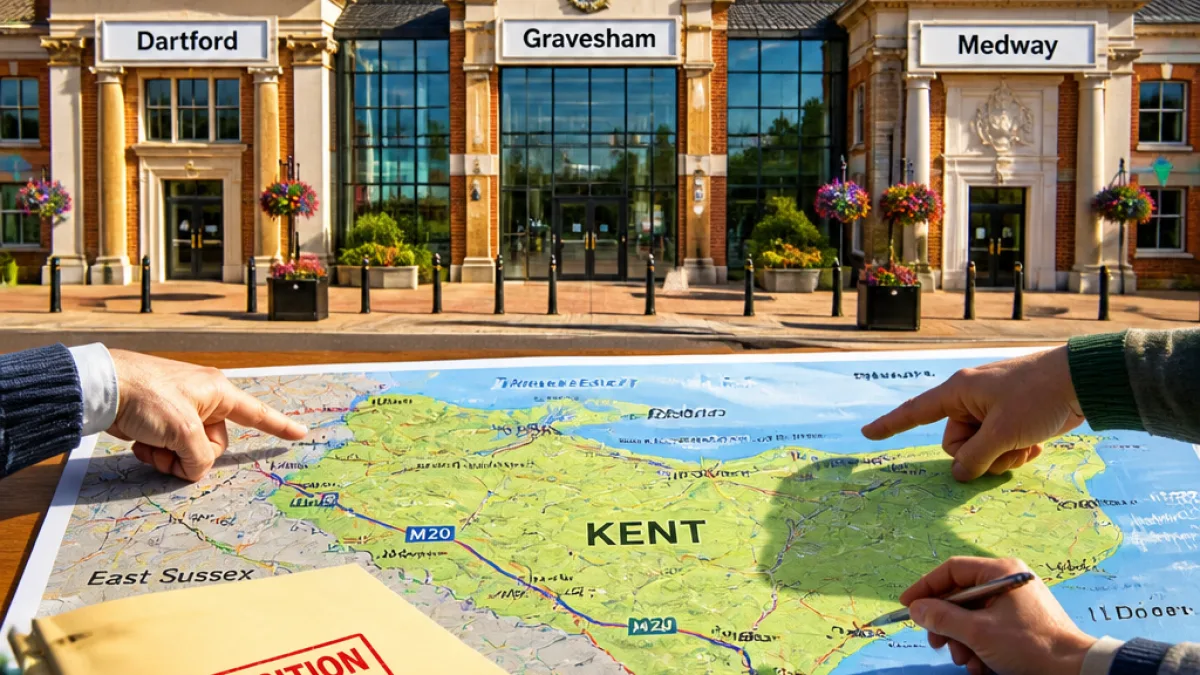
The government has confirmed plans that will see Medway become part of a new unitary authority alongside Dartford and Gravesham, as part of the largest reorganisation of local government in Kent for around 50 years. Dartford Borough Council will be abolished and its responsibilities transferred to the new body, with the changes due to take effect in April 2028.
What is changing and why it matters for Medway
Under the proposals, Kent County Council, Medway Council and the county’s 12 district, borough and city councils will be replaced by four new unitary authorities. For residents across Medway, the practical consequence is that services currently split between county and district councils — such as education, highways and social care — will be handled by a single council covering Dartford, Gravesham and Medway.
This means the new authority will take over responsibility for areas including:
- education and social care;
- highways and waste collection;
- housing, libraries and leisure services.
How the county will be reorganised
The government has divided Kent into four unitary areas. The full composition is:
| Unitary authority | Constituent councils |
|---|---|
| North Kent | Dartford, Gravesham and Medway |
| West Kent | Sevenoaks, Tonbridge and Malling, Maidstone and Tunbridge Wells |
| Mid Kent | Swale, Ashford and Folkestone and Hythe |
| East Kent | Canterbury, Thanet and Dover |
"Unitary authorities are single councils responsible for all local government services in their area."
The reform follows a public consultation that drew around 3,000 responses. Ministers say the change aims to simplify the structure of local government by ending the two-tier arrangement in areas where duties are split between county and district councils.
Officials have indicated further work will be carried out on the detailed transition arrangements before the new councils formally take over in April 2028. Until then, existing councils will continue to operate and provide services as now.
For Medway residents the coming months will be important for scrutinising the plans and seeking clarity on how local services, budgets, staff arrangements and local representation will be reorganised. The shift to a larger unitary body may offer streamlined decision-making, but will also raise questions about local accountability and how closely new arrangements will reflect Medway’s specific needs.