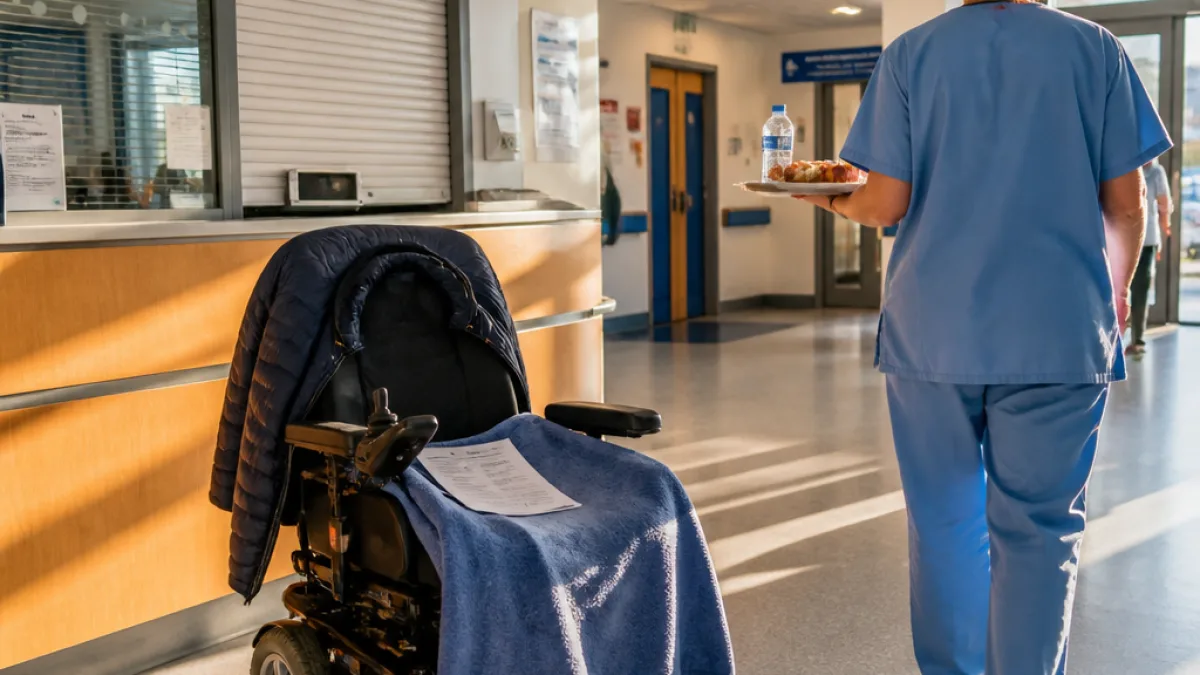
A man with serious existing health problems says he was left in his electric wheelchair in the reception area at Medway Maritime Hospital for 19 hours after the private patient transport operator contracted to take him home failed to turn up.
What happened
Kevin Taylor, 53, of Minster on Sheppey, attended Medway On Call Care (MedOCC) at Medway Maritime Hospital for what he was told would be an urgent appointment. He paid £55 for a taxi to reach the hospital after calling 111 and being advised to attend with suspected deep vein thrombosis; the diagnosis was later given as cellulitis. Mr Taylor said his appointment lasted about 45 minutes and he was finished by around 2.15pm on 9 July.
He says the patient transport firm contracted to provide his return journey, G4S, repeatedly failed to arrive despite assurances from hospital staff and repeated calls to the company’s job control. Standard wait estimates reportedly given to him ranged from two to four hours and later up to six hours. By midnight it was apparent the vehicle would not come; Mr Taylor remained in the reception area until approximately 11.15am the following morning.
"I spent 19 hours from 2.15pm until 11.15am the next morning. It was horrific because you're sitting there, all the other patients are coming to MedOCC... I was fed up. I’ve had no explanation."
Patient condition and immediate care
Mr Taylor, a father of four who lives in a residential care home and has previously had six heart attacks and two strokes, said he spent most of the night awake and in discomfort. He said hospital staff provided food and water but, in his account, could not secure timely collection.
- Patient: Kevin Taylor, 53, from Minster on Sheppey
- Appointment: Medway On Call Care at Medway Maritime Hospital, 9 July
- Finished appointment: around 2.15pm
- Collection from patient transport: around 11.15am next day (reported)
Response from G4S and wider implications
A spokesperson for G4S offered an apology for what they described as an “unacceptable wait” and said the matter would be investigated. Hospital staff were reported to have tried to assist while the patient waited.
The case highlights the reliance some patients have on non-emergency patient transport, particularly those with mobility and complex health needs. When scheduled collections fail to arrive, patients can be left exposed to discomfort and potential health risks, and care settings must find ways to safeguard dignity and safety while transport issues are resolved.
| Time | Event |
|---|---|
| Prior to appointment | Patient takes taxi to hospital after 111 advice (cost reported £55) |
| 1.30pm | Appointment at MedOCC |
| ~2.15pm | Appointment complete; patient begins waiting for transport |
| Overnight | Repeated reassurances given; no collection; patient remains in reception |
| ~11.15am (next day) | Transport arrives and patient taken home (reported) |
What this means for local patients
For patients who are frail, reliant on wheelchairs or who live in residential care, missed non-emergency transport can strip away the safety net that allows access to urgent community-based services without resorting to hospital stays or unaffordable taxis. The episode will raise questions for local NHS commissioners and providers about contractor performance, contingency plans at hospital front doors and the adequacy of communication with vulnerable patients when services fail.
G4S has acknowledged the complaint and said it will investigate. The details of any findings, remedial actions, or whether the patient will be offered recompense were not disclosed in the account provided to the local press.
The incident will be of interest to patients who use MedOCC at Medway Maritime Hospital and to the family carers and providers who arrange transport on their behalf. Local health watchdogs and commissioners may wish to review whether monitoring and escalation procedures are sufficient when contracted services fall short.
Anyone affected by similar problems with patient transport may wish to raise a complaint with their provider and the responsible commissioning body. Medway residents seeking information about non-emergency transport should consult their care provider or the hospital for the appropriate escalation route.