Nottinghamshire faces its biggest local government upheaval in half a century after ministers confirmed plans to replace nine existing councils with two new unitary authorities, cutting the number of councillors across the area from 408 to 198.
What has been decided
The Department for Levelling Up has accepted the plan put forward by Nottingham City Council. Under the decision, the county will be divided between a new Greater Nottingham Council and a separate Nottinghamshire Council.
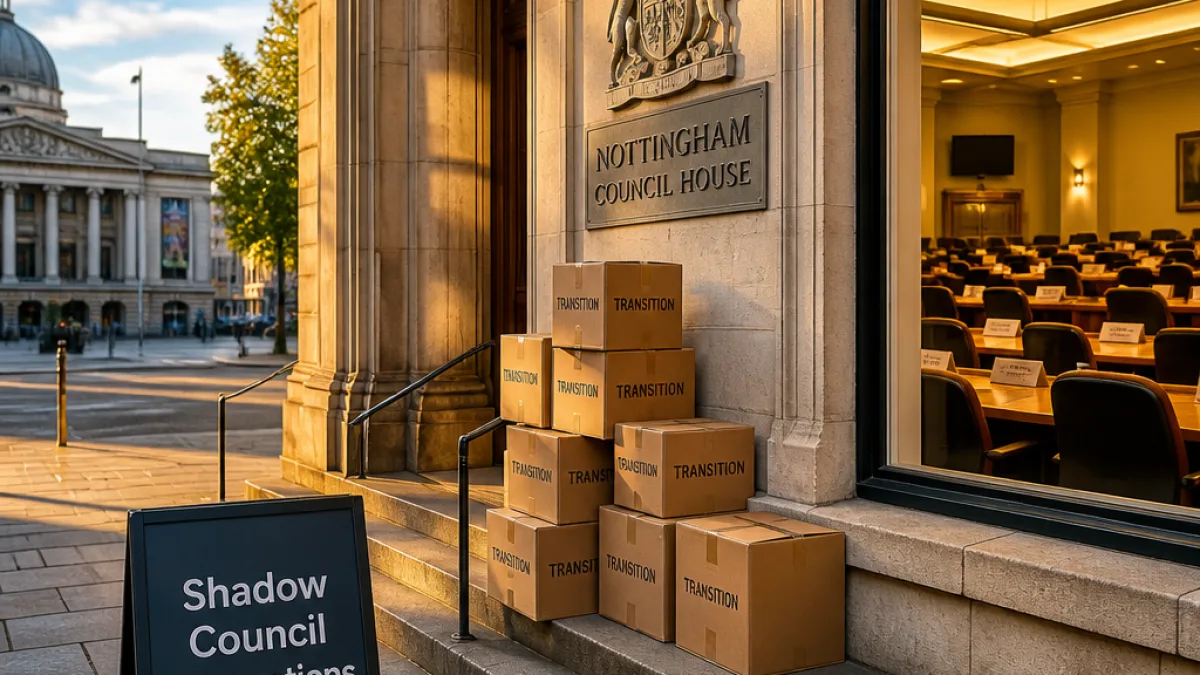
A letter to councils dated 30 July from Beatrice Andrews, deputy director for local government reorganisation, sets out the transitional steps: existing councils will continue to deliver services until they are abolished on 1 April 2028, while preparations for the new authorities will be handled by shadow councils elected in May 2027.
“Your councils will remain responsible for services in your areas until they are abolished on April 1, 2028, and will be under a duty to co-operate with each other and with the new councils,”
How the county will be split
The reorganisation pools neighbouring districts into two bodies. The composition announced in the letter states that each new council will have 99 councillors. The broad makeup is:
- Greater Nottingham Council – Nottingham plus parts of Broxtowe, Gedling and Rushcliffe.
- Nottinghamshire Council – Ashfield, Bassetlaw, Mansfield, Newark and Sherwood and the remaining parts of Broxtowe, Gedling and Rushcliffe.
The government accepted Nottingham City Council’s proposal over alternative plans that had been debated by the district and borough authorities.
Practical timetable and transitional arrangements
The letter makes clear there will be an Implementation Team drawing officers from the existing councils to manage the transition. Shadow councils elected in May 2027 will be tasked with preparing budgets, plans and other arrangements necessary to take on functions and powers from 1 April 2028.
| Key date | Action |
|---|---|
| May 2027 | Elections for shadow councils |
| 1 April 2028 | New unitary councils assume full responsibilities |
Local impact and questions ahead
For residents this change will mean dealing with a single council for most local services rather than the current two-tier system of county and district/borough councils. Proponents argue unitary status simplifies decision-making and can save money; opponents have expressed concern about democratic representation given the reduction in councillors.
What remains to be settled are the detailed ward boundaries, the precise distribution of services and budgets during the transitional period, and how local voices will be protected when the number of elected representatives is significantly lower.
Officers and councillors across the affected authorities will now be required to cooperate under the order to ensure continuity of services until the vesting day in 2028. Residents and local groups should expect consultations and further announcements on warding, service design and staffing as the Implementation Team begins its work.
For those wanting to follow developments: look out for consultation dates from your current council and information about the May 2027 shadow council elections, which will be the main opportunity to influence the make‑up of the new authorities.