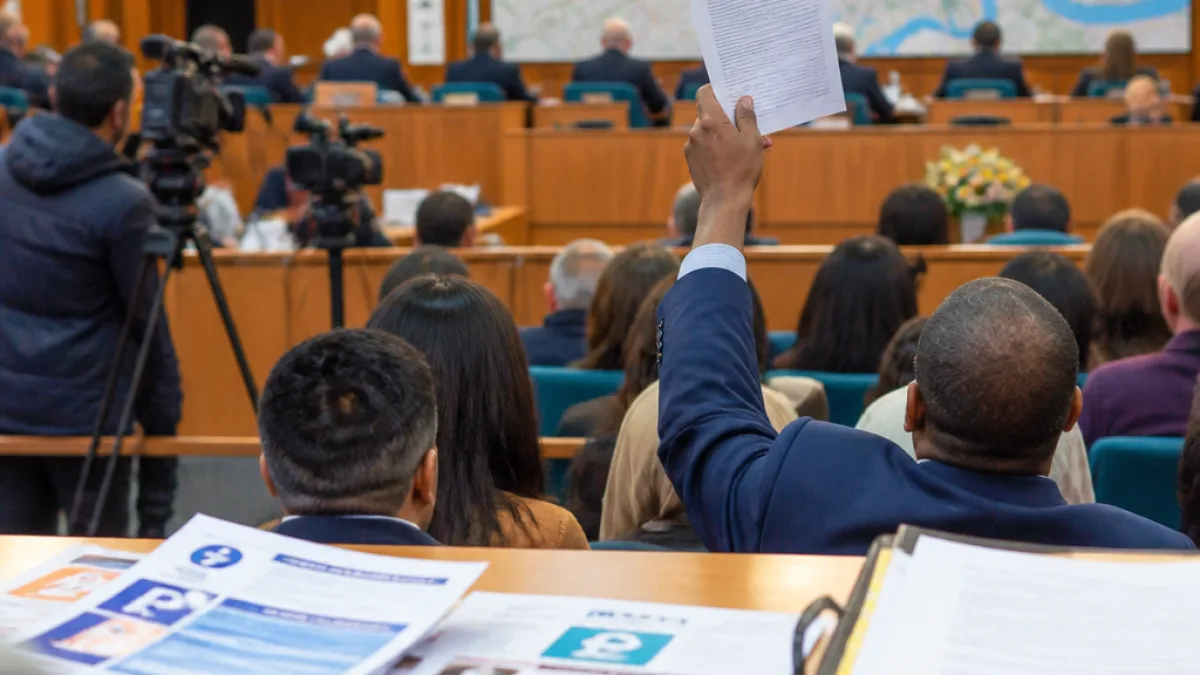
At a full Newham Council meeting this week, residents pressed the ruling Labour group on how its election pledge to introduce free parking in the borough would sit alongside London-wide transport and environmental policy set by the Mayor of London. Four written questions from residents flagged potential conflicts and called for clarity; the council’s cabinet member for roads supplied a standard legal reassurance rather than addressing specifics.
Residents seek clarity on legality and practicality
The Labour group campaigned this year on a package that included a promise of one free parking permit per household and one hour of free parking for residents across Newham. At the meeting, four residents submitted questions highlighting concerns about whether those changes would be compatible with ongoing Greater London transport objectives.
- Martin Warne drew attention to Mayor Sadiq Khan’s developing measures, including possible parking surcharges on larger vehicles, and argued that London policy is moving towards discouraging car use.
- Nina Schlautmann referenced the Mayor’s target for 80% of journeys in London to be made on foot, by bicycle or by public transport by 2041, asking how free parking aligns with that ambition.
- Shabina Sultana and Josephine Grahl asked whether changes to the borough’s emissions-based parking scheme would require City Hall approval, noting the scheme’s role within Newham’s Local Implementation Plan (LIP).
Council response focused on legal process
Councillor Susan Masters, Labour’s cabinet member responsible for roads, was not present at the meeting. In identical written replies, she did not set out how the pledge would be implemented or whether it had been discussed with City Hall. Instead, the responses reiterated a procedural point:
“The council and cabinet must take into account all relevant and material considerations so that any decisions they make are lawful.”
The written reply stops short of confirming whether proposals would require the Mayor of London’s approval or of explaining how the council would reconcile any divergence between local policy and the Mayor’s transport strategy. Concerns over compatibility with the LIP were raised by residents after other boroughs have faced legal scrutiny when making changes without needed clearance from City Hall.
What this means for Newham residents
The exchange highlights two immediate implications for residents:
- Policy uncertainty: the council has not publicly set out the legal or administrative route it would follow to introduce the proposed free permits and free hour, leaving open whether the measures can be implemented as pledged.
- Potential conflict with London targets: if proposals reduce costs for car use, they may not sit comfortably with the Mayor’s stated aim for a modal shift to walking, cycling and public transport by 2041.
| Issue raised | Detail |
|---|---|
| Free permit pledge | One free parking permit per household (Labour manifesto) |
| Free parking duration | One hour of free parking for residents (Labour manifesto) |
| Mayor’s target | 80% of journeys by foot, bicycle or public transport by 2041 |
Next steps and local oversight
For measures affecting on-street parking and emissions-based charging, the Local Implementation Plan provides a framework to deliver London-wide policies at borough level. Residents who asked questions at Monday’s meeting cited a recent case in Tower Hamlets where changes to low-traffic neighbourhood schemes met legal challenge because necessary approvals had not been secured.
Until the council publishes detailed proposals and any legal assessments or engagement with City Hall, questions about the practicality and legality of the free-parking pledge will remain unresolved. Councillors and residents will be watching for formal reports or cabinet papers that set out the operational, financial and regulatory implications of the promised changes.
The issue underlines a broader tension for local authorities that want to ease costs for households while also contributing to London-wide efforts to reduce car dependency and emissions. Newham residents seeking further clarity should expect the council to follow standard decision-making procedures, including impact assessments and potential consultation, before any changes are introduced.