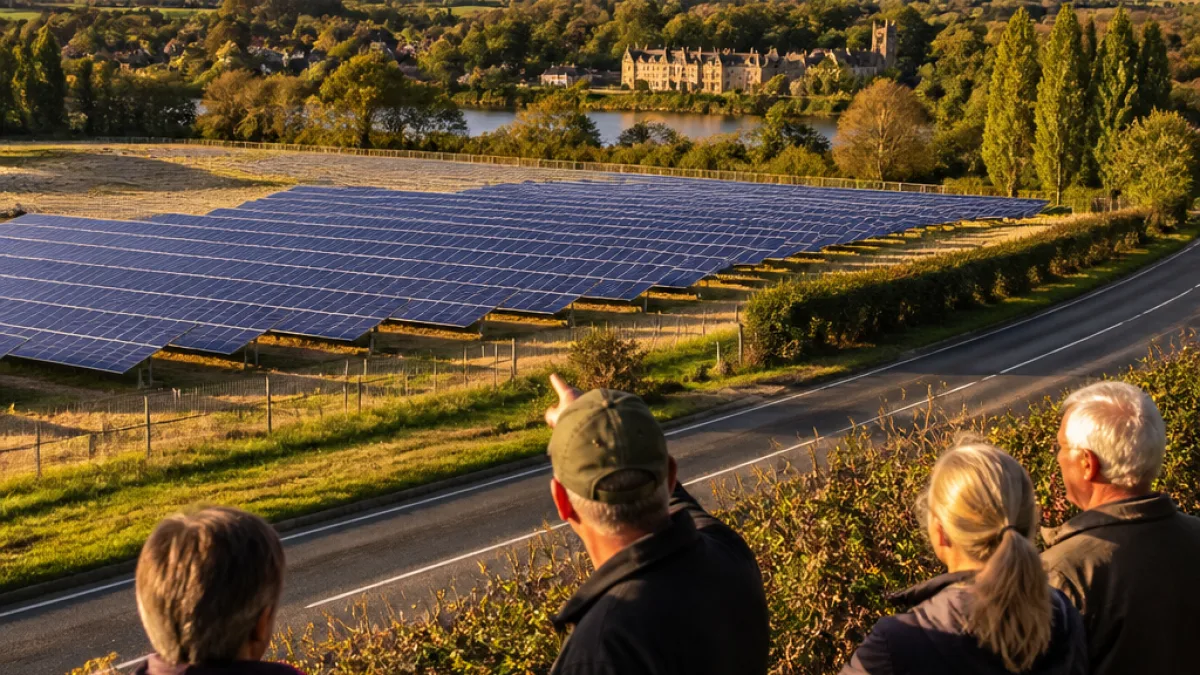
South Oxfordshire District Council has refused planning permission for a proposed 57‑hectare solar farm close to Nuneham Courtenay after councillors heard objections that the site would damage a landscape long celebrated for its artistic and historic associations.
Application and local concerns
The proposal, debated by the council's planning committee on 30 July, would have delivered up to 49.9 megawatts of generation during daylight hours — a capacity the applicant said could supply the equivalent of about 13,000 homes annually — and would have been consented for a period of 40 years.
The site lies northwest of Nuneham Courtenay adjacent to the A4074 and facing the recently built Cowley Road Solar Farm. It attracted sustained opposition from Nuneham Courtenay Parish Council, which argued the additional development would cause "cumulative harm" to the landscape together with the existing Cowley facility and substation, and would cause "substantial harm" to designated heritage assets.
"This site is not the difference between hitting net zero and missing it," said Mandy Rigault, chair of Nuneham Courtenay Parish Council. "Oxfordshire is not failing to pull its weight - it's already doing more than its share, and the same clean energy is being delivered elsewhere on a far bigger scale with far less harm."
Heritage and landscape objections
Speakers at the meeting highlighted the area's cultural significance. Malcolm Airs, Professor of Conservation and the Historic Environment at Oxford University, told councillors that while he recognised the urgent need for alternative energy sources, he considered the site unsuitable because of the degree of landscape change it would introduce.
"Quite simply, this is the wrong location for a massive solar farm that would totally destroy what Walpole called one of the most beautiful landscapes in the world," Professor Airs said.
A council planning officer advised members that the site occupies a position important in resisting the southward expansion of development from Oxford, citing the continuous extent of development in the area and pointing to nearby allocated sites and existing solar infrastructure.
Decision and implications
Committee members concluded that the adverse effects on landscape character and on designated heritage assets outweighed the benefits of renewable energy generation at this location. The refusal emphasises the planning balance local authorities must strike between the urgent national objective of increasing low‑carbon energy supply and statutory duties to protect historic landscapes and prevent urban sprawl.
- Site area: 57 hectares
- Proposed output: 49.9 MW (daylight generation)
- Estimated homes powered: 13,000 per year
- Permission sought for: 40 years
| Issue | Argument raised |
|---|---|
| Landscape | Would harm views and areas associated with JMW Turner and be cumulative with nearby solar development |
| Heritage | Potential substantial harm to designated heritage assets |
| Urban sprawl | Site considered important in preventing further southward expansion of Oxford |
| Renewable energy | Would contribute to local green energy but alternatives cited elsewhere |
The refusal does not prevent future proposals on different sites or amended schemes; it does, however, set a clear precedent for how the district council is weighing heritage and landscape considerations against renewable energy delivery in sensitive locations. For residents and campaigners on both sides of the debate, the decision is likely to influence subsequent planning applications across the district, particularly where large arrays sit close to historically important landscapes.
Further procedural steps — such as an appeal by the applicant — were not reported in the council summary of the meeting. The matter illustrates the tensions local planning authorities face in meeting national decarbonisation targets while conserving landscapes and heritage that inform community identity and cultural tourism.