
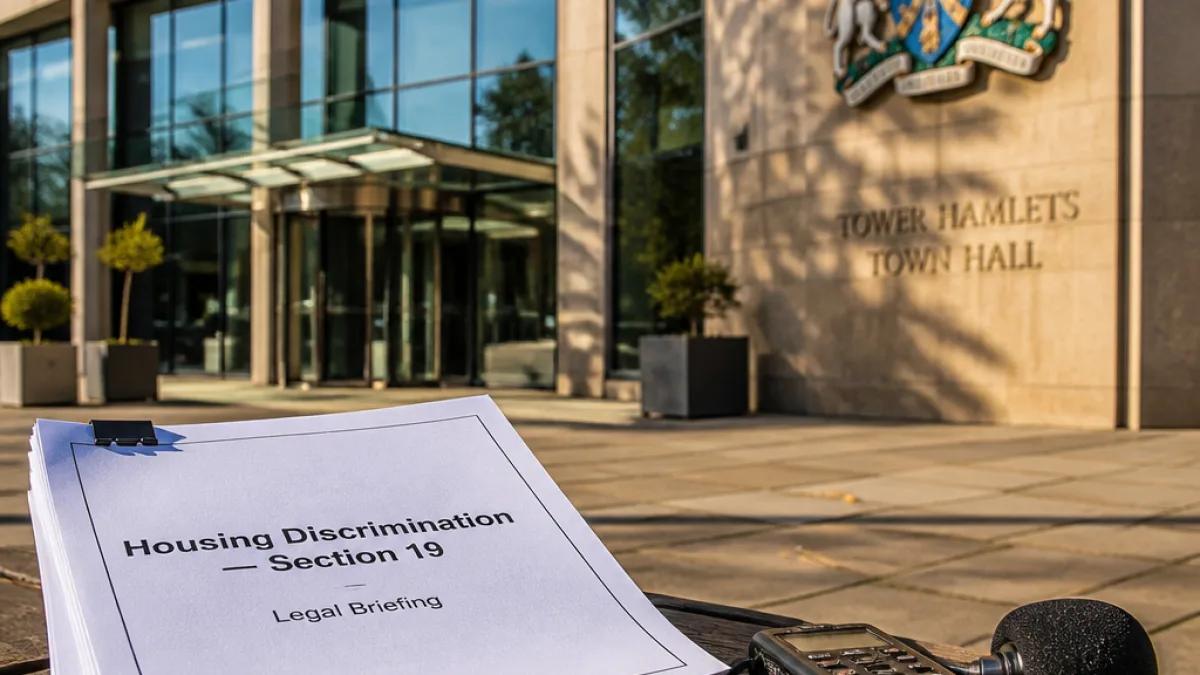
A new legal briefing focused on housing discrimination has placed the 2025 Court of Appeal judgment in Begum v London Borough of Tower Hamlets under the microscope, drawing out practical lessons for residents, landlords and local authority lawyers in the borough.
What the session covered
The discussion formed the seventh instalment in a series looking at key discrimination cases since the Equality Act 2010 came into force. Speakers Iris Ferber KC and Max Gordon considered the facts and implications of Begum, using the judgment to illustrate common pitfalls when advancing an indirect discrimination claim under section 19 of the Act.
Both speakers are established practitioners in the field. Iris Ferber KC specialises in employment, property and social housing litigation and took silk in 2023. Max Gordon maintains a busy civil practice with a focus on employment, contractual and property disputes and regularly appears across a range of tribunals and courts.
Key legal lesson for Tower Hamlets landlords and tenants
The podcast emphasised that an indirect discrimination claim can fail if the claimant selects the wrong provision, criterion or practice (PCP) to challenge. The Begum judgment was used as an example of how choosing an inappropriate PCP can undermine a claim, a point likely to matter in housing disputes where council policies, tenancy conditions or allocation rules are questioned.
- Case focus: Begum v London Borough of Tower Hamlets, Court of Appeal, 2025.
- Legal issue: How to present an indirect discrimination claim under section 19 of the Equality Act 2010.
- Practical consequence: Importance of correctly identifying the PCP relied upon in a claim.
"The case illustrates and explains the dangers of choosing the wrong ‘provision, criterion or practice’ operated by the landlord," the session summary states.
Context and wider series
The episode is part of a broader programme analysing influential housing discrimination decisions, including cases such as Akerman-Livingstone and Z v Hackney. The series aims to give senior legal professionals and practitioners a concise, practical guide to the authorities shaping current housing discrimination law — material that is of clear relevance to Tower Hamlets given ongoing pressures around social housing, allocations and tenancy management.
| Element | Detail |
|---|---|
| Speakers | Iris Ferber KC; Max Gordon |
| Series | Seventh podcast on housing discrimination cases |
| Principal lesson | Careful selection of the PCP in indirect discrimination claims |
For borough residents and those involved in housing administration, the discussion offers a timely reminder: legal outcomes may turn on precise drafting and the conceptual framing of challenges to policy. The podcast is aimed at legal professionals but its practical findings are of direct consequence to anyone engaged in housing disputes involving equality law.