Small businesses face growing cyber risks as criminals change tack
Small and micro businesses are increasingly in the crosshairs of cybercriminals, as attackers shift away from heavily fortified institutions towards organisations with leaner security resources. That is the clear warning from industry practitioners who say that practical preparation—ranging from robust backups to staff training—now matters as much as any cutting-edge tool.
Mark Adams, who runs AYS Technologies Canada, a Milton-based firm advising companies on IT and cybersecurity since 2003, says the threat profile has evolved alongside defensive improvements made by larger organisations. In his words:
“The big players have learned how to adapt to the environment, so the criminals have had to go after smaller organisations. There are also more criminals doing this kind of thing now.”
Email remains the front door for many breaches
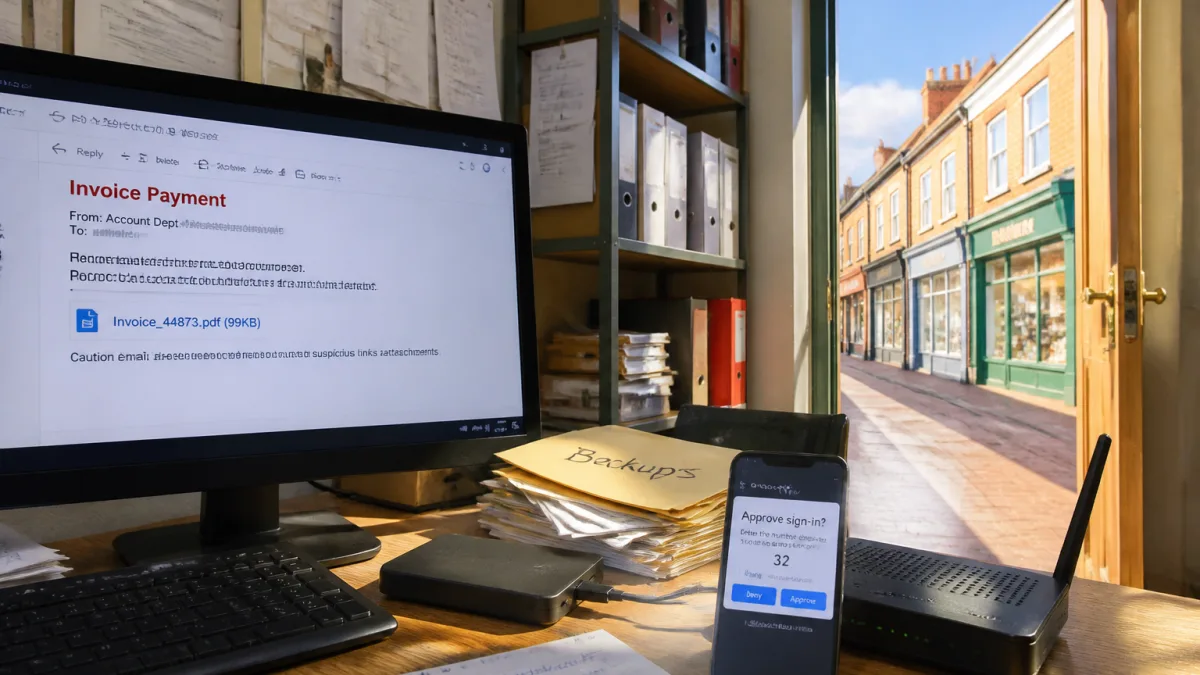
While attackers’ techniques continue to diversify, Adams reports that most compromises his team encounters originate in the inbox. Social engineering is often the first step: a convincing fake invoice, a message urging a user to open or upload a document, or a prompt to re-enter account details. Once a user interacts, intruders can gain a foothold—and in some cases, persistence—within back-end systems. As Adams explains,
“Criminals can’t just jump onto an organisation’s system—someone has to do something to allow them in.”
Attackers’ motives are typically financial. After an initial breach, they may attempt to alter payment details, redirect funds, or exfiltrate sensitive data to leverage further demands. Because such activity often resembles everyday business processes, it can be difficult to spot without layered controls and well-rehearsed response procedures.
AI cuts both ways: faster defences, sharper scams
Emerging technology is changing the tempo on both sides. Adams cautions that artificial intelligence is accelerating risks even as it strengthens defence.
“AI can help us mitigate these things, but it can also help the bad guys accelerate their reach and how well they can infiltrate our systems,”he says. That means more polished phishing emails, more targeted lures, and potentially more convincing impersonation, balanced by tools that can flag anomalies and aid rapid containment.
Four pressure points SMEs should prioritise
According to AYS, the present danger areas for smaller enterprises include vendor and supply chain exposure, identity takeover, and day-to-day access management. In practice, tighter discipline in these areas can markedly reduce risk:
- Vendor attacks: Compromise of a supplier can be a route into your systems. Treat external connections and shared platforms as potential entry points.
- AI-powered phishing: Better-written, context-aware lures increase the chance an employee clicks. Assume inboxes will be probed and prepare accordingly.
- Account compromise: Stolen or guessed credentials open doors quickly. Multi-factor authentication and password hygiene are critical.
- Employee access management: Excess permissions make breaches worse. Limit access to what staff need, review regularly, and revoke promptly when roles change.
Back to basics: training, backups and verification
Technical controls matter, but day-to-day habits can be decisive. Regular, scenario-based awareness training helps staff recognise and report suspicious emails. Verified call-backs for invoice or bank detail changes can block common frauds. And reliable, tested offline backups ensure that even if systems are encrypted or corrupted, a business can recover without capitulating to demands.
| Risk area | Typical entry point | First line of defence |
|---|---|---|
| Vendor attack | Shared portals/integrations | Vendor due diligence; least-privilege access |
| AI-enabled phishing | Email/social platforms | Staff training; email filtering; verification steps |
| Account compromise | Credential theft/reuse | MFA; unique passwords; rapid lockout |
| Excess access | Overbroad permissions | Role-based access; periodic reviews |
Preparedness over perfection
For many smaller operators, the objective is not perfect security but sensible resilience: assume mistakes will happen, limit how far intruders can move, and rehearse the first 24 hours of a response. Clear ownership of cyber hygiene, a simple incident plan, and relationships with trusted advisers can make the difference between a brief interruption and a protracted crisis.
As Adams puts it, attackers are ultimately looking for money and will go where the barriers are lowest. By raising those barriers—through basic controls, alert staff and tested recovery—small firms can narrow the window of opportunity, contain damage quickly, and keep trading with confidence.