Health officials sound alarm over takeaway hotspots
Bradford’s public health team has warned that parts of the district face an over-concentration of hot food takeaways, linking their prevalence to poorer health outcomes in the city’s most deprived neighbourhoods. The intervention came in a formal submission to Bradford Council’s planning department opposing a proposed outlet on Whetley Hill, which has since been refused.
In their advice to planners, the officers cited evidence tying the availability and consumption of fast food to elevated risks of obesity, diabetes and cardiovascular disease. They also pointed to wider research on the health burden created by diet-related conditions, and the knock-on impact on local NHS services.
“There is already an over-concentration of fast food take aways within the Bradford District,” the public health letter stated. “Latest data from 2024 shows there are 759 outlets within the district at a rate of 135.5 per 100,000 population. This compares poorly with the UK average rate of 115.92.”
Officers argued that approving further takeaways, particularly in communities already dealing with entrenched health inequalities, would undermine public health outcomes. They added that if Bradford matched the England average density, the district would have around 649 outlets — roughly 110 fewer than are currently operating.
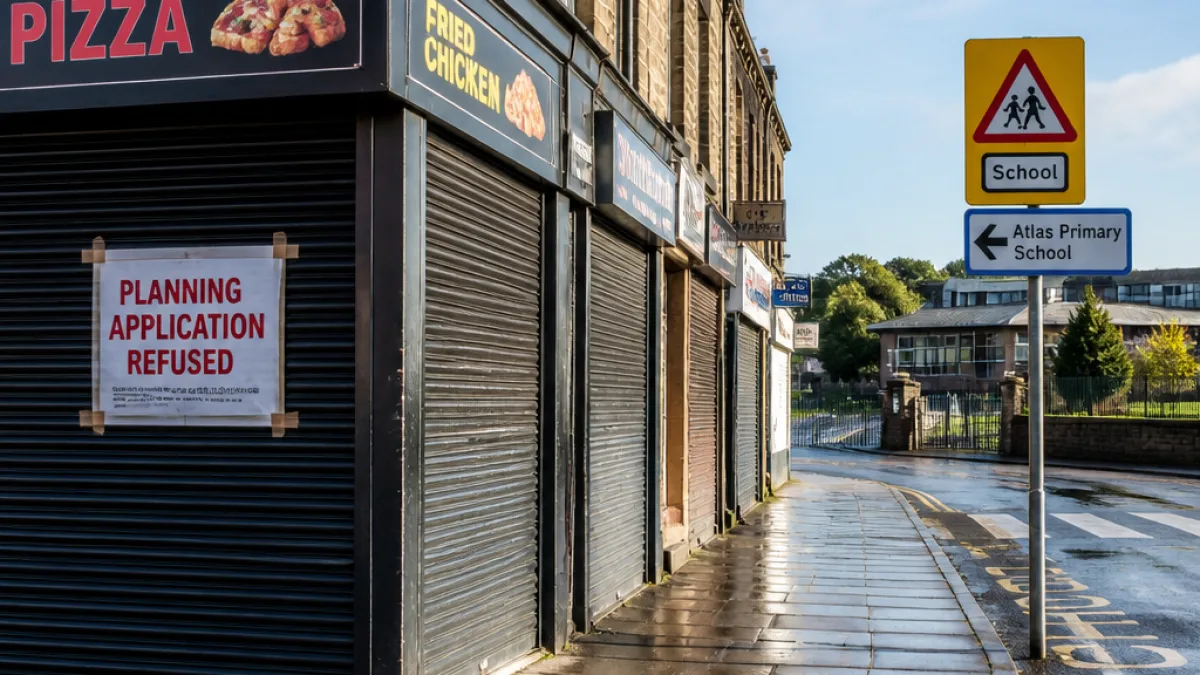
Planning refusal near Atlas Primary School
One of the key reasons for the Whetley Hill proposal being turned down was its proximity to Atlas Primary School, at approximately 40 metres away, according to the Local Democracy Reporting Service. Bradford Council has had a long-standing rule, introduced in 2014, preventing any new hot food takeaway from opening within 400 metres of a school, park, leisure centre or other facility used by children. The policy is intended to support healthier environments for children and young people by limiting easy access to calorie-dense, nutrient-poor options.
There are exceptions: the 2014 policy does not apply to designated “local centres”, which include Bradford city centre and recognised town and village centres. Outside those zones, however, planners have routinely applied the 400m buffer to resist proposals they consider incompatible with public health aims.
What the data shows
Public health officers emphasised the gap between Bradford’s takeaway density and national levels, and set out the broader health implications. They referenced national planning guidance that expects local decisions to help people live healthier lives, including by promoting access to healthier food, especially in areas with marked health inequalities.
| Measure | Bradford | National/Benchmark |
|---|---|---|
| Total outlets (2024) | 759 | — |
| Rate per 100,000 population | 135.5 | 115.92 (UK average) |
| If at England average density | ~649 | — |
| Difference vs current | 110 fewer | — |
Health research group Born in Bradford has previously described the city as being “flooded” with outlets selling unhealthy food, saying local children are consuming too much sugar and fat, while falling short on fibre, vitamin D, fruit and vegetables. Their findings have fed into policy debates about how the city environment shapes diet and long-term wellbeing.
Why it matters for communities
The council’s stance reflects growing concern that the clustering of takeaways in lower-income areas may be reinforcing health inequalities. While individual food choices remain personal, public health teams argue that environment and availability play a significant role, particularly around schools where young people can be drawn to cheap, high-calorie offers.
- Conditions linked to higher fast-food consumption include obesity, type 2 diabetes, metabolic syndrome, cardiovascular disease and cancer.
- High rates of preventable disease increase pressure on primary care and hospitals.
- Planning policy is one tool councils use to shape healthier high streets and protect children’s food environments.
National policy context
The officers referenced national planning policy which, they argued, expects decisions to support healthy lives by encouraging good health and preventing ill-health. In practical terms, they said, that includes ensuring communities — especially those with significant health inequalities — have better access to healthier food choices and are not unduly exposed to dense clusters of hot food takeaways.
While the city centre and other designated local centres remain exempt from the 400m restriction, the Whetley Hill decision underscores how the council weighs health evidence alongside commercial considerations in residential areas and near schools. The refusal suggests a continued readiness to apply the 2014 buffer where proposed takeaways risk cutting across the authority’s public health objectives.
The bottom line
With 759 outlets already trading — and a density significantly higher than the national rate — Bradford’s planners and health officials are signalling that new takeaway applications in sensitive locations will face close scrutiny. For families, schools and health services seeking to improve diet and reduce preventable illness, the latest decision near Atlas Primary School marks a clear statement of intent to keep takeaways at arm’s length from children’s daily routes.