Falkirk’s layered past on open display
Falkirk’s reputation as a place that constantly rewards the curious has been reinforced by new attention on the collections at Callendar House, where the town’s story is told through manuscripts, artefacts and film locations woven into everyday life. An archivist at the historic house and museum has described the work as a process of discovery that mirrors the area itself, where major chapters of Scottish history sit within easy reach of residents and visitors.
“Falkirk is a town of constant surprises,”
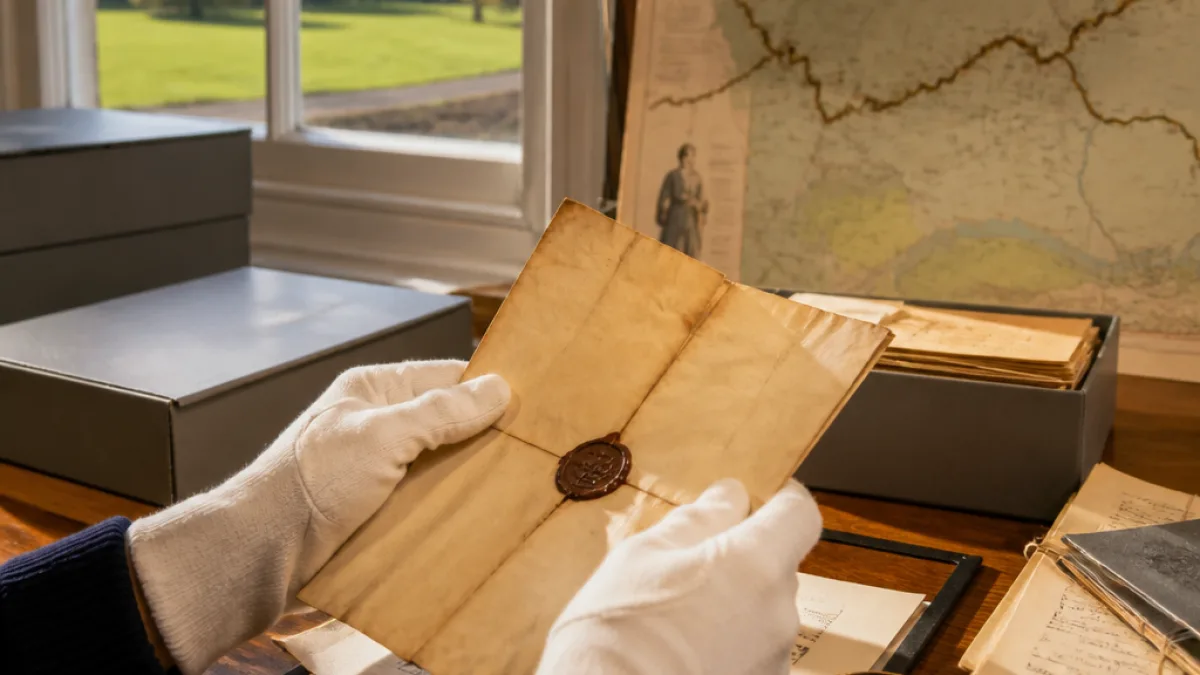
the archivist explained, adding that enquiries come from far afield and can open unexpected avenues of research. Among the recent finds was a letter bearing the signature of Sir Walter Scott, a reminder of the depth contained within the local holdings. That sense of immediacy is part of the draw: looking from the house, the line of the Antonine Wall can be traced; step to the other side of Callendar Park and the Union Canal is close at hand, its historic course altered long ago to preserve the vista from the estate.
From battlefields to bookshelves
The town’s past can be read in layers. Exhibits recount the defeat of William Wallace at the Battle of Falkirk, the later Jacobite success at the Battle of Falkirk Muir, and the final Jacobite victory at a second engagement near Falkirk linked with Bonnie Prince Charlie. Personal stories emerge from these wider narratives: Callendar House’s Earl of Kilmarnock supported the Jacobite cause while his son, Lord Boyd, stood with the British government—an intergenerational split that culminated in tragedy following Culloden.
For many, the museum’s strength lies in how it moves from national events to individual lives and back again. The archive’s range—spanning correspondence, local records and domestic spaces—gives context to the political fractures that ran through families and communities in Falkirk and beyond.
On-screen settings and a working house
Callendar House has also found a place in contemporary culture through filming. Its Georgian Kitchen has become a familiar set to fans of period drama, a space where costumed storytelling meets the tangible textures of an 18th-century interior. The production work has left its own folklore. A prop connected to a beheading scene became the stuff of an in-house prank after filming wrapped, a wry footnote illustrating how the heritage site remains a lived environment as well as a collection of rooms and cases.
Amid the scholarship and staging there are lighter moments. Staff and regulars speak fondly of a visiting retriever known locally for his punctual appearances at reception, adding a touch of routine warmth that softens the thresholds between museum and community.
Why this matters for Falkirk
As a focal point for research, exhibition and filming, Callendar House underpins Falkirk’s cultural identity and visitor economy. Its proximity to nationally significant assets—the Antonine Wall and the Union Canal—strengthens a compelling proposition: substantial heritage in a compact, walkable setting. For residents, the archive’s work helps to preserve the civic record and invite new perspectives on familiar streets. For visitors, it offers a primer on central Scotland’s strategic crossroads, told through original sources and carefully curated displays.
Those who arrive expecting a single attraction often leave tracing connections: from Roman frontiers to waterways, from Jacobite politics to literary circles. As the archivist noted, you rarely know what you will uncover until you start looking—an observation that suits a town that wears its stories openly yet continues to surprise.
Highlights at a glance
- Callendar House: Historic mansion with museum galleries, working-period kitchen and an active archive.
- Antonine Wall: Roman frontier earthwork visible from the estate grounds.
- Union Canal: Historic waterway diverted historically to preserve the house’s outlook.
- Jacobite history: Exhibits on Falkirk’s battles and the divided loyalties of the era.
- On-screen heritage: Filming location that brings period drama into a real domestic setting.
Key locations and context
| Site | Notable detail |
|---|---|
| Callendar House | Archive discoveries, museum galleries and Georgian Kitchen set-piece |
| Antonine Wall | Roman frontier line visible from the grounds |
| Union Canal | Historic diversion to preserve the estate’s view |
| Falkirk battlefields | Sites connected to Wallace’s defeat and Jacobite victories |
Practical takeaways
For anyone in central Scotland, Falkirk offers a compact itinerary where major historical themes converge within a short radius. A single visit can cover archaeology, military history, domestic life and modern screen culture, anchored by an archive that continues to surface new material. That blend, and the informality with which the town shares it, help explain why Falkirk remains a frequent source of pleasant surprise for first-time and returning visitors alike.