
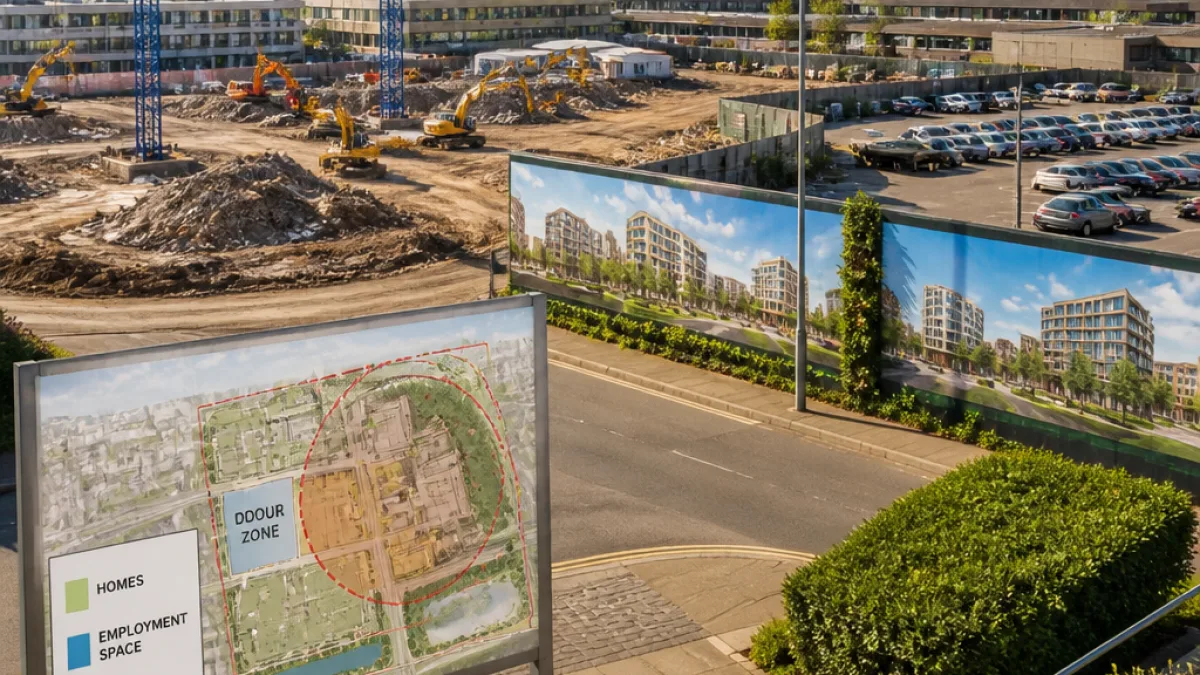
Outline masterplan submitted for large-scale redevelopment
The Crown Estate has submitted an outline masterplan to Cambridge City Council to redevelop Cambridge Business Park, the site off Milton Road that currently hosts a mix of offices and tech facilities. The papers describe a mixed-use scheme that could deliver around 173,500 sq m (about 43 acres) of commercial employment space alongside new housing and local amenities.
Homes, height and employment: the scheme in brief
Under the application, the number of homes proposed depends on whether an existing environmental restriction linked to the nearby water treatment works remains in place. The council submission sets out two scenarios:
- If the odour zone stays: between 210 and 315 homes could be delivered.
- If the odour zone is removed: the site could accommodate up to 500 homes.
The plans also allow for taller buildings than present on the site: commercial blocks of up to nine storeys and residential blocks reaching up to 12 storeys are proposed. The application signals a phased approach, with existing buildings either demolished, refurbished or retained depending on future requirements.
Developer says scheme will boost jobs and local offer
Matthew Sampson, speaking for The Crown Estate, characterised the masterplan as a means to grow local employment and support innovation businesses while opening the park up to residents with shops and restaurants. He framed the project as one that would create space for start-ups and provide a strong offer for established firms seeking new premises in the city.
"Our outline masterplan application serves as a blueprint for achieving these aims for the park's future, proposing a mixed-use development that supports purpose-driven innovation and opens up the park to local people with a variety of shops, restaurants and amenities."
Context: why the odour zone matters
The potential scale of housing is affected by the presence of an odour-management zone connected to a planned relocation of Anglian Water’s Cambridge treatment works. That relocation was cancelled after the Ministry of Housing judged it unaffordable, and the retention of the odour zone has constrained how intensively land near the works can be developed.
What this could mean locally
If approved, the redevelopment would be one of the largest changes to employment land in Cambridge for some time. The scheme aims to deliver modern lab, office and flexible workspace tailored to the innovation cluster, while also introducing residential capacity near a major employment hub. Key local impacts include:
- Increased provision of purpose-built space for research and technology businesses;
- A sizeable addition to housing supply, subject to odour-zone decisions and detailed planning;
- Transport, infrastructure and services pressures requiring careful mitigation through planning conditions and section 106 obligations.
| Feature | Proposed |
|---|---|
| Employment space | ~173,500 sq m |
| Homes (with odour zone) | 210–315 |
| Homes (without odour zone) | Up to 500 |
| Maximum storeys | Commercial up to 9, Residential up to 12 |
The Crown Estate, which manages a national portfolio and holds assets on behalf of the monarch for the duration of each reign, will now await the council’s validation and the formal planning process. Officers and local councillors will need to weigh the economic benefits against concerns over scale, impact on neighbouring areas and infrastructure capacity. Interested residents and organisations will have the opportunity to comment once the council opens the consultation on the submitted documents.