Council and unions align on language at work
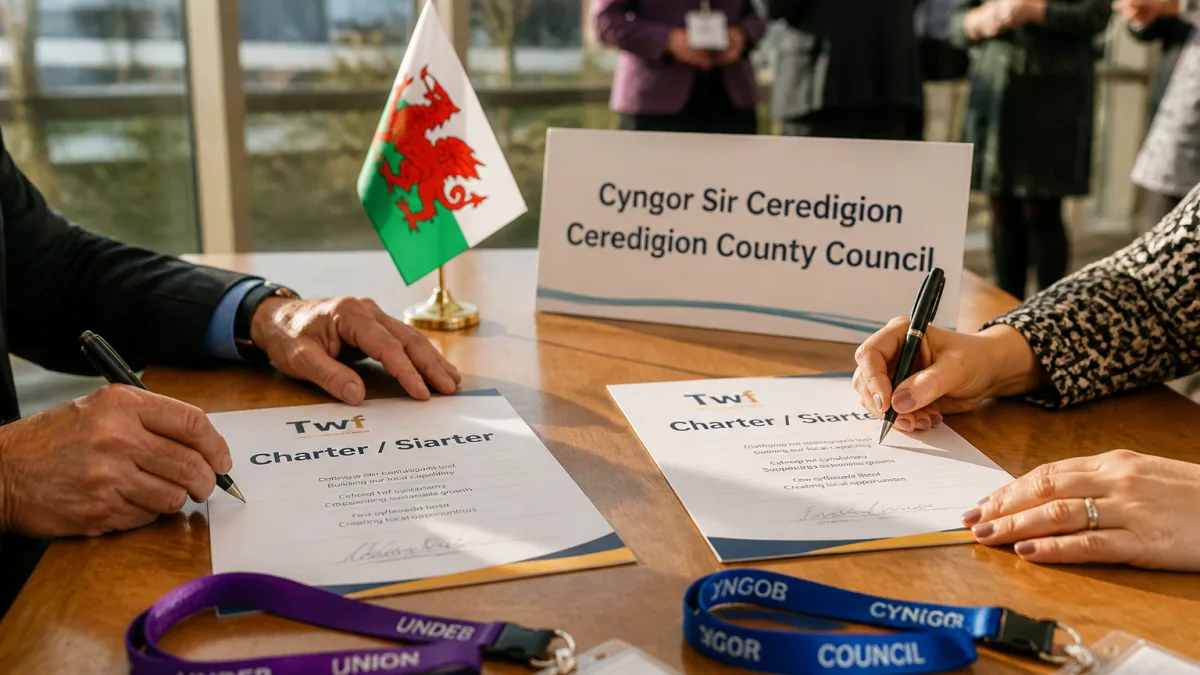
Ceredigion County Council has formally signed the TUC Cymru Twf Charter – a workplace framework designed to normalise and strengthen the use of the Welsh language across organisations. The step, taken at a signing event with trade union partners, cements a shared commitment to help staff use Welsh more confidently as part of everyday working life.
The Charter, developed and led by TUC Cymru, promotes a collaborative approach between employers, employees and unions. By adopting it, the Council is building on existing efforts to support Welsh in internal communications, staff development and routine interactions across teams.
What the Charter changes
Although not a statutory instrument, the Twf Charter offers a practical structure for making Welsh a natural feature of the workplace. According to the Council, the agreement sets expectations that Welsh will be encouraged, heard and recognised as a routine skill, rather than an add‑on. The focus is on day‑to‑day support: from beginners seeking to start using Welsh, to fluent speakers who want more opportunities to use it confidently at work.
- Support for staff who speak Welsh, are learning, or want to start using it in their roles.
- Recognition of Welsh as a workplace skill integral to daily activity.
- Cultural shift so Welsh is heard and used naturally across services and teams.
Leaders framed the Charter as a practical tool for creating positive work environments where Welsh can thrive through partnership with unions.
“We are proud to sign the Twf Charter and to reaffirm our commitment to supporting Welsh as a natural part of working life at Ceredigion County Council. The Welsh language belongs to everyone, whether staff are fluent speakers, learners, or keen to begin using more Welsh at work. By working in partnership with our trade unions and TUC Cymru, we can continue to create an inclusive workplace where staff are encouraged and supported to use and develop their Welsh language skills.”
That was the message from Councillor Bryan Davies, the Council Leader, who linked the Charter to a longer programme of support for the language across the workforce.
“I am very pleased that the Council and the Trade Unions have agreed to co-sign this Charter, as every step towards creating a workplace culture where Welsh is heard more often is an important one. The workplace is a valuable environment for raising awareness of the Welsh language and for providing opportunities to use and practise it, both i
Councillor Catrin MS Davies, Cabinet Member for Culture, Leisure and Customer Services, said the agreement underscores the value of workplaces as everyday spaces where language skills can be nurtured.
How the framework will work
The Twf Charter is designed to be delivered jointly by management and unions, making it easier for staff at all levels to access learning routes and use Welsh without hesitation. It sits alongside the Council’s ongoing internal work to encourage bilingual communication and create more opportunities for Welsh to be used in meetings, customer-facing interactions and routine correspondence where appropriate.
In practice, this could mean more visible prompts to use Welsh, stronger pathways for staff training and mentoring, and clearer recognition of Welsh ability in job roles. While the Charter focuses on the workforce, residents may notice the effects where front-line teams feel more confident to offer and use Welsh in day-to-day contact.
At a glance: key commitments
| Area | Commitment | Who is involved |
|---|---|---|
| Staff support | Encourage speakers and learners to use Welsh at work | Council and trade unions |
| Skills recognition | Treat Welsh as a valuable, everyday workplace skill | Employers and employees |
| Culture | Foster environments where Welsh is heard and used daily | All teams |
Why it matters locally
For a county where Welsh carries significant cultural and community importance, a unified approach between the Council and unions can make a tangible difference to how language is learned, shared and normalised at work. The Charter signals sustained backing for staff who want to develop their skills, and it places responsibility on the organisation as a whole to create space for Welsh to be used meaningfully—not just in formal settings but in everyday exchanges.
By embedding expectations and support within a recognised framework, the Council aims to reduce barriers faced by learners, grow confidence among fluent speakers, and expand the occasions where Welsh is used. Over time, that can help ensure more consistent access to Welsh in internal and public-facing contexts, depending on role and service need.
What happens next
The signing indicates the start of a shared work programme with unions rather than a one-off gesture. The Council has signalled that it will keep building on measures already in place—supporting learning, recognising skills, and creating a culture that brings Welsh into everyday routines. Progress will rely on practical steps: targeted support for staff, visibility of bilingual resources, and line‑management backing so teams feel confident using Welsh where it fits their work.