Roundtable puts Orthodox community concerns before MPs in Parliament
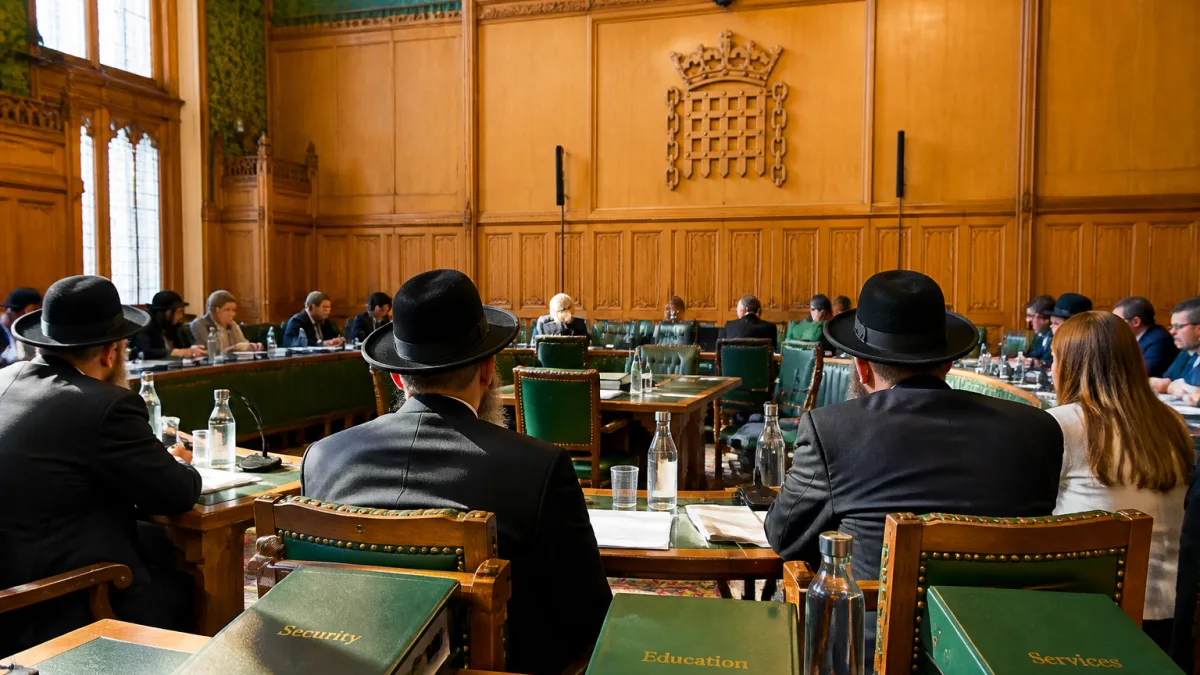
Senior representatives of the UK’s Charedi (Orthodox Jewish) community have set out a detailed account of the day-to-day challenges facing families and communal services at a high-level meeting in Westminster. The discussion, hosted by the Interlink Foundation in the House of Commons’ historic Committee Room 15, brought together ministers, MPs and community organisations to focus on security, education and access to public support.
Motty Pinter, Interlink’s Director of Communal Affairs, underscored the purpose of the session, stressing that leaders wanted proportionate policy responses grounded in lived experience rather than preferential treatment. In his words:
“The Charedi community is not asking for special treatment, but for practical and fair solutions that allow our families to live safely, educate our children, and access the same support as everyone else.”
He added that constituency MPs heard directly from organisations delivering services on the ground, and called for that understanding to be translated into urgent action across government.
Who was in the room
A cross-party group of parliamentarians attended the Westminster meeting, reflecting constituencies with significant Jewish populations as well as broader interest in community safety and service provision. MPs present included:
| MP | Constituency |
|---|---|
| Sarah Sackman | Finchley and Golders Green |
| David Lammy | Tottenham |
| Mark Ferguson | — |
| Dan Tomlinson | Chipping Barnet |
| David Pinto-Duschinsky | Hendon |
| Christian Wakeford | Bury South |
| David Burton-Sampson | — |
Interlink convened a broad coalition of communal bodies to brief MPs, among them the Union of Orthodox Hebrew Congregations, the Federation of Synagogues, Chinuch UK, Agudas Israel Housing Association, Hatzola, Shomrim, Chaverim, Bikur Cholim and Chevra Kadisha services.
Security and everyday services at the forefront
Security featured prominently in the discussion. Community safety volunteers from Shomrim outlined how they support residents and work alongside the authorities, responding to antisemitic incidents, missing-person cases, burglaries and welfare issues. Leaders sought recognition of the operational demands faced by local responders and the pressures on families that follow from heightened security concerns.
In parallel, service providers described the pressures on education, health and social support within growing Orthodox communities. Speakers stressed the need for policy frameworks that are practical and fair, ensuring that Orthodox families can access mainstream support in ways that are workable on the ground. Organisers framed the session as an opportunity for MPs to examine how current policies are affecting real households and essential services in real time.
- Security: volunteers and community groups reported increased demands linked to antisemitic incidents and neighbourhood safety.
- Education and family support: organisations emphasised the importance of access to statutory services that fit practical needs.
- Partnership working: attendees urged closer engagement between government, MPs and community providers.
Parliamentary engagement in Westminster
The meeting formed part of ongoing engagement between Orthodox communal organisations and Westminster policymakers. By convening leaders and MPs in the Commons, Interlink aimed to bridge the gap between casework and policymaking, allowing parliamentarians to test how policies play out for families and the services that support them.
Attendees said the session offered a consolidated view of the pressures facing a growing Charedi community nationally, from safeguarding and schooling to housing and emergency response. The organisers framed the objective as not to secure exceptions, but to ensure that existing systems can function equitably for all, including Orthodox families.
Next steps
Community leaders called for clarity on follow-up within Whitehall and Parliament, seeking to turn discussion into delivery. As Pinter put it, the focus now is on converting the information shared at Westminster into concrete steps across government departments. While no formal commitments were announced in the room, the emphasis on practical solutions and equitable access suggests further exchanges between MPs, ministers and service providers in the coming weeks.
For Westminster observers, the roundtable illustrates how constituency-driven concerns can be channelled into the legislative and policy conversation. By presenting operational realities directly to decision-makers, community groups are pressing for adjustments that improve safety, service access and accountability without recasting the principle of equal treatment under the law.