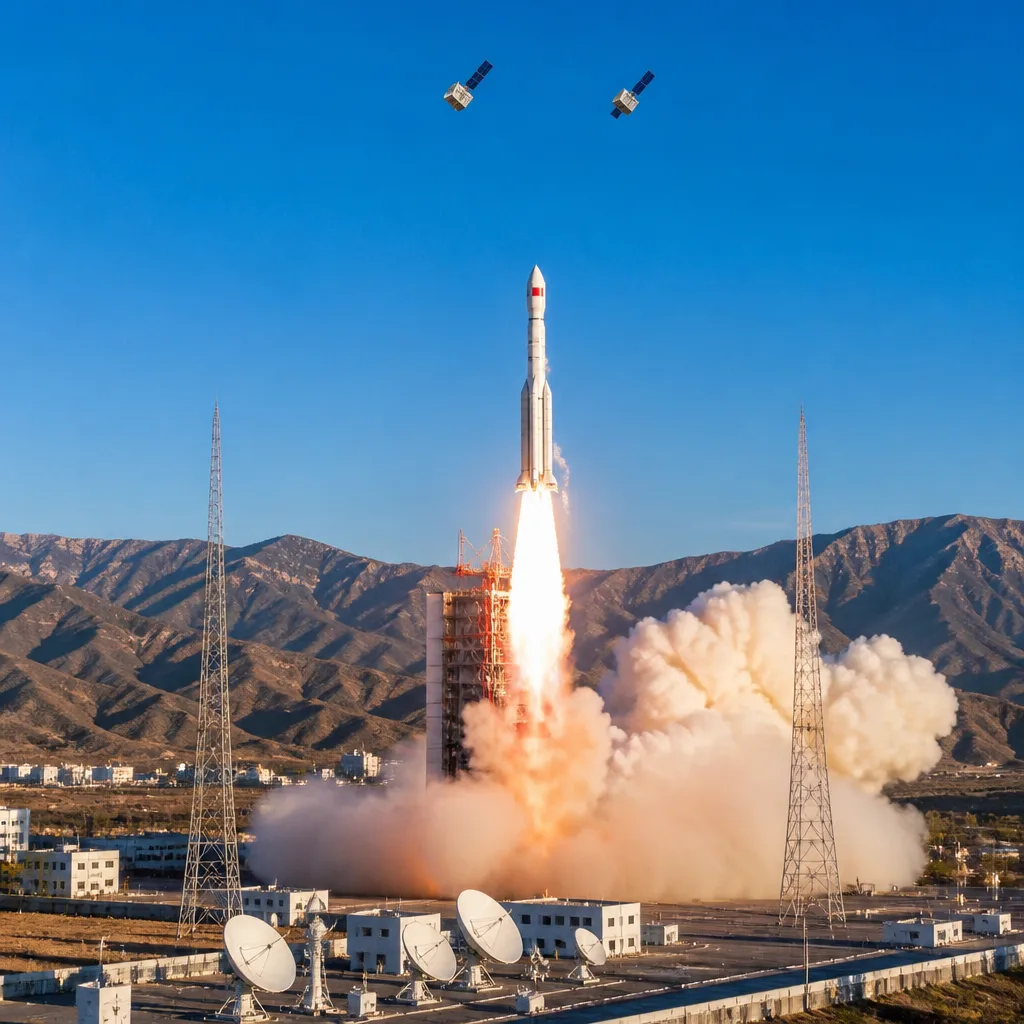
China launched two satellites designed to test communications technologies from the Taiyuan Satellite Launch Center in Shanxi Province on 30 July. A modified Long March-6 medium‑lift rocket departed at around 09:00 and successfully inserted the pair into their planned orbits, according to official reports.
What the satellites will do
The newly deployed spacecraft are intended primarily for satellite communications, television and broadcasting, and data transmission. In addition to providing services, they will be used to carry out a series of technology tests and verification activities to prove systems and payload performance in orbit.
- Communications links for voice and data services
- Broadcasting and television transmission experiments
- On‑orbit technology validation and verification
The launcher and its capabilities
The rocket was developed by the Shanghai Academy of Spaceflight Technology and is described as a new‑generation, medium‑lift vehicle suited to dense launch campaigns. Published specifications note the vehicle can deliver at least 4.5 tonnes to a sun‑synchronous orbit at roughly 700 kilometres altitude. The successful mission represents the 660th flight for the Long March family of carrier rockets.
| Item | Detail |
|---|---|
| Launch vehicle | Modified Long March-6 |
| Operator / developer | Shanghai Academy of Spaceflight Technology |
| Lift-off time | About 09:00 (30 July) |
| Payload capacity (to SSO, ~700 km) | At least 4.5 tonnes |
| Long March series flight number | 660th mission |
Why this matters
Test satellites and frequent launch capability serve multiple functions: validating new communications equipment in the space environment, expanding service capacity for broadcast and data links, and demonstrating the operational readiness of launch systems. The combination of a medium‑lift rocket able to support "high‑density" launch requirements and satellites focused on communications underlines a continued emphasis on growing orbital infrastructure.
While the immediate mission is described as technological verification, the activities feed into broader patterns: iterative satellite upgrades, more frequent constellation deployments and a steady tempo of national launch activity. For operators and regulators elsewhere, such missions affect spectrum coordination, orbital slot planning and the competitive landscape for satellite services.
The mission was reported as successful in placing both spacecraft into their planned trajectories. Further details about the satellites' specific payloads, operators or scheduled testing timelines were not provided in the initial announcement.
InfoRadar Technology