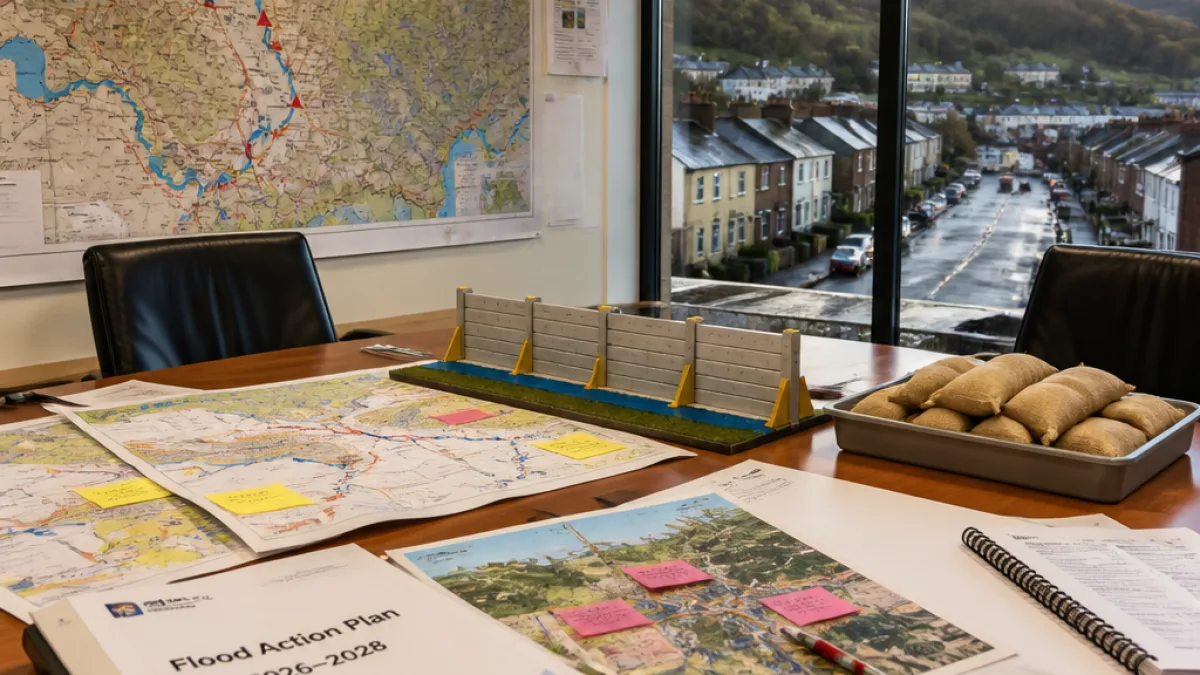
Rhondda Cynon Taf Council has approved an updated Flood Action Plan (2026–2028) to work alongside its existing Local Flood Risk Management Strategy, setting out short‑term priorities and a more adaptable approach to managing flood risk across the county borough.
Why the plan has been revised
The council, which acts as Lead Local Flood Authority for matters such as surface water, ordinary watercourses and groundwater, is required to refresh its action plan every two years. Cabinet considered officers’ recommendations at its meeting on 13 July after a two‑year progress review of the previous plan was presented to the Climate Change, Prosperity & Frontline Services Scrutiny Committee in June.
Officials told members that the review revealed the need for a plan that can respond quickly to real‑time flood events while still progressing longer‑term schemes. Storm response and recovery work, they said, can alter the sequence and pace of planned mitigation projects, so flexibility has become a key theme for 2026–2028.
Who does what when the water rises?
The paper to Cabinet reiterated how responsibilities are shared across organisations involved in flood risk:
- Rhondda Cynon Taf Council – lead local authority for local flooding from surface water, ordinary watercourses and groundwater; duty to develop and monitor the local strategy and action plan.
- Natural Resources Wales – responsible risk management authority for flooding from main rivers.
- Welsh Water – responsible for managing sewer flooding risk.
| Organisation | Primary responsibility |
|---|---|
| Rhondda Cynon Taf Council | Local sources: surface water, ordinary watercourses, groundwater |
| Natural Resources Wales | Main river flood risk |
| Welsh Water | Sewer flooding |
What this means for residents
The refreshed plan is intended to keep council activity and investment focused on the areas most at risk, while building in the capacity to adapt priorities after storms or other incidents. That approach is designed to ensure that post‑event learning directly informs the sequencing of future relief schemes and operational responses within the two‑year period.
For communities who have faced flooding before, the changes mean the council is committing to a rolling process of review and adaptation rather than a fixed timetable that cannot respond to emerging incidents. The current Strategy runs to 2030, with action plans updated biennially; this latest update replaces the previous 2024–2026 action plan.
Next steps and practical points
- The Cabinet report concluded that flexibility and adaptability would be central to delivering flood work over the next two years.
- Residents should continue to report local flooding concerns to the council so that real‑time events feed into future priority setting.
- Flood alleviation schemes and operational responses may be re‑sequenced in light of storm events and recovery efforts.
The council’s decision keeps flood risk management under regular review and aims to ensure that limited resources are targeted at the places most likely to be affected as climate pressures continue to change the local risk profile.