Article 4 plan aims to safeguard jobs and investment
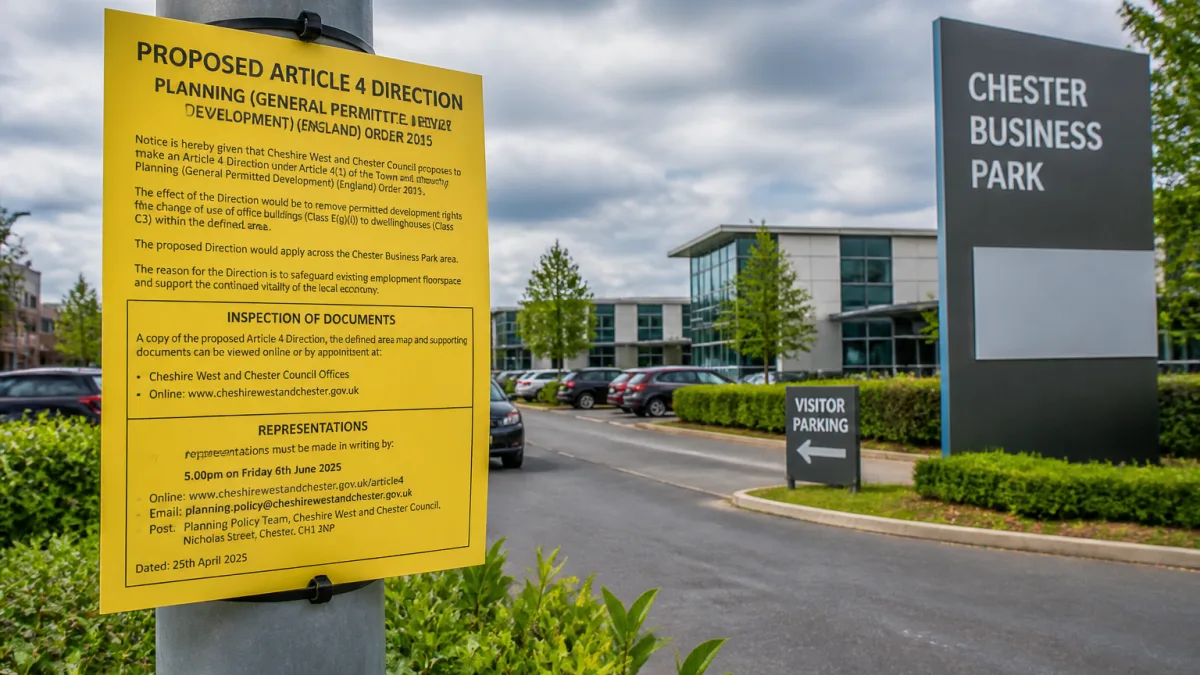
Cheshire West and Chester Council is preparing to restrict automatic office-to-residential conversions across three of the borough’s most important employment locations, citing the risk of losing valuable workspace to housing. The authority intends to introduce Article 4 Directions for Chester Business Park, Sealand Industrial Estate and Gadbrook Park.
The proposed measures would remove permitted development rights that currently allow offices to be turned into homes without a full planning application. Instead, developers would need to seek permission in the usual way, giving the council the ability to weigh economic impacts, design quality and local infrastructure needs before any change of use proceeds.
Together, the three sites provide around 1.57m sq ft of employment floorspace and support more than 6,500 jobs. A report going to cabinet this week warns that the combination of relatively low office capital values and continuing demand for housing could encourage further loss of commercial space unless stronger controls are put in place.
Residential development in these strategic employment locations could result in “wholly unacceptable adverse impacts for local businesses and limit new investment opportunities”.
The report continues that there is also a need to ensure any housing is planned in a way that fosters cohesive communities and meets recognised space standards, standards that are not always secured through permitted development.
Example at Gadbrook Park highlights council’s concern
The case for tighter control is illustrated by Octagon House at Gadbrook Park in Northwich, where a prior approval has allowed conversion to 66 flats under existing permitted development rules. While legal, such conversions can reduce the supply of modern workspace in well-connected business locations, potentially displacing firms and constraining growth.
The council argues that these sites are strategic to the borough’s economy and should not be eroded without a transparent assessment of impacts on jobs, transport, services and the wider business ecosystem. Similar protections are already in place elsewhere, including an Article 4 covering office-to-residential changes across Manchester city centre.
What an Article 4 Direction would change
- Removes automatic permitted development for office-to-residential conversions at the named sites.
- Requires a full planning application, allowing conditions to be set or proposals to be refused where harms outweigh benefits.
- Supports the council’s objective to retain a balanced supply of employment land alongside planned housing growth.
If approved by cabinet on Thursday, the Directions would be confirmed to take effect after a 12-month notice period. During that time, the council would notify stakeholders, and any prior approvals submitted before the Direction comes into force would continue under current rules.
Sites covered and role in local economy
| Employment location | Role |
|---|---|
| Chester Business Park | Regional office hub for major employers serving the Chester area and wider North West. |
| Sealand Industrial Estate | Mixed industrial and commercial estate supporting a range of local firms. |
| Gadbrook Park, Northwich | Business park with significant office stock; location of Octagon House conversion. |
Planning consultancy Iceni has supported the council in compiling the evidence base for the Directions. That evidence underpins the policy case that protecting these locations is essential to sustain investment, safeguard existing employment and ensure future growth can be accommodated.
Context: balancing housing delivery and employment space
The move comes as councils across the country seek to reconcile increased housing need with the retention of high-quality employment land. While permitted development has delivered additional homes, it has also sometimes produced small units with limited amenities and reduced the supply of offices in precisely the places businesses want to be. Requiring a full application does not preclude residential schemes, but it allows the authority to secure better design, appropriate amenity and infrastructure contributions, or to refuse proposals where the economic impact would be too great.
Residents, businesses and developers will be able to follow the cabinet decision later this week and, if the Directions are confirmed, take part in the statutory process ahead of the 12‑month commencement. The council has indicated it wants to prevent a piecemeal loss of employment space that could undermine enterprise zones, supply chains and local jobs, while continuing to plan housing growth through the Local Plan process in suitable locations.