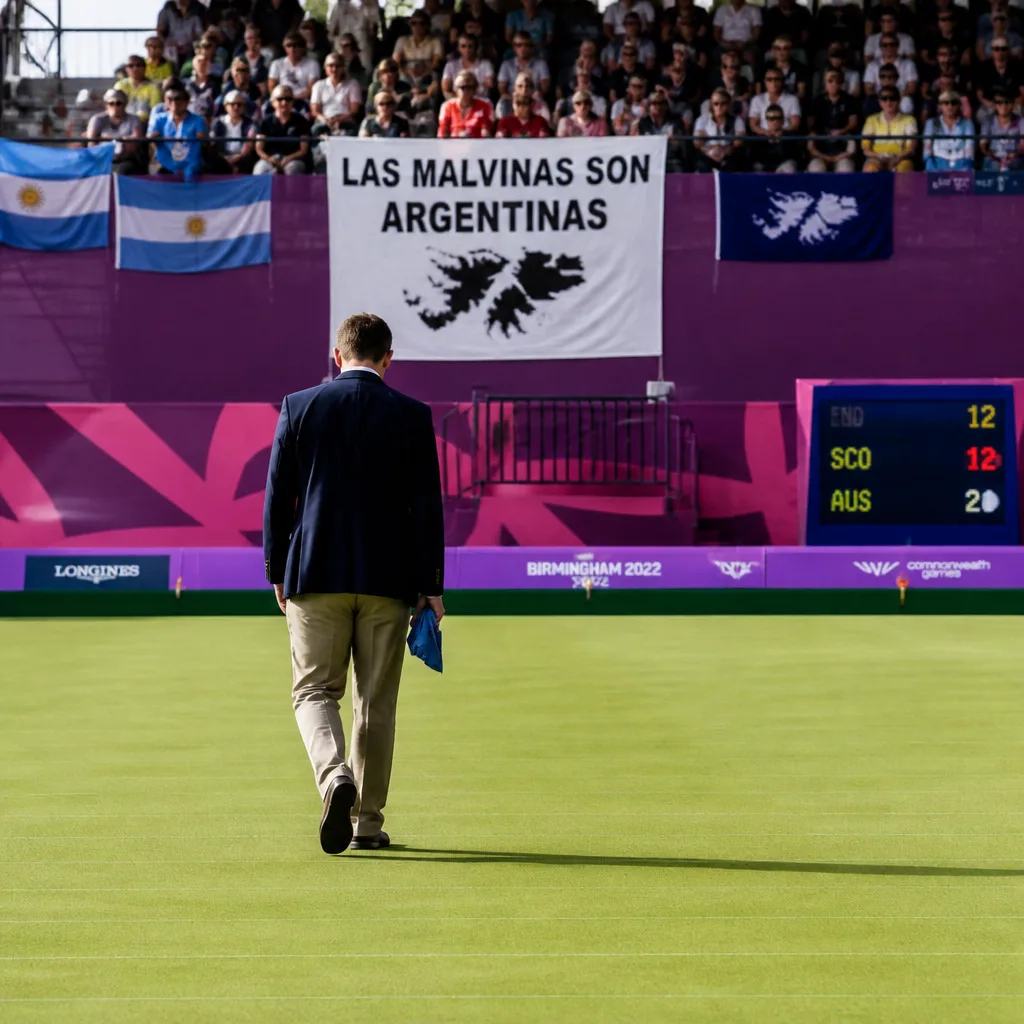
Cecil Alexander, a 45-year-old bowls player representing the Falkland Islands at the Commonwealth Games, said he was dismayed that Argentina’s World Cup team displayed a banner asserting its claim on the islands, describing the gesture as politicising sport.
What happened
Alexander made the remarks after losing his opening men’s singles match in straight sets to Izzat Shameer Dzulkeple of Malaysia. He expressed frustration that an international football celebration had referenced the long-running dispute over the South Atlantic territory known in Britain as the Falkland Islands and in Argentina as Islas Malvinas.
“It’s disappointing when politics gets mixed with sport,” Alexander said. “We are here to compete and represent our country. We keep politics out of it.”
Why it matters to the UK
The banner in question was shown by Argentina’s players after their semi-final victory over England at the World Cup. The episode reawakened diplomatic sensitivity around a dispute that led to the 74-day 1982 conflict. The human cost of that war remains a pointed reminder of how emotive the issue is on both sides.
| Casualties (1982 Falklands conflict) | Number |
|---|---|
| Argentinian fatalities | 649 |
| British fatalities | 255 |
Political response and the sporting body
In the aftermath of the World Cup incident, the former prime minister of the United Kingdom, Keir Starmer, was reported to have supported calls for Fifa to consider whether the display breached governing rules. A spokesperson for Starmer said publicly that while the global tournament did not belong to Britain, the Falklands did, and that the UK's commitment to the islanders' right to self-determination remains unchanged.
“The World Cup might not be ours, but the Falkland Islands definitely are. Our position is unchanged. Self-determination rests with the islanders and our commitment to the Falklands will never waver,” the spokesperson said.
Broader context and consequences
The incident illustrates how international sport can become a stage for national assertions. For residents and representatives of the Falkland Islands — a British Overseas Territory with its own local identity — symbolic acts at high-profile events can feel like attempts to influence perceptions of sovereignty. For the UK Government, such moments require careful diplomatic management while reaffirming commitments to the local population.
- Diplomatic sensitivity: Renewed attention on the islands risks straining relations with Argentina and could prompt formal protests or calls for investigation.
- Sporting governance: Fifa may face pressure to review whether political messages displayed by teams contravene tournament rules on political statements.
- Local perspective: Islanders and their representatives emphasise self-determination and the separation of politics from athletic competition.
Bowls, the sport Alexander plays, is one of the original programmes of the Commonwealth Games and is being contested indoors in Glasgow for the first time at this edition of the Games. Alexander, who moved to the Falkland Islands from South Africa eight years ago, said he values representing the territory and prefers to focus on competition rather than geopolitics.
The episode is a reminder that global sporting events can revive historical disputes long after they are settled on the battlefield. For British audiences, it underscores why the issue of the Falkland Islands remains both politically sensitive and personally resonant for those directly connected to the territory.