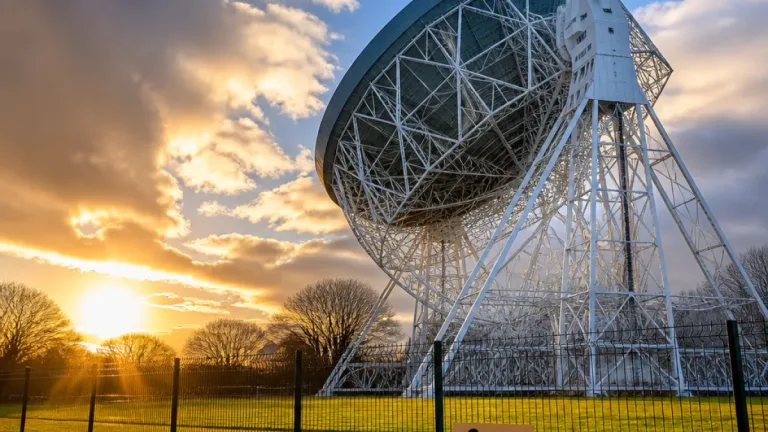
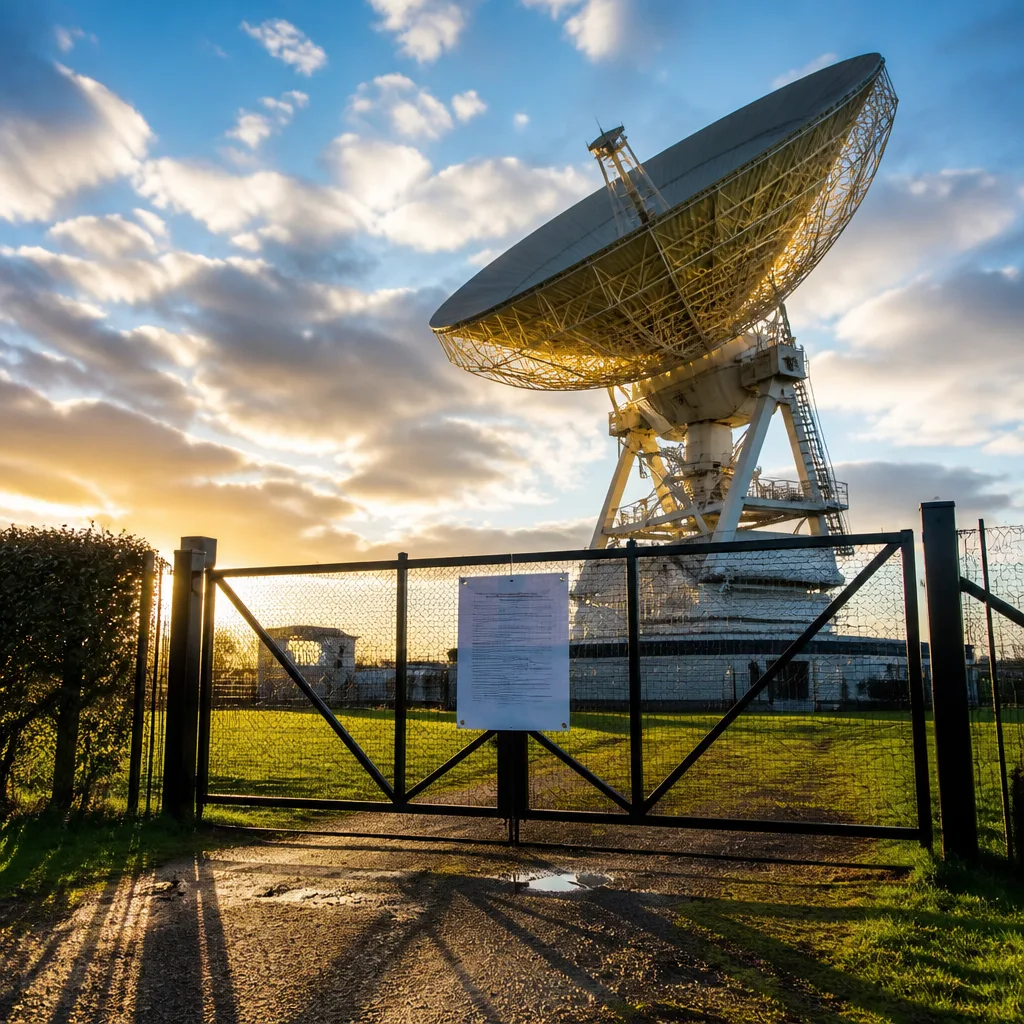
The Jodrell Bank Observatory in Cheshire, home to one of the world’s largest steerable radio telescopes and a fixture of British astronomical research for more than seven decades, faces possible closure after a decision to reduce its funding, the public body that oversees research finance has said.
UK Research and Innovation (UKRI) has indicated it must concentrate investment on projects it judges capable of delivering the “greatest long-term impact”. If the funding change proceeds as reported, the observatory would cease operations in April 2028.
Heritage site under financial pressure
Jodrell Bank’s Lovell Telescope and associated facilities have been central to the UK’s radio astronomy and have supported international collaborations for decades. The reported funding shift prompted an immediate response from the trade union Prospect, which warned the move would be deeply damaging to the country’s research ecosystem.
“Jodrell Bank is not just an iconic site in UK science in the North West of England, it is a facility that underpins our world leading research capabilities. Closing it would be a tragedy that undermines the mission for the UK to be a science superpower.”
Prospect’s senior deputy general secretary also described the cuts as potentially the beginning of a wider programme that could devastate public sector science and result in job losses among researchers. The union urged the incoming government—whose agenda emphasises regional growth—to reconsider before permanent harm is done.
Consequences and context
The prospect of losing Jodrell Bank raises several practical and strategic questions for UK science policy:
- Research capacity: the observatory supports ongoing scientific programmes in radio astronomy; closure would disrupt long-term projects.
- International standing: Jodrell Bank has been part of global collaborations—changes could affect the UK’s role in those partnerships.
- Regional impact: the site is a scientific and cultural institution in the North West, with local economic and educational links.
UKRI’s stated need to prioritise investments to maximise long-term impact sits against these concerns. The decision reflects the difficult trade-offs facing public research funders when budgets are constrained and strategic priorities must be set.
Timeline
| Item | Status |
|---|---|
| Reported funding decision by UKRI | Under way |
| Potential closure date | April 2028 |
Further details on the scale of the funding reduction, the specific programmes affected at the observatory and any mitigation measures have not been disclosed in the report. Stakeholders including academic partners, staff and regional representatives will be watching for formal announcements and any opportunity to appeal or propose alternative funding models.
The debate highlights the tension between targeted investment strategies by research funders and the value of maintaining long-established scientific infrastructure that serves both research and public engagement roles. How ministers and UKRI navigate that balance will have tangible consequences for the UK’s scientific landscape.