
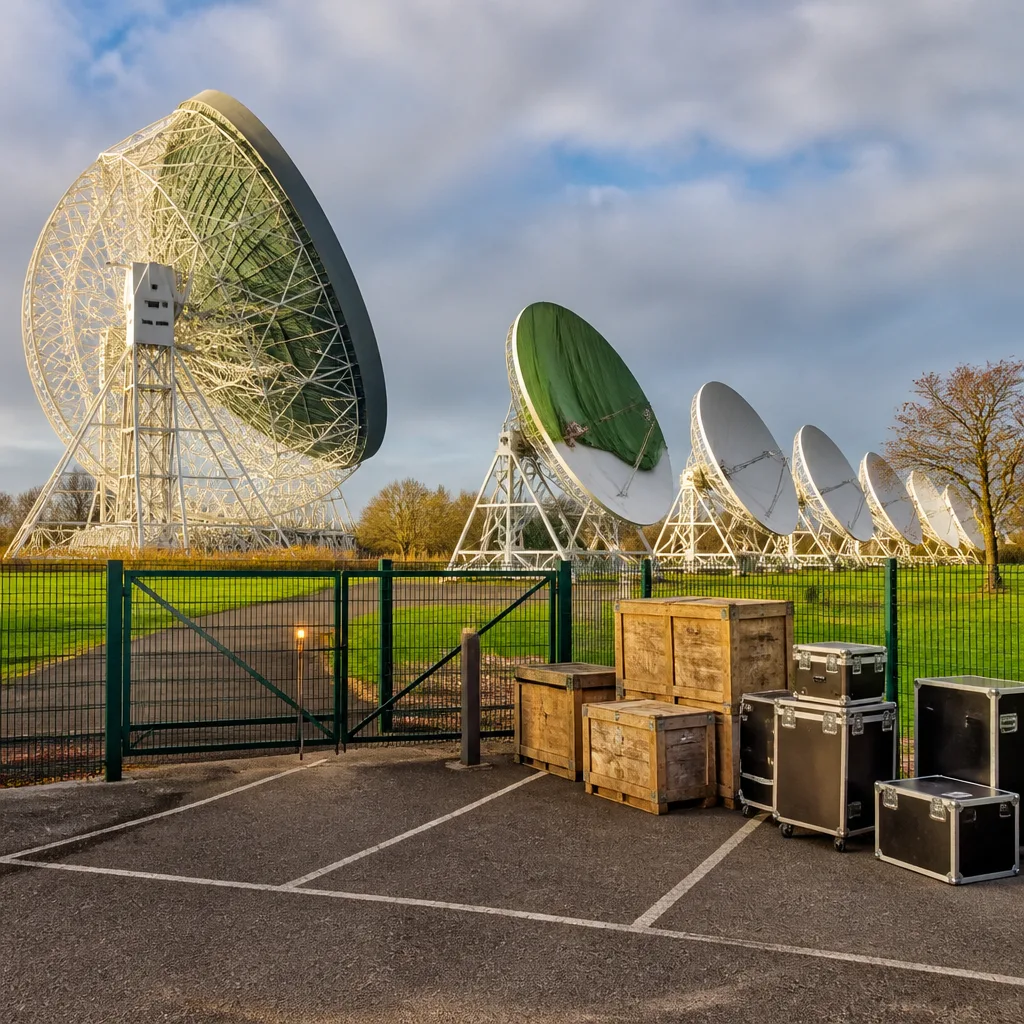
UK Research and Innovation (UKRI) has confirmed that funding for the e-Merlin radio-astronomy project has been cut to zero, placing the Jodrell Bank Observatory and the wider seven-telescope network in jeopardy.
The announcement, made on 27 July by the Science and Technology Facilities Council (STFC), is part of a package of decisions which list nine projects as “not prioritised for further funding”. The move may force a major scaling-back of operations at the Cheshire site, home to the Lovell Telescope and a hub for research used by nearly 3,000 scientists.
What has been cut and who is affected
The funding withdrawal affects e-Merlin — the UK network of seven radio telescopes whose lead station is at Jodrell Bank and whose partner sites include Cambridge — and a range of other physics and space projects. The UKRI announcement also confirmed a reduction in British participation in certain CERN research activities, and the cancellation of a planned UK contribution to an upgrade of a key CERN experiment.
- e-Merlin: funding reduced to zero; implications for Jodrell Bank operations.
- Quantum Technologies for Fundamental Physics: not prioritised.
- Electron–Ion Collider project: UK access to a new US-based facility is affected.
- HiPERCAM and ULTRACAM: two high-speed optical camera projects lose support; these feed data to the Vera Rubin observatory in Chile.
The STFC said the decisions followed a period of consultation and form part of efforts to rein in rising costs across its portfolio.
"After listening to our community we have protected core di
Local, national and international consequences
For Cheshire and the North of England, Jodrell Bank is more than a research facility: it is a high-profile scientific landmark and a contributor to regional identity and the local economy. The potential loss of the observatory would present a challenge for the new government led by Andy Burnham, which has pledged to strengthen regional economies.
Nationally, the cuts reduce UK capacity in radio astronomy and related fields at a time when international cooperation on big-science facilities is increasing. Among the seven other projects losing funding are initiatives intended to give UK researchers access to forthcoming facilities or instruments; their removal will limit opportunities for UK teams to participate in cutting-edge experiments.
Immediate outlook and next steps
The BBC has reported that the entire Jodrell Bank Observatory could close unless alternative funding is found by 2028. The observatory is operated by the University of Manchester; other affected e-Merlin sites are spread across the UK.
Those seeking to sustain the facility will now have to consider alternative funding routes, partnerships or re-prioritisation within universities and regional bodies. The announcement is likely to prompt urgent discussions between UKRI, the STFC, the University of Manchester, local authorities and scientific stakeholders about contingency plans and the wider impact on research programmes.
| Project | Status (per UKRI/STFC) |
|---|---|
| e-Merlin (including Jodrell Bank/Lovell) | Funding cut to zero |
| Quantum Technologies for Fundamental Physics | Not prioritised |
| Electron–Ion Collider project | Not prioritised |
| HiPERCAM and ULTRACAM | Not prioritised |
The STFC described its decisions as a response to escalating costs and the need to safeguard core facilities, but the exact scale of savings or the detailed rationale for each project withdrawal was not included in the public statement. The loss of access to instruments and international partnerships will be watched closely by the research community and by MPs concerned with both national scientific standing and regional development.
Any plans to protect or reconfigure Jodrell Bank will need swift political and financial attention if the observatory is to continue supporting the thousands of researchers who rely on its data.