
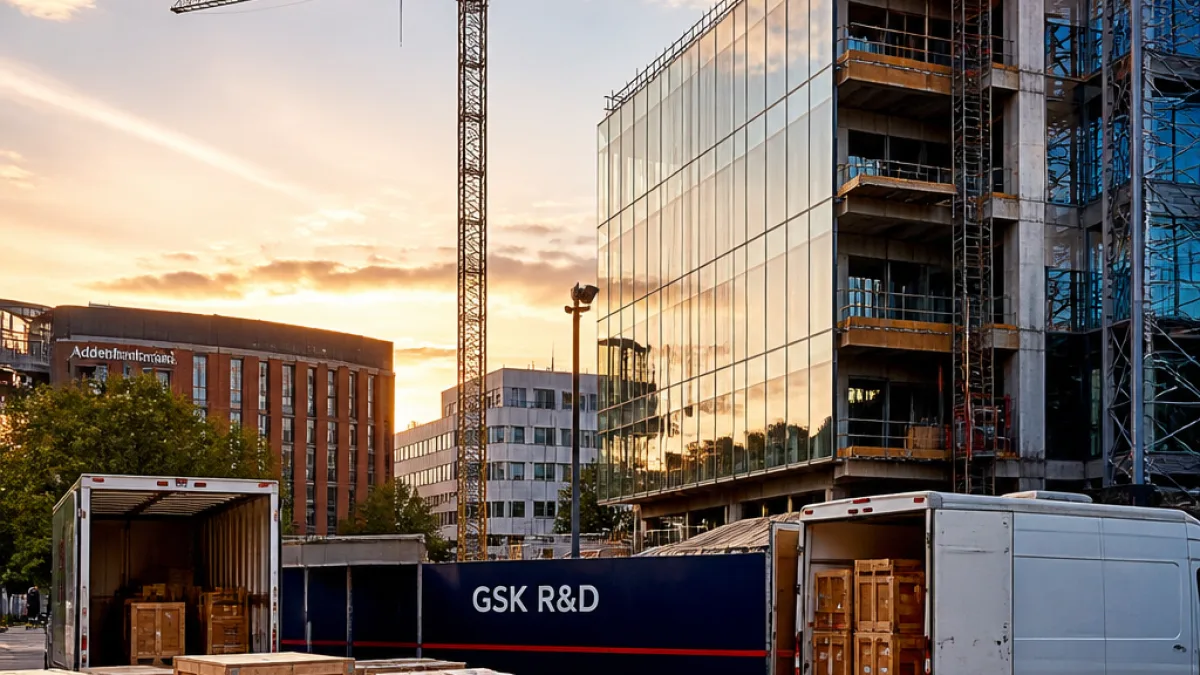
GlaxoSmithKline (GSK) has confirmed plans to open a substantial research and development centre on the Cambridge Biomedical Campus, marking a significant shift of operations from its long‑established site in Stevenage. The company says the move will see roughly 1,000 staff transfer to Cambridge and forms part of a reported £400 million investment in the new facility.
What GSK is building in Cambridge
The new facility, currently under construction on the Cambridge Biomedical Campus, will comprise state‑of‑the‑art laboratories and infrastructure intended to support GSK’s research across oncology, respiratory, hepatology, vaccines and HIV. GSK described the campus as being “in the heart of the UK life sciences Golden Triangle”, a location that the company says will accelerate collaboration with local universities, hospitals and biotech firms.
- Approximate investment: £400m
- Planned workforce to relocate: ~1,000 staff
- Stevenage site closure date: 2029 (site will be phased out)
- Complementary upgrades: existing R&D laboratories at Ware to be improved; some Stevenage staff to move there
Local partnerships and campus context
The Cambridge Biomedical Campus is already home to major clinical and research institutions, including Addenbrooke’s Hospital and Royal Papworth Hospital, alongside other industry players such as AstraZeneca. GSK noted existing collaborations on the campus and cited access to clinical units and translational research opportunities as key advantages of the move.
“The new location will accelerate our R&D and help us deliver new, competitive products,” the company said in outlining the rationale for the Cambridge site.
GSK highlighted a number of collaborative initiatives and centres on the campus that will be neighbours to the new facility, including data‑driven discovery and translational immunology partnerships. The firm said these connections are expected to strengthen translational research — the pathway from laboratory science to clinical practice — by bringing scientists into proximity with patients, clinicians and academic partners.
Impact for Stevenage and employees
The decision ends more than five decades of GSK presence in Stevenage. Local representatives have warned of disruption for staff and the community. Kevin Bonavia, the Member of Parliament for Stevenage, described the announcement as “disappointing” and criticised the timing and communication around the plans, saying they had created uncertainty for employees and the wider town.
GSK has indicated that moves will be phased, and that some employees will be offered roles at Ware after upgrades there. The company has not published detailed staff transition plans in its statement, but the relocation and the planned 2029 closure of the Stevenage site will be matters of immediate concern for affected workers and local stakeholders.
| Item | Detail |
|---|---|
| Investment | £400m |
| Staff relocating (approx.) | 1,000 |
| Stevenage site | Set to close in 2029 |
What this means for Cambridge
For Cambridge, the arrival of a major global pharma company’s R&D operations reinforces the city’s status as a leading life‑sciences cluster. The Cambridge Biomedical Campus already employs thousands in health and research roles; a new GSK centre will add critical mass and could stimulate further collaboration, investment and supply‑chain activity in the area.
At the same time, the relocation sharpens competition for skilled staff and laboratory space across the Golden Triangle. Local planners, employers and training providers will want clarity from GSK about recruitment timelines, opportunities for local suppliers, and any community engagement the company plans to undertake as construction progresses.
GSK’s move is part of a wider reorganisation of its UK R&D footprint that also includes upgrades at Ware. For Cambridge the immediate consequence is to strengthen the Biomedical Campus as a focal point for translational research, clinical partnerships and commercial life‑science activity.