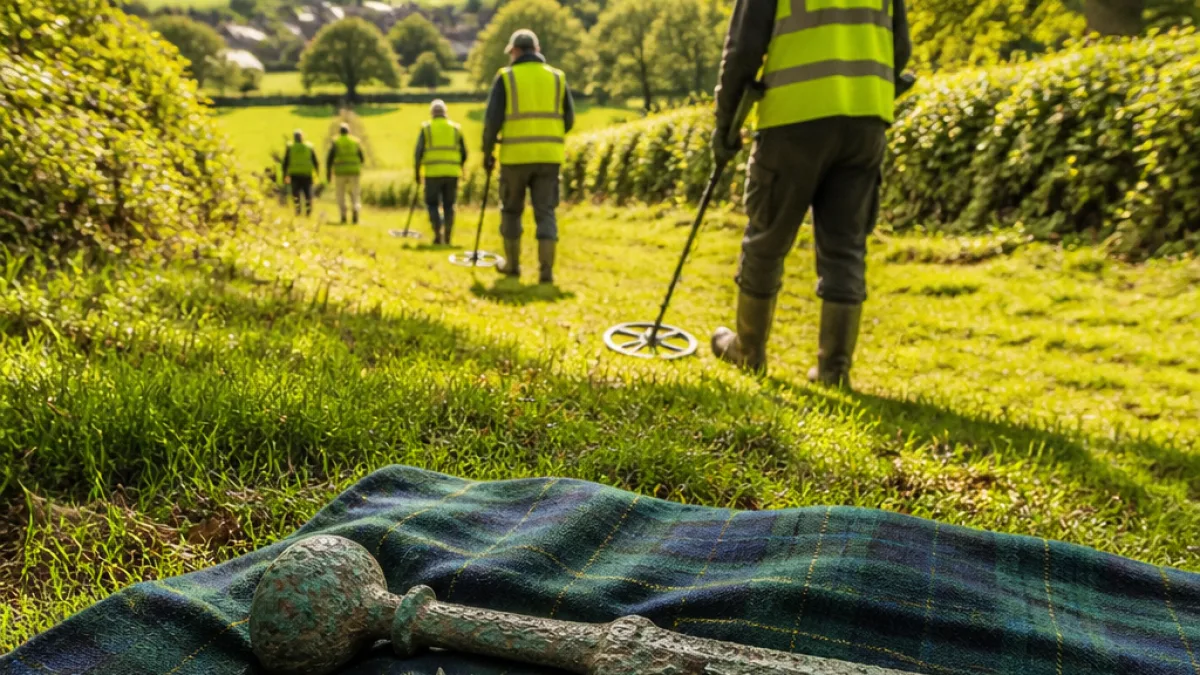
Volunteers in Surrey are preparing to search the countryside around Ockley for physical traces of a medieval battle that, according to contemporary chroniclers, saw Vikings fight West Saxons along a route from the River Thames into Surrey.
Background to the hunt
Accounts from the period, including references by the Welsh monk and chronicler Asser, describe a confrontation in which Viking forces pushed from the Thames, attacked London and then moved into Surrey via the Roman road Stane Street, meeting King Æthelwulf and his forces. Local interest has coalesced around the suggestion that a place named Aclea mentioned in the sources corresponds to the modern village of Ockley.
Members of a local history group, who describe themselves as the Bearded Bleepers, say they intend to search fields and woodlands in the area for artefacts that could confirm the site of the engagement. They have identified the kinds of finds that would be most informative.
"To give us proof that the battle took place round here it would mean finding something like a sword pommel, arrowhead or possibly some Viking strap ends,"
The group’s speaker added:
"We're going to search it and we're going to try our darndest to find something."
What would count as evidence?
Organisers are realistic that locating conclusive proof from a ninth-century battlefield is difficult. Items that could indicate presence of combatants include small metal fittings, weapon components and projectiles. Non-metal finds such as disturbed ground patterns or concentrations of medieval pottery would also be of interest to archaeologists.
- Sword pommels and weapon fragments — direct evidence of combatants.
- Arrowheads — common battlefield artefacts, especially if found in clusters.
- Strap ends and dress fittings — personal equipment that can indicate cultural origin.
| Artefact type | Significance |
|---|---|
| Sword pommel | Strong indicator of combat location; datable by style |
| Arrowhead | Typical battlefield find; quantity and distribution important |
| Strap end | Personal equipment; can suggest cultural identity of wearer |
Any finds would require professional assessment and legal recording. In England, archaeological remains are protected and metal-detecting or excavation on private land must have the landowner’s permission and follow proper recording procedures.
Local landscape and place-name evidence
Proponents of the Ockley hypothesis draw on toponymy: the old name Aclea can be interpreted as a clearing among oaks, and Ockley remains an area where oakwoods are notable. While place-names can point researchers towards likely areas, they rarely provide conclusive proof on their own.
For residents and landowners, the proposed searches will be a matter of local interest. If the group proceeds, landowners will be approached for permission and finds will need to be logged properly so they can contribute to the wider archaeological record.
This initiative highlights the continuing public appetite in Surrey for connecting landscape, written sources and material evidence to better understand early medieval events that shaped the region.