Residents and councillors across Nottinghamshire will see sweeping changes to local government after the Government confirmed the names and structure of two new unitary authorities that will replace the county’s nine existing councils.
What has been decided
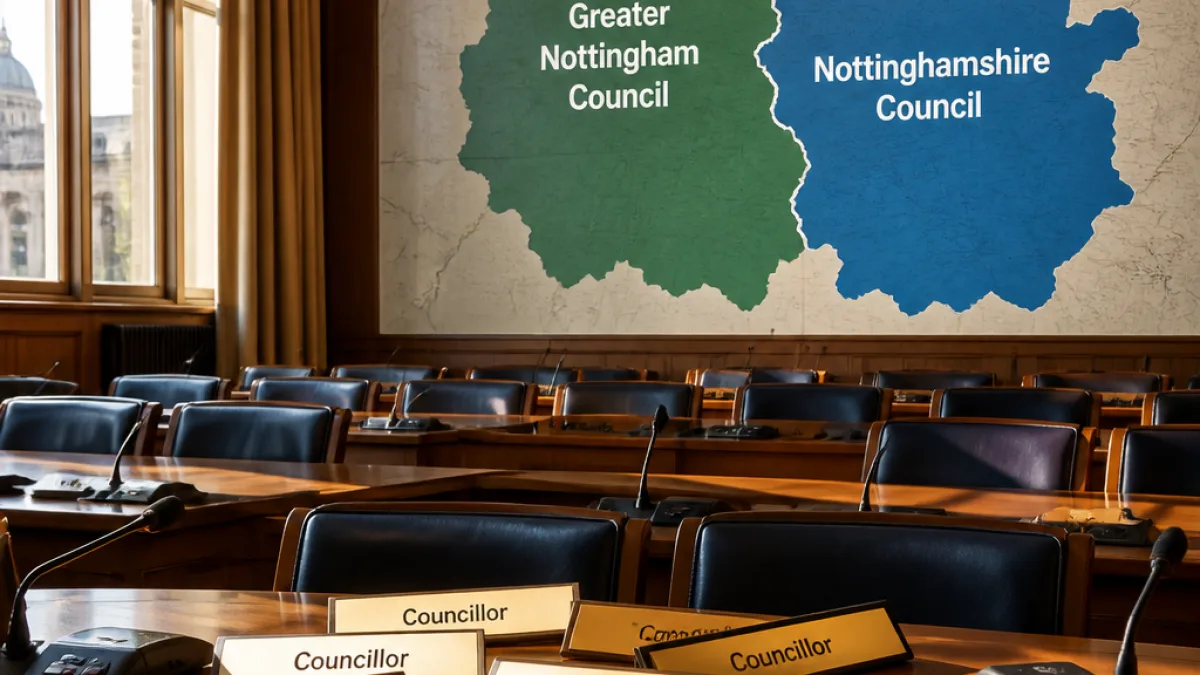
In a letter sent on 30 July, the Department for Levelling Up set out that the two replacement bodies will be called the Greater Nottingham Council and the Nottinghamshire Council. The move is part of the Labour Government’s Local Government Reorganisation (LGR) programme and follows competing proposals from existing councils.
The changes mean the overall number of councillors representing the city and county will fall from 408 to 198. Each of the two new councils will have 99 councillors.
Which areas go where
The new Nottinghamshire Council will combine the five district and borough areas of Ashfield, Bassetlaw, Mansfield, Newark and Sherwood with parts of Broxtowe, Gedling and Rushcliffe. Greater Nottingham Council will encompass Nottingham City and selected wards from Broxtowe, Gedling and Rushcliffe.
| New council | Main components |
|---|---|
| Greater Nottingham Council | Nottingham City; 15 wards from Broxtowe; 15 wards from Gedling; 17 wards from Rushcliffe |
| Nottinghamshire Council | Ashfield, Bassetlaw, Mansfield, Newark & Sherwood; 5 wards from Broxtowe; 4 wards from Gedling; 7 wards from Rushcliffe |
Transition and timing
The transitional arrangements set out in the Order require existing councils to continue delivering services until they are abolished on 1 April 2028. Preparations will be supported by the creation of ‘shadow’ councils, for which elections are planned in 2027. Those shadow bodies will be responsible for preparing budgets and plans to allow a smooth transfer of responsibilities when the new councils assume full powers.
“Your councils will remain responsible for services in your areas until they are abolished on April 1, 2028, and will be under a duty to co-operate with each other and with the new councils.”
Local impact and political implications
This is the most significant reorganisation of local government in Nottinghamshire for half a century. Cutting the number of councillors by more than half will reshape political representation in wards across the county and the city. Councillors, council officers and residents will face a period of change as services are reorganised and new governance arrangements put in place.
Practical questions remain for many households: which authority will handle local planning applications, bin collections, social care and children's services from April 2028, and how staffing and service levels will be managed during the handover. Existing councils have been told to co-operate in the run-up to abolition and to support the shadow councils to prepare necessary budgets and operational plans.
Key points for residents
- Two new unitary councils: Greater Nottingham Council and Nottinghamshire Council.
- Councillor numbers reduced from 408 to 198, with 99 councillors on each new authority.
- Existing councils continue to deliver services until 1 April 2028; shadow council elections will be held in 2027.
Further detail, including exact ward boundaries and how services will be divided between the two new councils, will be published as transitional plans are drawn up by the shadow authorities. Residents seeking clarification about which body will manage specific local services in future should continue to contact their current council for now.
The coming months are likely to see detailed negotiations between councils and intensified public interest as the 2027 shadow elections approach and preparations accelerate towards the April 2028 handover.