Nottinghamshire County Council has warned that a reduction in the Government funding it receives to create school places could leave hundreds of local children without a secondary school place in their own area from September 2027.
Shortfall concentrated across several towns
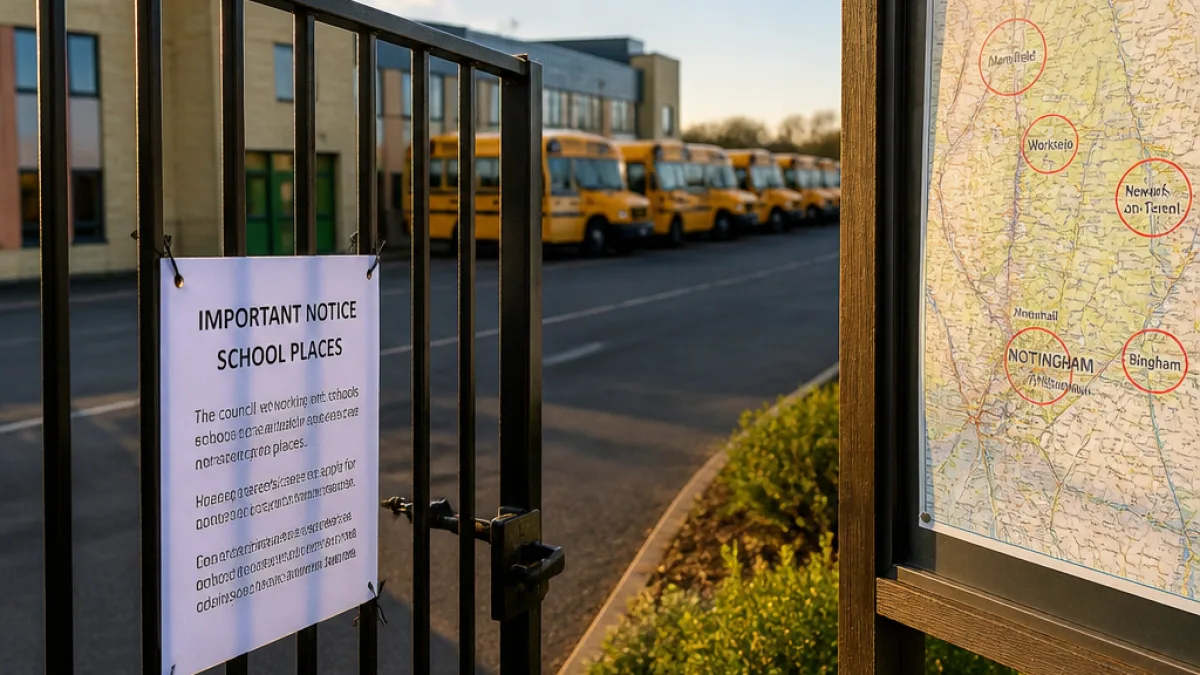
A cabinet report published in July highlights an "insufficiency" of places in a number of planning areas, a shortfall the council says could mean around 338 pupils would need to be transported out of their local communities to find a school. The authority's analysis identifies shortages in Hucknall, Worksop, Harworth, Retford, Broxtowe South, Carlton, Mansfield, Warsop, Rainworth, East Leake, Rushcliffe East and West Bridgford.
"significantly less"
The report states the pot of money passed down from the Department for Education for delivering extra school places is significantly less this year, leaving the council in a vulnerable position as pupil numbers have been rising.
Rising demand and recent action
Between January 2018 and January 2026 the number of year seven pupils in Nottinghamshire rose by 10 per cent, increasing from 8,703 to 9,578. Council projections used to plan school expansions indicate demand is likely to remain high until it begins to ease from the 2029–30 academic year.
Nottinghamshire has already taken steps to cope with the pressure: since 2022 the authority says it has created 1,700 additional secondary places and has supported the opening of an extra 303 year seven places for 2026–27 within existing school buildings. Several school building projects are also progressing and are expected to increase capacity for the 2027–30 period.
Immediate risks and numbers
Despite that progress, the cabinet report’s figures paint a worrying short-term picture. It warns that, at present levels of funding, approximately 28 year seven pupils in the county could be left "totally without" a school place for September 2027. A larger cohort—around 338 pupils—could be offered places but only at schools outside their local area, necessitating transport arrangements.
- Affected planning areas named in the report: Hucknall, Worksop, Harworth, Retford, Broxtowe South, Carlton, Mansfield, Warsop, Rainworth, East Leake, Rushcliffe East and West Bridgford.
- Additional secondary places created since 2022: 1,700.
- Extra year seven places within existing buildings for 2026–27: 303.
Councils submit annual pupil projections by planning area to the Department for Education, but funding settlements are decided over multi-year periods and do not always match local, current need. That timing mismatch is central to Nottinghamshire’s concern: rising pupil numbers combined with a smaller funding allocation leave the authority less able to accelerate building or expansion work to meet sudden demand.
| Statistic | Figure |
|---|---|
| Year seven pupils (Jan 2018) | 8,703 |
| Year seven pupils (Jan 2026) | 9,578 |
| Estimated pupils needing out-of-area transport (2027) | 338 |
| Pupils potentially totally without a place (2027) | 28 |
What families should know
The council says it will continue to press for capital funding and push on with its building projects to increase capacity. Families in the named areas should expect the council to contact those affected directly if allocations require pupils to travel to alternative schools. Parents awaiting secondary transfer decisions are advised to keep in touch with their child's current school and the county admissions team for the latest information on offers and transport arrangements.
The issue highlights wider tension between local planning and central funding cycles: where pupil numbers rise rapidly, councils can be left having to manage gaps between demand and the timetable for receiving capital investment. Nottinghamshire's figures show demand has risen markedly in recent years and, while the authority has already added places, it warns that without increased funding the short-term squeeze could leave some children facing disruption to their transition to secondary school.