
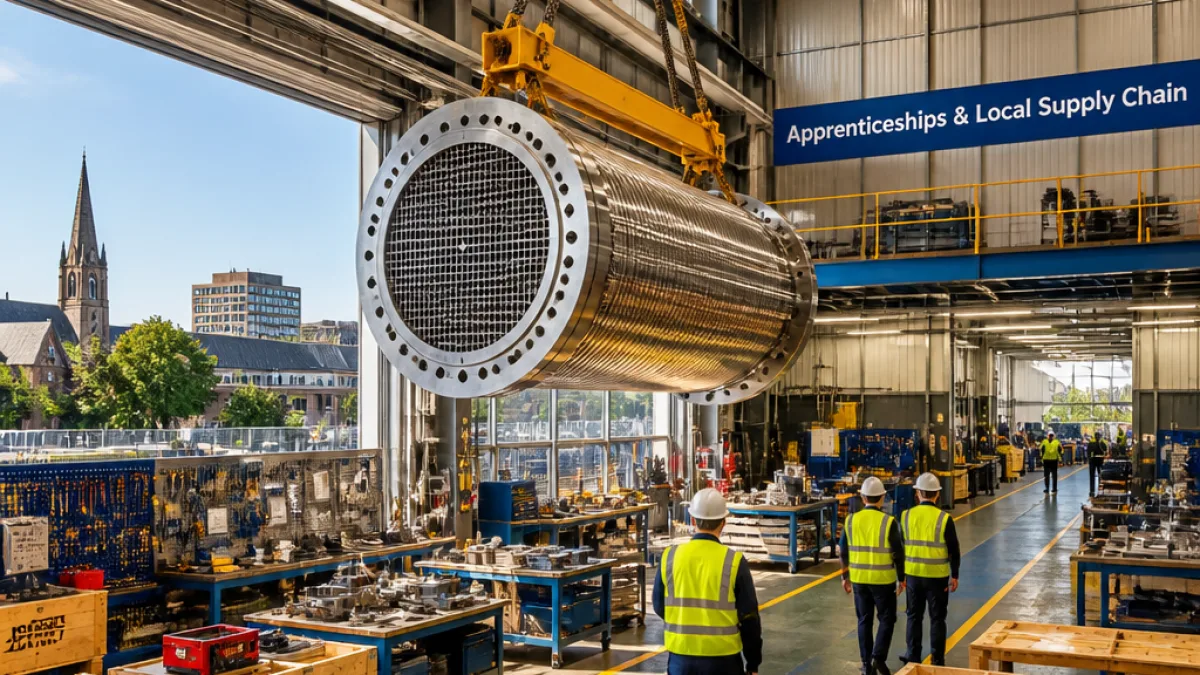
Derby stands to gain from a fresh £8.4bn tranche of government spending on the Dreadnought submarine programme, reinforcing the city’s role in supplying nuclear reactor cores and underpinning thousands of jobs.
Local manufacturing and jobs supported
Rolls‑Royce manufactures the nuclear reactor cores used on the programme at facilities linked to Derby. That work supports roughly 4,000 local positions tied to the Defence Nuclear Enterprise, while the enterprise as a whole sustains about 47,000 jobs across the UK today. Government forecasts referenced alongside the announcement project that employment connected to the enterprise could rise to 65,000 by 2030, with up to 22,000 apprenticeships anticipated by 2035.
What this means for Derby businesses and skills
Officials say the additional funding will not only protect roles directly associated with producing reactor cores but also generate work for regional suppliers and contractors through defence procurement and supply‑chain activity. The announcement is expected to spur demand for skilled engineers, technicians and apprentices — creating routes for local firms to bid for subcontract work.
“Prioritising defence capability is important and for it to create jobs and apprenticeships in Derby is a win‑win,”
The comment above was supplied by Richard Blackmore, Director of Policy and Insight at the East Midlands Chamber, which said it is prepared to advise companies on supplier routes, procurement readiness and accessing apprenticeship and skills support.
- Direct jobs in Derby: c. 4,000 supported by Rolls‑Royce work on reactor cores.
- National scale: c. 47,000 jobs currently in the Defence Nuclear Enterprise; expected to reach c. 65,000 by 2030.
- Apprenticeships: up to 22,000 apprenticeships forecast by 2035.
Practical implications for residents and firms
For local residents the development signals stability and potential growth in engineering and manufacturing roles — sectors that have long been central to Derby’s economy. For small and medium‑sized businesses, it suggests forthcoming contracting and supply opportunities, but also the need to meet defence procurement standards and quality requirements.
The East Midlands Chamber has indicated it can offer guidance to firms seeking to become suppliers, prepare for tenders or develop apprenticeship schemes. Businesses unfamiliar with defence procurement processes should consider engaging with local business support to improve readiness for upcoming supply‑chain opportunities.
| Metric | Figure |
|---|---|
| Jobs linked to Rolls‑Royce work in Derby | ~4,000 |
| Current Defence Nuclear Enterprise jobs (UK) | ~47,000 |
| Forecast jobs by 2030 (UK) | ~65,000 |
| Projected apprenticeships by 2035 | 22,000 |
The investment is likely to be watched closely by local training providers and employers as they plan skills provision and recruitment. Any firm or individual considering applying for apprenticeships or seeking supplier routes should contact representative bodies such as the East Midlands Chamber for further information on available support and readiness.
As the programme progresses, updates on contract awards and regional supply‑chain activity will be important for Derby firms wanting to capitalise on the expansion of work tied to the Dreadnought programme.