
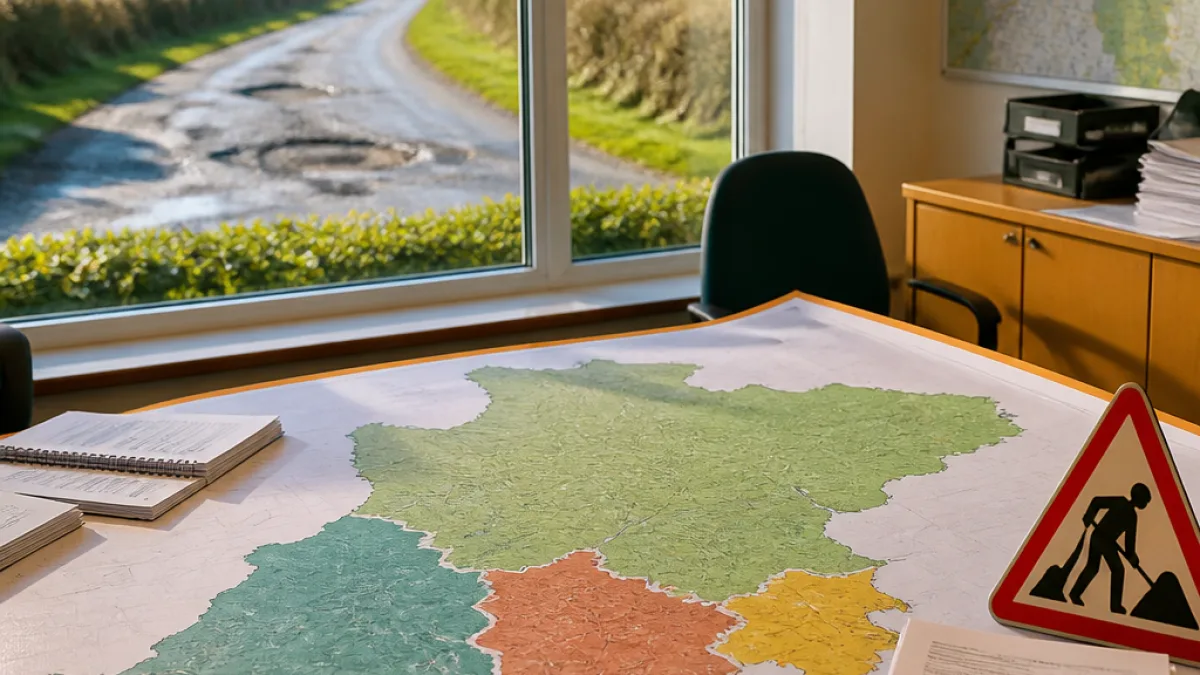
Devon’s council map redrawn as campaigners warn of rural strain
Plans unveiled by the government on 16 July to reorganise local government in Devon into four unitary authorities have drawn a sharp response from the county’s countryside campaigners, who fear the changes could leave a single, sprawling rural council carrying disproportionate responsibility for essential services. The charity Devon CPRE has characterised the move as a “bonanza” for urban areas and a setback for the remainder of rural Devon.
Under the outline described by Devon CPRE, the proposals envisage expanded unitary footprints for Plymouth, Exeter and Torbay, with a fourth authority responsible for the rest of the county’s largely rural geography. The group argues that such a configuration would detach the major urban tax bases from a substantial hinterland that depends on them to help pay for highways, education and social care across a large, sparsely populated area.
Devon CPRE chair Steve Crowther said: “Of course, the urban unitaries are welcoming this because they’ve expanded their empires and claim they can cut council tax by removing costs. But what they are not telling you is that a vast rural area like Devon requires its few urban settlements to help pay the enormous costs of roads, education, social care etc. in the 2,500 square miles that are left now they have opted out.”
Mr Crowther contends that local leaders outside the three city-based areas have already branded the plan a “disaster”, warning that an authority stretching “from Salcombe to Lynton, from Hartland to Axminster” would face an uphill task maintaining services without a significant urban contribution. He also cautioned that some residents could find their local planning authority headquartered as far as 50 miles from where they live, complicating access to the planning system in an already challenging housing and land-use environment.
Rural economy and service delivery in the spotlight
Devon CPRE highlights the precarious economics of parts of rural Devon, pointing to low household incomes and pressure on farm businesses. The group says livestock-grazing farms – a mainstay in a county renowned for pasture – have faced falling average incomes in recent years, citing figures of less than £23,000. It links that financial fragility to wider stewardship of the landscape, arguing that the upkeep of countryside cherished by visitors and residents alike depends on viable farm incomes.
“There are areas of rural Devon which have some of the lowest incomes in the entire country,” Mr Crowther said, adding that livestock farmers “have seen their average incomes drop to less than £23,000 in recent years.”
He further criticised national policy decisions affecting rural communities, including changes to agricultural subsidies and the application of Inheritance Tax to land assets, and warned of knock-on effects for a county heavily reliant on landscape-based and coastal tourism. In his view, removing urban cross-subsidy while costs in social care, education and transport rise would intensify the challenge for a single rural authority expected to cover a wide territory with dispersed settlements.
What the proposal implies for residents
While detailed implementation steps have not been set out in the material cited by campaigners, the key practical concerns raised by Devon CPRE centre on:
- Funding pressures: Fewer urban tax bases sharing costs for county-wide services could magnify budget strain on the residual rural authority.
- Access to planning: A more distant planning authority headquarters may complicate public participation in planning decisions for residents far from administrative centres.
- Service reach: Maintaining roads, education and care over a large rural area with limited economies of scale could become more complex.
The organisation stresses that these are structural issues tied to geography and demography, not simply managerial efficiency. It argues that, without careful safeguards, organisational savings in city-based unitaries could be achieved at the expense of service resilience in the countryside.
Geography of the proposed unitaries
According to Devon CPRE’s description, the reorganisation would reshape local government as follows:
| Proposed authority | Character | Notes from campaigners |
|---|---|---|
| Plymouth (expanded) | Urban | Expected to gain from consolidation; retains its own tax base. |
| Exeter (expanded) | Urban | Likely net beneficiary of unitary status, according to CPRE. |
| Torbay (expanded) | Urban/coastal | Similarly positioned to consolidate services within its boundary. |
| Rest of Devon | Predominantly rural | Would cover a large area “from Salcombe to Lynton, from Hartland to Axminster”. |
Calls for rural-proofing
Devon CPRE frames the debate as a question of whether Whitehall has adequately understood rural realities. The group argues that reform which concentrates authority and revenue in three urban enclaves risks weakening the financial and institutional capacity of the remaining council to deliver statutory services. It urges recognition of the distinct costs of serving a scattered population across 2,500 square miles, and warns that without robust rural-proofing, any promised efficiency gains could be offset by reduced access, longer journeys and pressure on already-stretched services.
The government’s announcement has prompted strong words from campaigners and, according to CPRE, concerns among local leaders outside the proposed urban authorities. Further detail on boundaries, budgets and transition arrangements will be pivotal to assessing the ultimate impact. For now, the central question posed by rural advocates is whether the financial architecture of a four-way split will sustain – rather than weaken – the services on which countryside communities rely.