
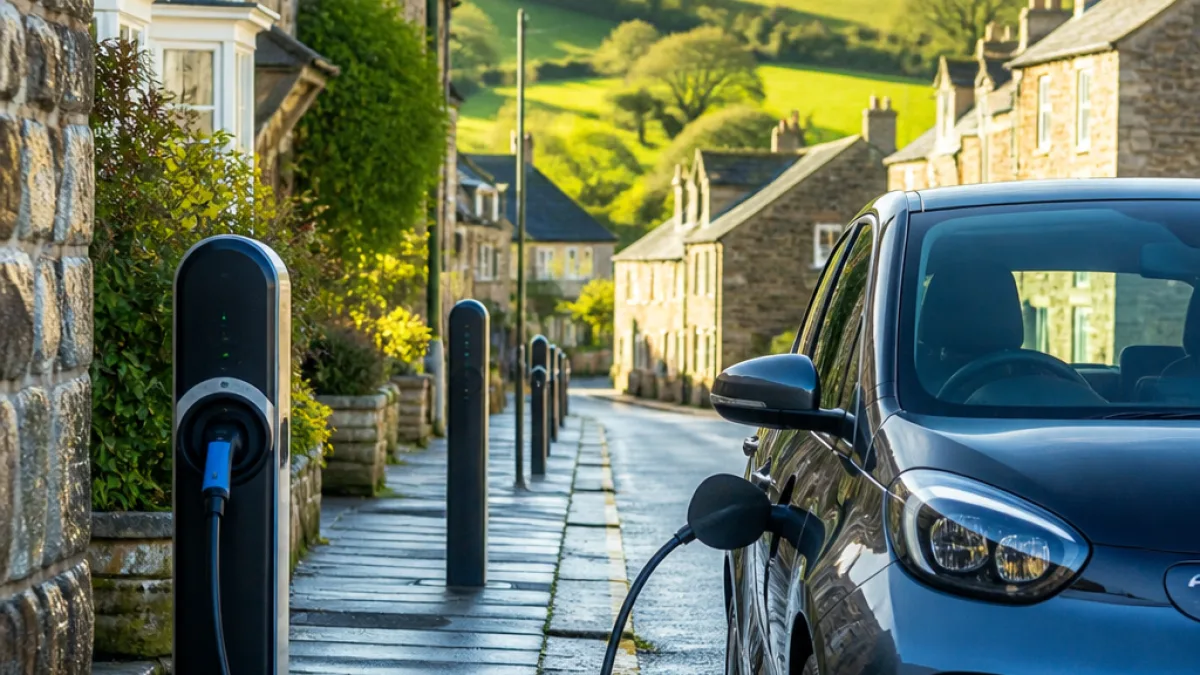
Devon County Council has confirmed a trial to install 30 on-street electric vehicle (EV) charge points across the county in partnership with on-street operator char.gy. The project is being delivered as an early roll-out under the Government’s Local Electric Vehicle Infrastructure (LEVI) Fund, with installations expected to begin in early to mid-August.
Purpose and local context
The council says the trial aims to improve access to residential charging for drivers who do not have off-street parking — a frequently cited barrier to switching to EVs in urban and rural communities alike. Funding for the trial will be released on a per-charge-point basis through the LEVI scheme, allowing the authority to assess costs and outcomes before any wider rollout across Devon.
Operator and energy supply
char.gy, which operates more than 5,000 public on-street charge points around the UK, will supply and manage the kerbside units. The company confirmed that all chargers installed as part of this trial will be powered by 100% renewable electricity.
“This trial is an important step in turning LEVI funding into real, usable infrastructure for communities.”
How this compares regionally and nationally
Nationally, the UK had roughly 87,000 public charge points across more than 45,000 locations by the end of 2025, according to Zapmap. The South West has historically lagged behind denser urban areas in charger provision, in part because of the logistical challenges of deploying infrastructure across a large, rural county such as Devon.
- Trial size: 30 kerbside charge points
- Operator: char.gy (over 5,000 on-street units nationally)
- Power source for trial units: 100% renewable electricity
- Funding mechanism: LEVI, released per charge point
| Metric | Figure |
|---|---|
| Planned Devon trial chargers | 30 |
| char.gy on-street network (UK) | 5,000+ |
| Public charge points in UK (end 2025) | ~87,000 |
The trial will allow the council to gather practical lessons on site selection, installation processes, user behaviour and costs. Those lessons are likely to shape any subsequent, larger investment across the county and inform how LEVI funding can be allocated most effectively.
For residents, the immediate effect will be the availability of more options for overnight and local charging without the need for a private driveway or dedicated off-street space. For the council and partner agencies, the priority will be assessing whether kerbside chargers can be expanded in a way that meets demand while remaining cost-effective and operationally sustainable.
Further details on the specific locations of the initial 30 charge points and a timetable for installation have not been published by the council at this stage.