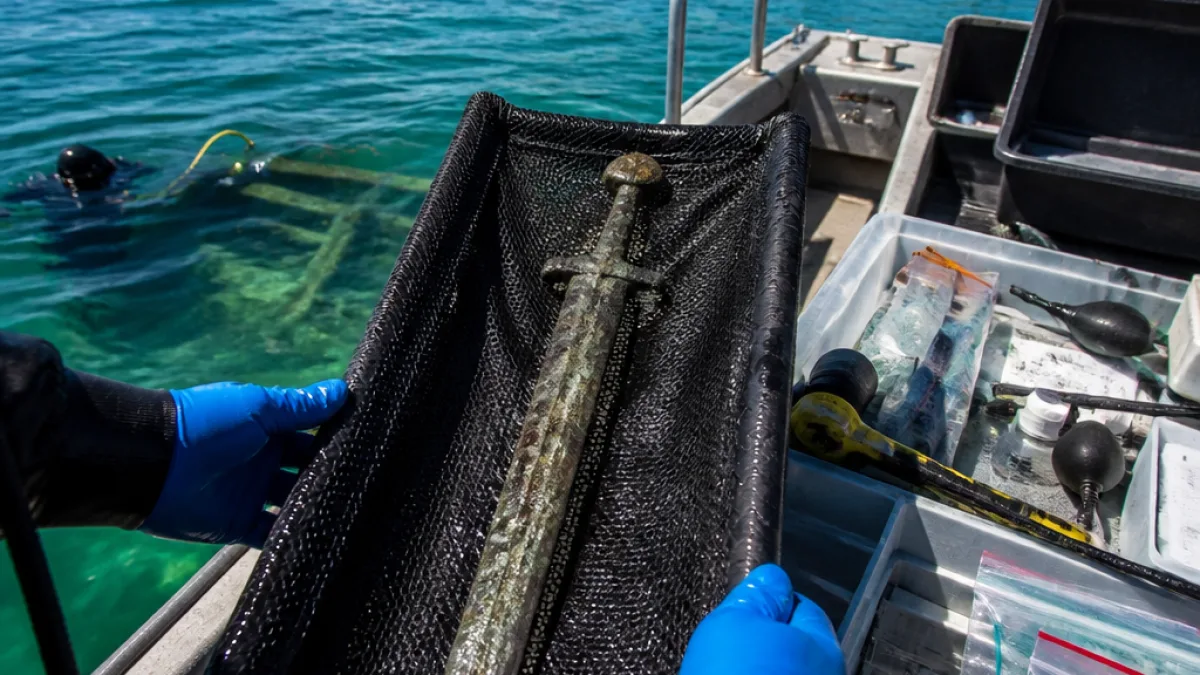
A rare Bronze Age sword has been recovered from the seabed off Devon, the first weapon of its kind found at the long-studied protected wreck area near Salcombe.
Discovery at protected wreck site
The blade was located during excavations at the overlapping Salcombe Cannon and Moor Sand sites by volunteer divers working with the South West Maritime Archaeological Group (SWMAG). The two divers credited with the find are Becky Gill and Catherine Gillon, who made the discovery earlier this year while taking part in an initiative supported by Historic England and delivered in partnership with MSDS Marine.
Preliminary analysis dates the object to the Middle or Late Bronze Age (circa 1300–800 BCE). Following conservation work, the intention is for the sword to be transferred to the British Museum.
Volunteer-led project and significance
The recovery formed part of a scheme designed to integrate newer volunteers into maritime archaeology work and to safeguard specialist skills. Project staff emphasised the role volunteers played in locating and recovering the material.
“A kid at Christmas does not come close to the excitement of finding this sword,”
That was the response from Becky Gill, capturing the emotional impact of the find. Her dive partner, Catherine Gillon, reflected on the human story linked to the artefact: she said she wondered who made the weapon and who last handled it some three thousand years ago.
Alison James, project manager at MSDS Marine and archaeological adviser to SWMAG, described the discovery as “incredibly exciting” and as a reminder of why protected wrecks and volunteer contributions matter for maritime archaeology. The project team said the recovery is notable because no similar weapon had previously been recovered from this historic area since investigations began in the late 1970s.
What we know so far
- Finders: Becky Gill and Catherine Gillon
- Sites: Salcombe Cannon and Moor Sand (overlapping protected wreck sites)
- Dating (preliminary): Middle or Late Bronze Age, c. 1300–800 BCE
- Next steps: Conservation, followed by donation to the British Museum
| Detail | Information |
|---|---|
| Location | Protected wrecks off the Devon coast (Salcombe area) |
| Finders | Volunteer divers Becky Gill and Catherine Gillon |
| Project partners | Historic England, MSDS Marine, SWMAG |
Conservation work will be required to stabilise the sword before it can be studied in detail and eventually accessioned by the British Museum. The find highlights the continuing archaeological potential of protected wrecks around the South West coast and the value of volunteer involvement in maritime research.
For local communities and anyone interested in Devon’s maritime past, the recovery is a tangible link to people who lived and worked in the region several millennia ago. Further updates are expected as conservation progresses and specialists complete their assessments.