Devon’s system of local government is set for its biggest change in decades, after ministers confirmed the county will move to four unitary councils and abolish both Devon County Council and the eight district authorities by 2028. The decision, announced in the House of Commons by Secretary of State Steve Reed MP, has triggered immediate political backlash, with the Liberal Democrat leader of North Devon Council branding the outcome a “stitch-up”.
Four new authorities to replace county and districts
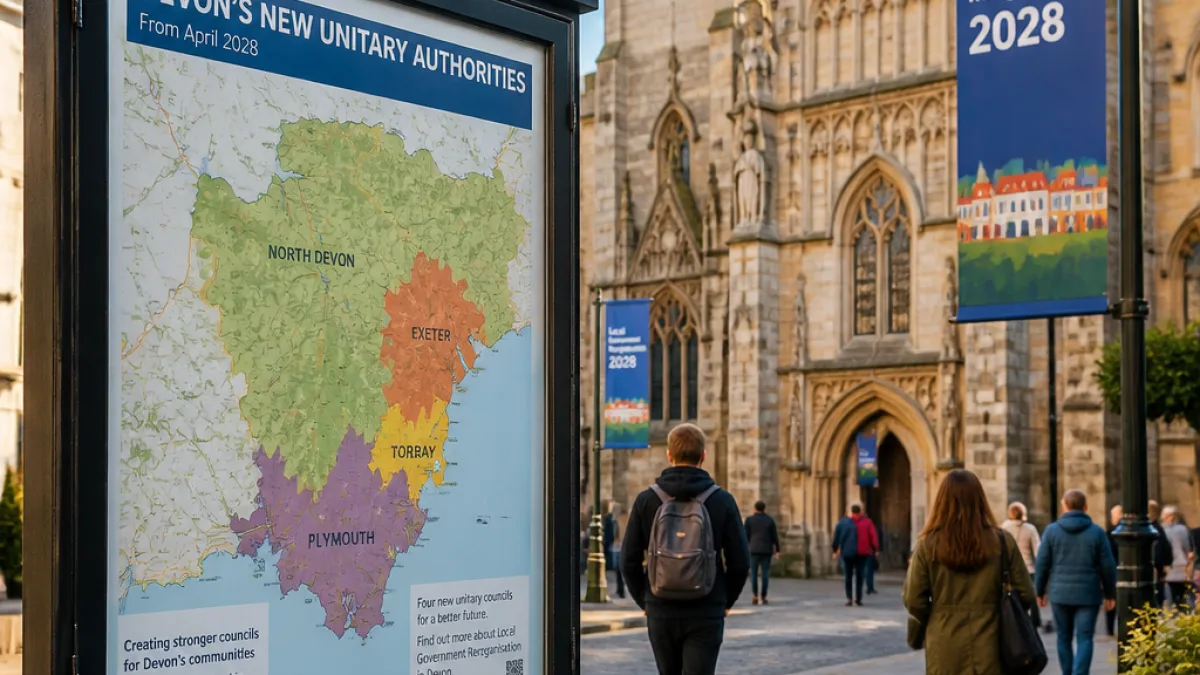
Under the plan outlined to MPs, Devon would be administered by three expanded city unitaries — Plymouth, Exeter and Torbay — alongside a large rural body described as a Devon coast and countryside authority. According to the model set out, the rural unitary would draw together North Devon, Torridge and West Devon, and take in the remaining areas of East Devon, Mid Devon, Teignbridge and South Hams.
The reorganisation would replace the present two-tier arrangement, in which responsibilities are shared between the county council and district councils. Once implemented, each unitary would oversee the full range of local services within its borders.
| Current structure | Proposed structure |
|---|---|
| Devon County Council + 8 district councils | 4 unitary councils |
| Districts: East Devon, Exeter, Mid Devon, North Devon, South Hams, Teignbridge, Torridge, West Devon | Expanded Plymouth; Expanded Exeter; Expanded Torbay; Devon coast & countryside (North Devon, Torridge, West Devon + remaining parts of East Devon, Mid Devon, Teignbridge, South Hams) |
| Multiple tiers of responsibility | Single-tier responsibility per unitary |
North Devon leader: ‘Not the best option for residents’
North Devon Council leader David Clayton said the outcome was widely expected but not, in his view, in the county’s best interests. He argued the decision would advantage the Labour-led city councils.
“[It] was always going to benefit the Labour-run councils of Plymouth and Exeter.”
Cllr Clayton said his authority, alongside other districts, had supported an alternative blueprint known as the 1-4-5 model. That proposal would have created three unitaries, placing North Devon with Torridge, East Devon, Mid Devon and Exeter in a grouping with the city as a key economic driver. He insisted their option had been thoroughly worked through and costed.
“This is what we wanted as we thought it would best serve our residents, it was all costed out and was the best all round option.”
Concerns over scale and rural voice
While reiterating his longstanding support for single-tier councils as a simpler, “one-stop” route for residents, Cllr Clayton warned that the proposed rural unitary is set to be geographically extensive and overwhelmingly countryside in character. He fears funding could flow towards larger urban centres.
“My biggest fear is that money will go into the authorities with large cities and the rural areas will lose out.”
He added that the newly configured coast and countryside body would be “absolutely huge”, raising questions, in his view, about how effectively it can respond to remote communities compared with a more balanced three-way split.
What changes for residents and services?
The shift to unitaries means all local services would sit under one council per area. Supporters of single-tier systems argue it reduces duplication and simplifies accountability. Critics worry about distance from decision-makers in large rural authorities and the distribution of resources between city and country.
- Timeline: Abolition of Devon County Council and the eight districts is scheduled for 2028.
- Geography: Three expanded city councils (Plymouth, Exeter, Torbay) and one large rural unit.
- Alternative considered: Districts had pushed a three-unitary “1-4-5” option grouping Exeter with northern and eastern districts.
Political backdrop
The announcement was delivered in the Commons by Steve Reed MP, the Secretary of State for Housing, Communities and Local Government. Cllr Clayton suggested the outcome reflected national political dynamics, asserting the process favoured Labour-run cities. He described the decision as a “stitch up”, saying many leaders had anticipated this direction of travel.
“I think most of us knew what would happen and that Plymouth and Exeter would get what they wanted as they are Labour councils and it's a Labour government. We could all see the direction of travel and it's been a bit of a stitch up.”
The government has set out a clear preference for unitary structures in several parts of England in recent years, contending they provide clearer lines of responsibility. In Devon, the debate now turns to the practicalities of transition, the shape of local representation and how urban and rural priorities will be balanced inside the new map.
As preparations begin, residents will be looking for clarity on how the transfer to single-tier authorities will be managed and how the new boundaries will affect day-to-day services. District and county leaders across Devon face an intense period of planning to ensure continuity ahead of the 2028 changeover.