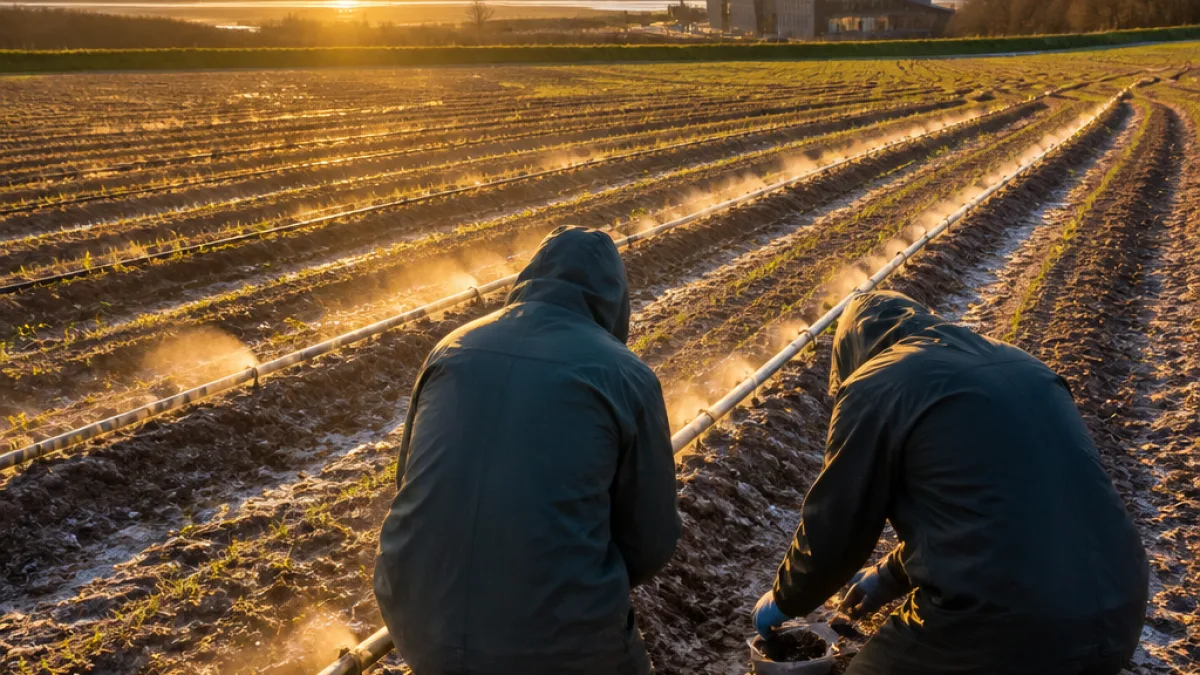
Farmers across low-lying parts of Lincolnshire could be offered a new tool to protect crops from the creeping threat of salinisation, after researchers at the University of Lincoln reported promising results from experiments using small amounts of seawater in irrigation.
Soil microbes can be conditioned to tolerate saltier conditions
Professor Matthew Goddard, who leads the project, told InfoRadar the team have shown how naturally occurring soil microbes can be encouraged to adapt over time when soils are exposed to low-level saline irrigation. That adaptation, the researchers say, helps soils continue to support crops in conditions that would normally reduce yields.
"This approach could be integrated with other methods into a holistic management approach that could help secure food systems for future climate change conditions in a sustainable way,"
Goddard described the work as an attempt to emulate how the east of England might look in the coming decades. The experiments were designed around existing rainfall patterns but with added salinity to mirror the kinds of changes expected from rising sea levels, altered rainfall and higher temperatures.
Why Lincolnshire is vulnerable
Low-lying farmland in the county is particularly exposed to tidal surges and incursions of seawater into drainage and irrigation channels. The research team say farmers here face a "double whammy" of both sea surge events and more saline water used for irrigation.
- Cause of rising soil salinity: sea level rise, changing rainfall patterns and warmer temperatures.
- Proposed response: controlled, low-level saline irrigation to encourage microbial adaptation.
- Next steps: study interactions between salinity and fertilisers, and the effect on crop pathogens.
| Issue | What researchers did |
|---|---|
| Increasing soil salinity | Simulated future east-of-England conditions using low-level seawater irrigation |
| Soil response | Observed adaptation in naturally occurring microbial communities |
The team emphasise this is not a standalone cure. Instead, the microbial approach would form part of an integrated management strategy alongside other on-farm measures. They will now investigate how raised salinity interacts with common fertilisers and whether it affects crop diseases — work that could shape practical guidance for growers.
For Lincolnshire producers, the work offers a potentially low-cost and sustainable way to maintain productivity without resorting to heavy chemical interventions. But farmers and advisers will want to see further trials across different soil types, crops and real-world irrigation systems before changing established practices.
Local growers, drainage boards and agricultural advisers will be watching the next phase closely. Practical tests on working farms will be essential if the laboratory findings are to be translated into methods that protect the county’s food production as the climate continues to change.