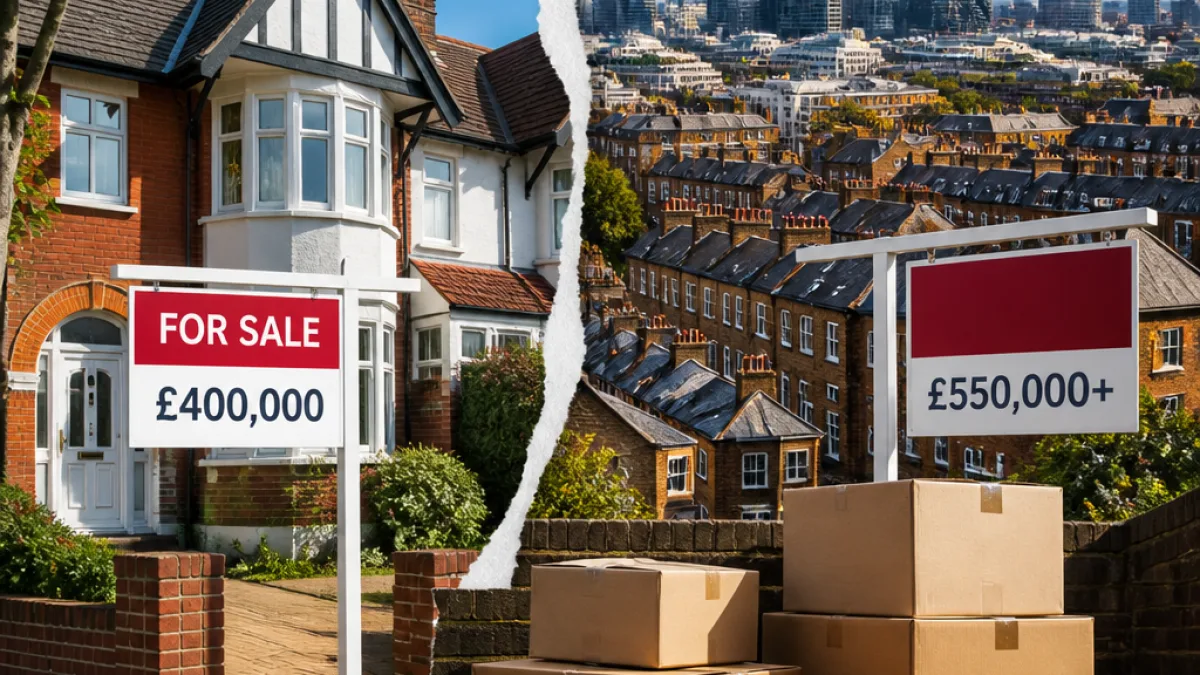
The gap between what homes fetch in Solihull and what they buy in London remains significant, according to market measures collated during 2026. For residents considering a move to the capital, the arithmetic is likely to come as a surprise: even established family properties in the borough will often not cover the price of an average London dwelling.
Local values and postcode differences
Official and industry sources give different snapshots of the Solihull market. The Office for National Statistics recorded an average Solihull house price of about £330,000 in March 2026, while property portal figures that include more recent transactions and asking prices lift the measure: Rightmove’s sales-based view sits closer to £408,000, and advertised prices commonly exceed £450,000.
- Family houses in the borough’s higher streets are typically quoted within a £520,000–£550,000 band.
- Parts of B91 (the upper end) register values in excess of £570,000.
- Mainstream family homes in B90 (Shirley, Dickens Heath, Cheswick Green) are often between £380,000 and £400,000.
- B92 (Olton, Lyndon, Elmdon) represents the more accessible end of the borough market, with properties available from roughly £310,000–£330,000.
- Flats are the exception to steady growth: typical sale prices are around £200,000–£220,000, and the sector has experienced an estimated 3.5% drop in the last year.
What your Solihull home is actually worth right now
The London affordability gulf
When those local figures are set against the capital, the margin becomes clear. The average London house price is commonly cited in the range of £542,000–£570,000, a figure distorted upwards by inner boroughs. Flats in London typically trade for in excess of £450,000, well above the Solihull average for apartments.
That means a sale from the more modest end of Solihull — for example, a B92 semi marketed at about £320,000 — will not be sufficient to buy an average London flat, let alone a house. Even a stronger outcome from B91, at roughly £550,000, would only place a seller level with the lower bound of average London house values and below many London flat prices when transaction costs and relocation expenditure are taken into account.
Comparative figures
| Measure | Typical Solihull value | Typical London value |
|---|---|---|
| Average house (ONS / Rightmove) | £330,000 / £408,000 | £542,000–£570,000 |
| Flats | £200,000–£220,000 | £450,000+ |
| Higher‑end family streets (B91) | £570,000+ | — |
Local consequences and practicalities
The disparity has a number of immediate implications for Solihull residents and local policy-makers. Sellers should adopt a realistic valuation of their property rather than aspirational figures; the capital’s market will not automatically convert a Solihull sale into equivalent buying power. Estate agents and financial advisers frequently warn that prospective movers should factor in stamp duty, moving costs and the premium London prices attach to location and type of property.
For those downsizing from a Solihull house to a London flat, proceeds may cover purchase costs only with additional capital or by accepting smaller properties and different neighbourhood profiles than those enjoyed in Solihull suburbs. Conversely, the relative affordability of many Solihull neighbourhoods remains an asset for the borough, attracting buyers priced out of London and supporting local housing demand.
Local councillors and housing officers are likely to watch market shifts closely. Persistently higher asking prices in Solihull could complicate affordability for local first‑time buyers, while a cooling in the apartment sector may require attention from planners and housing providers to ensure suitable supply and tenure mix.
For anyone thinking of trading a Solihull home for a London property, the practical advice is straightforward: obtain up‑to‑date valuations, be candid about net proceeds after costs, and consider whether supplemental funding will be needed to secure the type of London home being targeted.