Campaigners urge halt to CPO as town centre plan enters critical phase
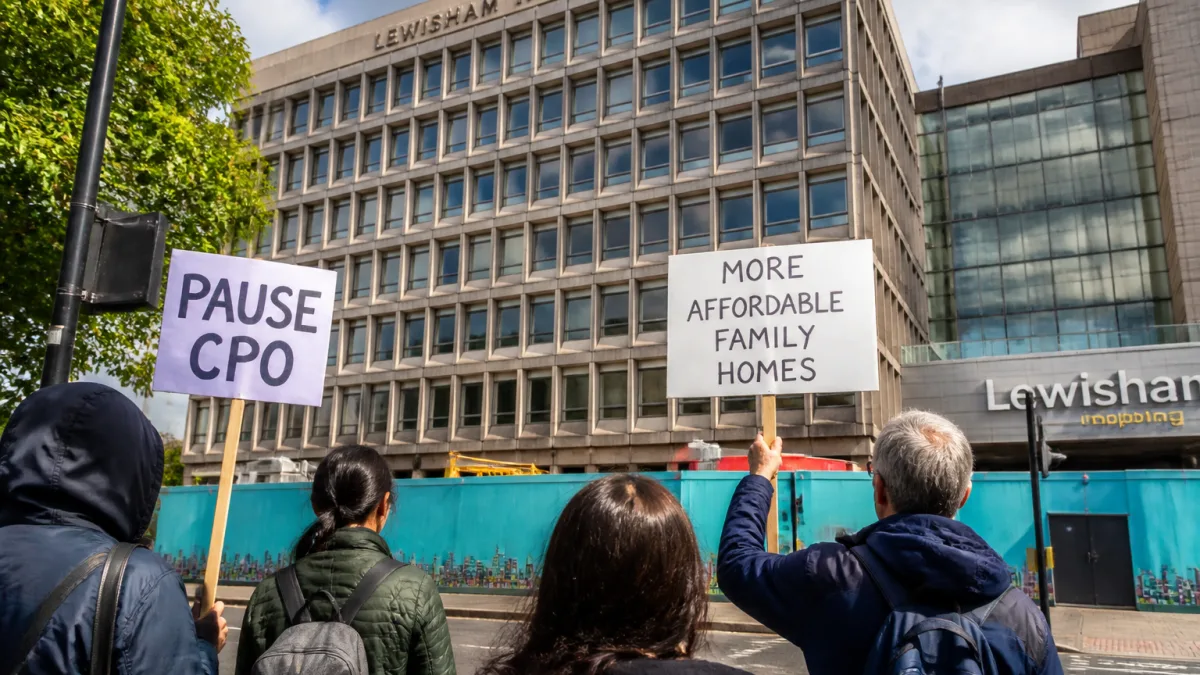
A long-empty office block in the heart of Lewisham has become the focus of a growing dispute over the future of the borough’s biggest redevelopment. The group Save Lewisham Shopping Centre is pressing the newly elected Green-led council to stop any move towards a Compulsory Purchase Order (CPO) for Lewisham House, arguing that doing so could force changes to the balance of affordable homes in the £1.5 billion scheme approved last October.
Lewisham House, once occupied by Citibank and now vacant for several years, sits within the footprint of the wider Lewisham Shopping Centre project. Developer Landsec has split delivery into six phases over roughly a decade and is understood to require control of the entire site to start the first phase. The campaign group contends that the fate of the office block is pivotal; pausing a CPO process, they say, could delay the start of construction and create leverage for a rethink on housing numbers and type.
Affordable homes at the heart of the row
The permission granted last year includes 1,744 homes, of which Landsec proposes 20% affordable. That headline offer comprises 98 social rent homes and 231 discounted market rent homes for key workers, with the remaining 1,415 intended as private. Campaigners insist that this mix falls short for local need, pointing to the council’s housing pressures and the shortage of larger properties for families. According to the group, more than 11,000 people are on Lewisham’s housing waiting list.
Christine Hannigan, from Save Lewisham Shopping Centre, said: "Another problem is the actual housing mix [on offer]. The council's own data reports that families on the housing waiting list need affordable three and four-bedroom homes and a lot of the people on the housing waiting list are families."
The group argues that without a significant uplift in family-sized homes at social rent, the scheme will not meaningfully reduce overcrowding. They also maintain that holding off on a CPO could compel the developer to revisit the tenure split.
What’s proposed in numbers
| Element | Figure |
|---|---|
| Total new homes | 1,744 |
| Affordable housing share | 20% |
| Social rent homes | 98 |
| Discounted market rent (key workers) | 231 |
| Private homes | 1,415 |
| Project value | £1.5bn |
| Phases | 6 |
| Indicative build period | around 10 years |
Campaigners’ case and potential implications
Save Lewisham Shopping Centre frames Lewisham House as a pressure point in the wider programme. Their position is that if the council holds back from any CPO steps, it could delay site assembly and the first phase, opening a window to renegotiate. They are not calling for the project to be scrapped outright but want what they describe as a fairer share of genuinely affordable, family-sized properties within the mix.
- Pause any progress towards a CPO for Lewisham House
- Increase the proportion of social rent homes in the scheme
- Boost the supply of three and four-bedroom family homes
The redevelopment was approved by Lewisham Council in October 2025, before the change in political leadership at the Town Hall. While planning consent provides a framework for delivery, campaigners say crucial implementation decisions remain, including site acquisition strategies. In their view, the new administration has scope to influence the shape and pace of the project at this stage.
Town centre stakes and the long build ahead
Beyond housing, the comprehensive plans for the shopping centre carry wide implications for Lewisham’s economy and public realm over the next decade. The site’s central position means construction phasing will affect footfall, local traders and transport interchange users. Any delay linked to land assembly could push back the entire programme; conversely, moving ahead without changes would lock in the current tenure balance for years to come. Campaigners argue that getting the mix right at the outset is critical given the development’s scale and longevity.
Lewisham House itself symbolises the tensions in many town centre overhauls: an underused commercial block whose acquisition unlocks major regeneration, yet whose treatment can define whether a scheme meets local housing need. With more than 11,000 households waiting for a secure home, the argument over how many of the proposed 1,744 units should be affordable—and for whom—will likely intensify as the first phase nears.
As it stands, the community group is urging councillors to set out their position on the CPO question and to press for a revised housing offer. Landsec’s phasing plan anticipates a construction period stretching close to a decade; what happens next with Lewisham House could determine when shovels hit the ground—and the kind of neighbourhood that emerges in the town centre.