
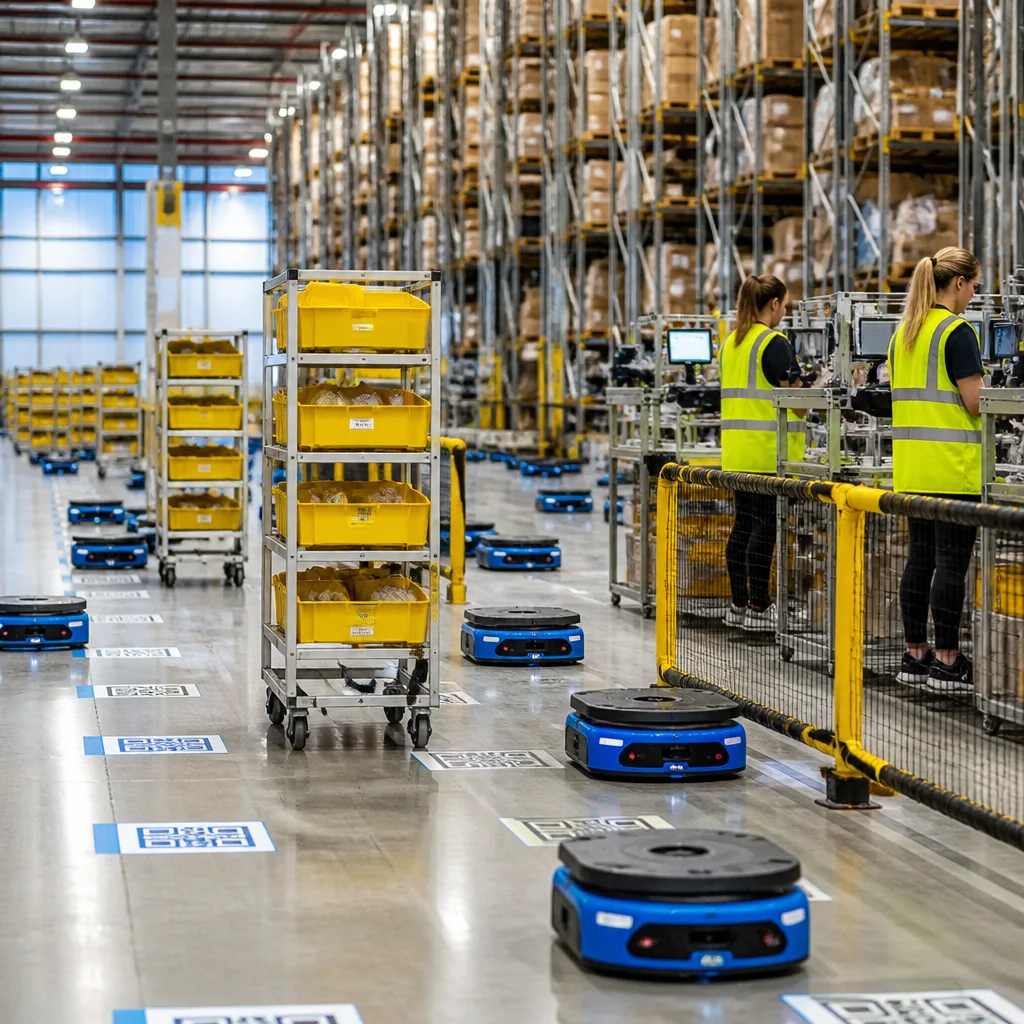
Two thousand small autonomous robots from Chinese manufacturer Geek+ are now operating across 10 sites in the United Kingdom, according to company material and recent reporting. The machines are being used by several major retailers, including Tesco, Asda and Next, as firms look to speed up online order fulfilment and squeeze more capacity from existing warehouses.
How the machines work
The devices move under storage racks, lift shelving units and carry goods to human workers who then pick items for dispatch. Unlike fixed conveyor systems, these autonomous mobile robots require only simple floor markers such as QR codes and temporary safety fencing to be deployed, reducing the need for major structural changes to warehouses.
Why this matters for the UK economy
Britain has struggled with weak productivity growth for more than a decade. International bodies such as the OECD have argued that wider adoption of robotics and automation will be central to boosting efficiency. The OECD’s 2026 report on SME technology adoption highlighted robotics as a key area where UK firms lag behind peers — even as the country has embraced other digital tools.
- Scale: Geek+ claims to be the world’s largest supplier of autonomous mobile robots.
- Market position: The UK is now the company’s biggest market in Europe.
- Deployment: Machines are in place at sites serving major national retailers.
Practical consequences and questions
Retailers say the technology increases picking speeds, reduces errors and allows more compact storage, potentially cutting delivery times for customers. For warehouse staff the systems change the nature of work: humans remain central to final picking and packing, while repetitive travel through aisles is handled by machines.
Policy questions follow. If robotics help raise efficiency, they may be a route to improved national productivity. But slower adoption in some UK firms, as noted by international analysts, suggests barriers remain — from cost and skills shortages to concerns about supply-chain dependence on foreign technology. Geek+ itself listed in Hong Kong in 2025 in one of that year’s larger robotics share sales, underlining the scale of international investment entering Britain’s logistics sector.
| Item | Fact |
|---|---|
| Robots deployed in UK | 2,000 |
| Number of UK sites | 10 |
| Notable retail customers | Tesco, Asda, Next |
For consumers the change is largely invisible, seen in faster fulfilment and potentially lower costs. For businesses and policymakers it is a live test of how quickly British industry can integrate robotics at scale — and whether those gains translate into broader economic improvement rather than isolated productivity pockets.