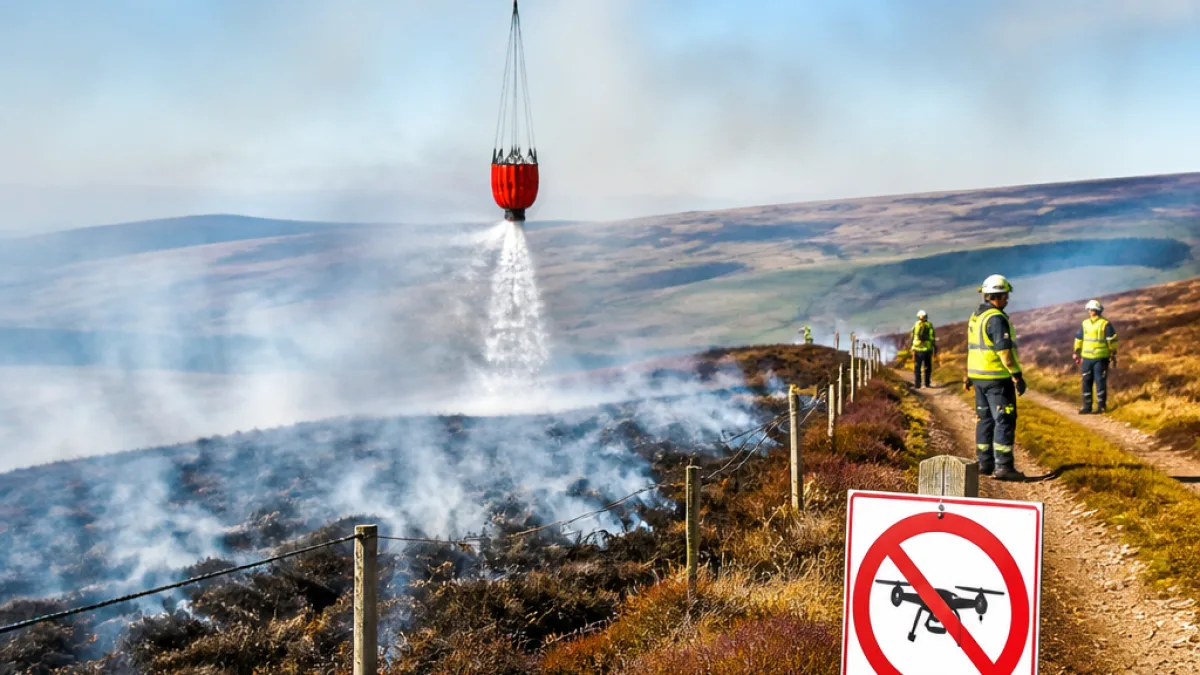
Major incident continues on High Peak moorland
Specialist teams from fire and rescue services across the UK are supporting Derbyshire Fire and Rescue Service (DFRS) in containing a large wildfire on Tintwistle Moor, near Glossop. Crews were first mobilised on 24 June and the incident was escalated to a major status on Monday. The fire has affected around 260 hectares of moorland, with efforts now focused on preventing further spread and extinguishing lingering hotspots.
As part of the containment strategy, DFRS has begun a controlled burn on sections of the moor to remove unburnt fuel and create fire breaks. The service cautioned that this approach may increase visible smoke at times, particularly around Crowden, which remains the priority sector for ground operations.
"Tactical" controlled burn may result in more smoke being visible.
Four helicopters have been deployed to support crews and volunteers on the ground, making repeated water drops to cool hotspots and suppress flare-ups. Aerial operations have targeted several fire-affected areas, including Didsbury Intake, Featherbed Moss, Arnfield Moor and Crowden.
Airspace restricted while aerial support operates
With aircraft active over the incident, DFRS has reminded the public that airspace restrictions are currently in place. The service has stressed that the flying of drones is prohibited in the area, both for safety reasons and to avoid disrupting helicopter operations crucial to the firefighting effort.
More than 100 firefighters and volunteers have been involved across both sides of the county boundary, reflecting the scale and complexity of the incident on upland terrain. The service expects to remain at the scene alongside partner agencies into next week, continuing damping-down and monitoring to reduce the risk of reignition.
Focus areas and response measures
Operations have been distributed across multiple moorland locations as crews work to contain edges of the fire ground and address active pockets. A combination of hand crews, specialist wildfire units and aerial suppression is being used to limit spread, particularly where peat and vegetation can smoulder and rekindle in dry, windy conditions.
| Location | Current emphasis |
|---|---|
| Didsbury Intake | Helicopter water drops on hotspots |
| Featherbed Moss | Flare-up suppression by air and ground |
| Arnfield Moor | Targeted cooling of heat sources |
| Crowden | Main focus; tactical controlled burn in use |
Public information and safety
While crews continue to work in challenging open country, the incident command has underscored the need for the public to respect the airspace restrictions and avoid any actions that could interfere with emergency operations. The use of drones near the scene is expressly forbidden and may endanger flight crews.
Moorland wildfires can be prolonged incidents, with dampening down and patrols necessary long after flames are first brought under control. DFRS has indicated that its presence will continue into next week, working alongside partner agencies to secure the perimeter and prevent further flare-ups.
Multi-agency effort
The ongoing response highlights extensive cooperation between DFRS and other services with specialist wildfire experience. Helicopter support is being used to reach areas difficult for vehicles and personnel to access, allowing rapid suppression of new hotspots before they spread over the exposed terrain.
Residents and visitors in the High Peak may notice increased smoke at intervals due to the controlled burning technique, which removes remaining fuel in a managed way to protect a wider area. Authorities continue to prioritise containment and safety across the affected moorland.
- 260 hectares impacted since first call on 24 June
- Four helicopters conducting water drops on hotspots and flare-ups
- Airspace restrictions in force; drones not permitted near the incident